At the beginning of the 20th century,missionary organisations operating in China found that Cheung Chau was an ideal setting for holiday villas for their missionaries. There was a building phase from 1908 to 1910.
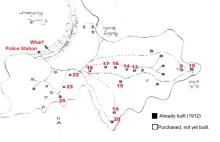
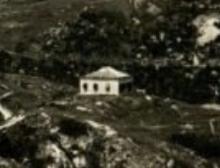
House 25 was a small bungalow, sturdily built, because of typhoons, of locally quarried granite on a small promontory in the south of the island at Nam Tam Wan. The granite walls were 18 inches thick, which ensured coolness in hot weather, and the internal rooms were divided with wooden partitions. There were two bedrooms.
Topped with a timber tiled roof, the house faced south for the sun and had a large garden or yard. Unlike other houses, it didn't have an annex for domestics.
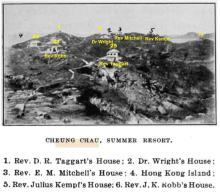
The house may be seen in an early Mission photo of 1911. Its then occupant/owner is recorded asRev D R Taggart, an American missionary and member of theReformed Presbyterian Churches China Mission. These missionaries between them owned/occupied at least 6 holiday villas on Cheung Chau, including numbers 2, 8, 14, 16, 23, & 25.
In 1926, another American missionary, Ruth Hitchcockof the Hebron Mission in Canton, China, became the owner of House #25. She purchased the property with funds from her parents in California, and found the house was invaluable not just as a holiday retreat but also a refuge when times were turbulent on the mainland, for herself and others.
In the spring of 1927, Miss Hitchcock went home on furlough, but her colleagues used her house on Cheung Chau to get away from anti-foreign unrest in Koon Shan, Kwangtung. They returned in 1928.
Prior to 1936 they rented a church building on the island and each year they went to the island to interview prospective baptism candidates, stay overnight in House 25, and perform the baptisms next day, returning to Kowloon on the launch. So we have entries for October 24th, 1930, and June 15th, 1934.
On June 18th, 1931, they stayed overnight in House 25 when they opened the new (rented) mission church on the waterfront.
In 1933, August 5th, we learn that a German missionary lady, 30 years old, was burned to death by an explosion of oil in Miss Hitchcock’s house. We know there were German nuns helping in the Hebron Mission work. This may have been one of them.
This gives a good idea of how these houses were used by others out-of-season. The diaries also show how these Cheung Chau missionaries/residents networked with each other. Other familiar names are mentioned - Jaffray, Clift, Rousseau, Mackenzie.
------------------------
Puzzlingly in the European owners list of 1938, the owner of House #25 is recorded as Mr J M Dickson. This is difficult to understand as Miss Hitchcock seems to haveowned it through to 1971.
By 1939 the photographs showhouse #25 with a flat concrete roof, replacing the earlier timber tiled roof. A common problem with timber roofs was destruction by white ants, so concrete roofs were a sensible solution.
During the War, while the house was vacant, it was stripped of all its wooden doors, windows and partitions by the locals for use as fuel, 'leaving only the four stone walls and reinforced concrete roof'.
Following the War, in September 1947 Miss Hitchcock was granted permission to return to China, and once back, she took the opportunity to have a workman do the necessary repairs to the house.
In 1949 when the Communists were coming to power in mainland China and all missionaries were being expelled, a problem arose with new missionaries arriving from America. As there was nowhere for them to go, Miss Hitchcock suggested they use her house on Cheung Chau. They filled the two bedrooms there with as many beds as they could, and one of the older girls from the orphanage came to serve as amah.
Ruth Hitchcock returned to the USA circa 1949/50, and looked after her mother until her death in 1953. At that point she received an invitation from the Alliance Seminary on Cheung Chau to teach there. When offered accommodation, she said she would live in her house (#25) next door to the seminary. She went out in 1955 and finally returned to the USA in 1971, which suggests she used her house all that time.
However we have another anomaly regarding ownership of the property as the previous post records that during the 1950s, the house was owned by a missionary family named Decker. Perhaps they used the house while Miss Hitchcock was in the States 1950-54.
Hopefully more information will be forthcoming for these anomalies.
Today the site is occupied by four semi-detached houses.
Ruth Hitchcock's story is told in the book The Good Hand of Our God.
Comments
Scott Boyle writes that a
Scott Boyle writes that a missionary family named Decker lived in this house in the 1950s.
House #25 history from 1910.
[Updated 31/12/25]
At the beginning of the 20th century, missionary organisations operating in China found that Cheung Chau was an ideal setting for holiday villas for their missionaries. There was a building phase from 1908 to 1910.
House 25 was a small bungalow, sturdily built, because of typhoons, of locally quarried granite on a small promontory in the south of the island at Nam Tam Wan. The granite walls were 18 inches thick, which ensured coolness in hot weather, and the internal rooms were divided with wooden partitions. There were two bedrooms.
Topped with a timber tiled roof, the house faced south for the sun and had a large garden or yard. Unlike other houses, it didn't have an annex for domestics.
The house may be seen in an early Mission photo of 1911. Its then occupant/owner is recorded as Rev D R Taggart, an American missionary and member of the Reformed Presbyterian Churches China Mission. These missionaries between them owned/occupied at least 6 holiday villas on Cheung Chau, including numbers 2, 8, 14, 16, 23, & 25.
In 1926, another American missionary, Ruth Hitchcock of the Hebron Mission in Canton, China, became the owner of House #25. She purchased the property with funds from her parents in California, and found the house was invaluable not just as a holiday retreat but also a refuge when times were turbulent on the mainland, for herself and others.
In the spring of 1927, Miss Hitchcock went home on furlough, but her colleagues used her house on Cheung Chau to get away from anti-foreign unrest in Koon Shan, Kwangtung. They returned in 1928.
--------------------
This next section is from the diaries of missionary Rose Reiton, who with her husband Albert founded the Cheung Chau Peniel (Mission) Church in 1936.
Prior to 1936 they rented a church building on the island and each year they went to the island to interview prospective baptism candidates, stay overnight in House 25, and perform the baptisms next day, returning to Kowloon on the launch. So we have entries for October 24th, 1930, and June 15th, 1934.
On June 18th, 1931, they stayed overnight in House 25 when they opened the new (rented) mission church on the waterfront.
In 1933, August 5th, we learn that a German missionary lady, 30 years old, was burned to death by an explosion of oil in Miss Hitchcock’s house. We know there were German nuns helping in the Hebron Mission work. This may have been one of them.
This gives a good idea of how these houses were used by others out-of-season. The diaries also show how these Cheung Chau missionaries/residents networked with each other. Other familiar names are mentioned - Jaffray, Clift, Rousseau, Mackenzie.
------------------------
Puzzlingly in the European owners list of 1938, the owner of House #25 is recorded as Mr J M Dickson. This is difficult to understand as Miss Hitchcock seems to have owned it through to 1971.
We have a Dr E J M Dickson who was a Presbyterian missionary in China, and a colleague of Rev. Julius Kempf, Dr. Kate McBurney, Rev. E. C. Mitchell, Rev. J. K. Robb, Dr. Ida Scott, Rev. D. R. Taggart, Dr. J. M. Wright, who all owned properties on Cheung Chau. He may be this owner. However, he and his wife returned to the States in 1933, so that makes it unlikely.
By 1939 the photographs show house #25 with a flat concrete roof, replacing the earlier timber tiled roof. A common problem with timber roofs was destruction by white ants, so concrete roofs were a sensible solution.
During the War, while the house was vacant, it was stripped of all its wooden doors, windows and partitions by the locals for use as fuel, 'leaving only the four stone walls and reinforced concrete roof'.
Following the War, in September 1947 Miss Hitchcock was granted permission to return to China, and once back, she took the opportunity to have a workman do the necessary repairs to the house.
In 1949 when the Communists were coming to power in mainland China and all missionaries were being expelled, a problem arose with new missionaries arriving from America. As there was nowhere for them to go, Miss Hitchcock suggested they use her house on Cheung Chau. They filled the two bedrooms there with as many beds as they could, and one of the older girls from the orphanage came to serve as amah.
Ruth Hitchcock returned to the USA circa 1949/50, and looked after her mother until her death in 1953. At that point she received an invitation from the Alliance Seminary on Cheung Chau to teach there. When offered accommodation, she said she would live in her house (#25) next door to the seminary. She went out in 1955 and finally returned to the USA in 1971, which suggests she used her house all that time.
However we have another anomaly regarding ownership of the property as the previous post records that during the 1950s, the house was owned by a missionary family named Decker. Perhaps they used the house while Miss Hitchcock was in the States 1950-54.
Hopefully more information will be forthcoming for these anomalies.
Today the site is occupied by four semi-detached houses.
Ruth Hitchcock's story is told in the book The Good Hand of Our God.
The Good Hand of our God
Thanks to Tung for flagging up this book elsewhere on Gwulo, which I was delighted to find is available online, like Winifred Clift's publications.
I have been able to add a fair bit to the story of this house above.
The Good Hand of our God by Ruth Hitchcock.