In the early 20th century, the island of Cheung Chau was settled on as a suitable spot for building holiday villas for Europeans, and European missionaries in particular. Cheung Chau offered all the advantages of The Peak of Hong Kong for a fraction of the cost - isolation, cool breezes, and extensive views. Cheung Chau actually had its own Peak.
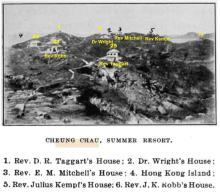
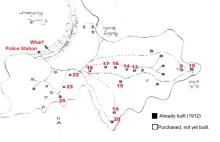
In 1908, building plots and labour were cheap on Cheung Chau, and there was a flurry of building. House #23 may have been built at this time as it may be seen in a Missions photo of 1911 marked 6. Built of locally sourced granite, it had a pitched tiled roof, reinforced with concrete ribs like House #8. It faced south, with accommodation for domestic staff at the rear.
In 1911 the owner is recorded as Dr J K Robb, a medical missionary, who served with his wife with the RPCNASouth China Medical Missionary Association in Tak Hing, South China, 1902-1919.
In 1913, in a letter dated Aug 13th, written on holiday on Cheung Chau, Dr Robb says:
"We are all enjoying ourselves on the island. As far as the place itself is concerned, there is not much to attract. However, with excellent bathing and a fine missionary community, we are really enjoying our vacation very much."
In the 1938 record of European house owners on Cheung Chau, Mr C G Alabaster was recorded as the owner of this house. He was the Attorney General of Hong Kong in1911, 1912 and 1928. He may have owned the house since 1924 as he appears in a photograph in front of the Assembly Hall at that time, styled as the Mayor of Cheung Chau, (China Mail 24th May, 1924).
Also in 1938, the DonaldCarlsonsarrived in Hong Kong to helpin the mission work at the Canton Bible Institute. It appears they were staying in House #23, for two years' study at the language school. Perhaps they were renting from C G Alabaster?
During the war, Alabaster was interned at Stanley, and it was during this time that he was knighted.
See the colour photograph of House#23 taken in 1950.It looks like it suffered the fate of other western-owned houses in the war and was destroyed by the Japanese. Alabaster said he lost - "furniture, household goods, silver, cutlery, glass, carpets, pictures, clothes, bedding ... jewelry, motor car*, wireless set, Masonic regalia etc ... all looted by the Japanese."
In 1949-50, the Christian and Missionary Alliance moved its Bible School from Wuzhou, Gwangxi to House #22 next door, changing its name to the Hong KongAlliance Seminary. It later purchased House #23 and gained a good-sized campus for its operations, possibly when Alabaster died in 1958**. It has gone on from there and is now known as the Alliance Bible Seminary.
* Motor car -This list must have included property in Hong Kong as well.
**The alternate theory about House #23 is that Arthur Lindquistbought it cheaply in 1949, because of war damage, repaired it, and offered it to Doris Ekblad-Olson in 1953 when she started in Hong Kong. Then, sometime between 1955-59, when he retired, he sold it to the Alliance Seminary. House #23 is quoted in Ekblad-Olson's book and the Missionary Evangel of 1953.
Comments
House #23 Overview
[Updated 03/Apr/2026]
In the early 20th century, the island of Cheung Chau was settled on as a suitable spot for building holiday villas for Europeans, and European missionaries in particular. Cheung Chau offered all the advantages of The Peak of Hong Kong for a fraction of the cost - isolation, cool breezes, and extensive views. Cheung Chau actually had its own Peak.
In 1908, building plots and labour were cheap on Cheung Chau, and there was a flurry of building. House #23 may have been built at this time as it may be seen in a Missions photo of 1911 marked 6. Built of locally sourced granite, it had a pitched tiled roof, reinforced with concrete ribs like House #8. It faced south, with accommodation for domestic staff at the rear.
In 1911 the owner is recorded as Dr J K Robb, a medical missionary, who served with his wife with the RPCNA South China Medical Missionary Association in Tak Hing, South China, 1902-1919.
In 1913, in a letter dated Aug 13th, written on holiday on Cheung Chau, Dr Robb says:
"We are all enjoying ourselves on the island. As far as the place itself is concerned, there is not much to attract. However, with excellent bathing and a fine missionary community, we are really enjoying our vacation very much."
In the 1938 record of European house owners on Cheung Chau, Mr C G Alabaster was recorded as the owner of this house. He was the Attorney General of Hong Kong in 1911, 1912 and 1928. He may have owned the house since 1924 as he appears in a photograph in front of the Assembly Hall at that time, styled as the Mayor of Cheung Chau, (China Mail 24th May, 1924).
Also in 1938, the Donald Carlsons arrived in Hong Kong to help in the mission work at the Canton Bible Institute. It appears they were staying in House #23, for two years' study at the language school. Perhaps they were renting from C G Alabaster?
During the war, Alabaster was interned at Stanley, and it was during this time that he was knighted.
See the colour photograph of House #23 taken in 1950. It looks like it suffered the fate of other western-owned houses in the war and was destroyed by the Japanese. Alabaster said he lost - "furniture, household goods, silver, cutlery, glass, carpets, pictures, clothes, bedding ... jewelry, motor car*, wireless set, Masonic regalia etc ... all looted by the Japanese."
In 1949-50, the Christian and Missionary Alliance moved its Bible School from Wuzhou, Gwangxi to House #22 next door, changing its name to the Hong Kong Alliance Seminary. It later purchased House #23 and gained a good-sized campus for its operations, possibly when Alabaster died in 1958**. It has gone on from there and is now known as the Alliance Bible Seminary.
* Motor car -This list must have included property in Hong Kong as well.
**The alternate theory about House #23 is that Arthur Lindquist bought it cheaply in 1949, because of war damage, repaired it, and offered it to Doris Ekblad-Olson in 1953 when she started in Hong Kong. Then, sometime between 1955-59, when he retired, he sold it to the Alliance Seminary. House #23 is quoted in Ekblad-Olson's book and the Missionary Evangel of 1953.
Sources:
Reformed Presbyterian Church North America - 40 Years in our China Mission.
The Reformed Presbyterian Mission in South China.
Wikipedia
Olive Trees Vol 26, 1912
Evangelical Beacon, 6th August 1940