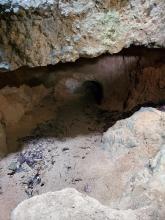
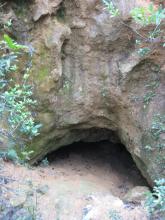
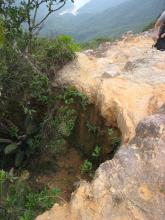
Japanese Tunnel Sir Cecil's Ride [????- ]
- Read more about Japanese Tunnel Sir Cecil's Ride [????- ]
- 6 comments
- Log in or register to post comments
This tunnel discovered by Craig:
This tunnel discovered by Craig:
It's quite difficult to place it accurately now as the whole of the King's Park Rise area has undergone tremendous development, but when it was just the four government blocks known as King's Park Flats, there was a small cave not far below and to the left of the southernmost block. We knew it as candy cave and most of the kids living in the Flats were familiar with it. It always struck me as an odd place to put a tunnel,(and tunnel it was not a cave)but then during the occupation I will assume there were no buildings on the rise.
RICHARD
next to a natural clearing as well as bunkers that overlooked wong nei chung valley. tunnel is by the river and is easy to enter
Thanks to craig for introducing this one:
I went along the Wilson Trail section two yesterday, minus the MTR trip from Quarry Bay to Lam Tim. When I went up the steps behind the quarry at Mount Butler I noticed a boarded up tunnel.

This tunnel lies on stage 5 of the Maclehose trail, between the three-way Shatin Pass Road / Jat's Incline / Fei Ngo Shan Rd junction, and Tate's Ridge. Not far from the road I remember seeing a collapsed tunnel entrance, and a noticeboard describing Japanese tunnels.
I'll get photos and a better description of the location next time I'm out hiking that way.
There are a couple of tunnel entrances here, one of which is very obvious. I assume they link up, but didn't fancy going in without a torch and some seriously good mosquito repellant!
These tunnels were the center of attention in early 1946 - when they exploded!
The tunnels were dug into the slope on the southern edge of the Diocesan Boys School (DBS) campus, near to Argyle Street. The tunnels would have been well known to the school at the time, as the school staff had been pressed into digging the tunnels by the Japanese. The DBS website notes:
We've looked at the tunnels built by the British before the war [1], but how about those built during the Japanese occupation?
The Japanese dug a variety of tunnels throughout Hong Kong. Some, like the tunnel near Diocesan Boys School [2], were used to store ammunition and explosives. Others in the built-up areas [3] were likely built as air-raid shelters. Then out in the countryside, many smaller tunnels were dug into hillsides [4]. These were likely prepared against possible invasion, and would be used by Japanese soldiers fighting a guerilla war.
These are described on the government website describing local monuments:
During the Japanese Occupation Period [when the compound was used as a base for the Japanese Navy], extensive underground tunnels were constructed beneath the lawn but after World War II, in view of public safety, these tunnels were blocked and the lawn was re-turfed.
The tunnels were destroyed during the recent development works to turn the compound into a hotel & shopping mall.