Welcome

Gwulo.com is for everyone that is interested in old Hong Kong.

If it's your first visit, you might like to start with one of the popular articles listed on the right, or just scroll down to browse through recent articles.

I hope you'll join in too, and ask a question or share your knowledge. Most pages let you leave a comment, and there's always the Forum where you can post a new message.

Enjoy the site,

David

PS 'Gwu lo' is roughly how '古老' sounds in Cantonese. It means 'ancient' or 'old-fashioned'.

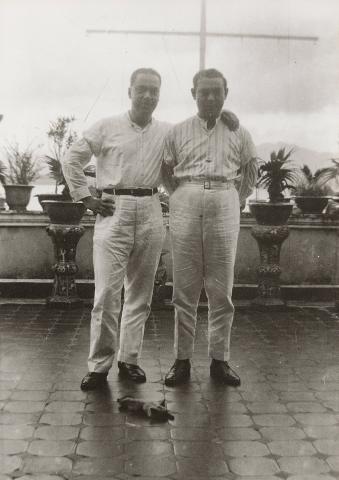
Christian Friedrich Wilhelm Petersen

If you know the nationality of this gentleman, please could you leave a comment below?

He appears as in the history of John Olson. They must have been good friends, as Petersen was appointed as executor of Olson's will.

Historian Carl T Smith wrote about Petersen in his article "The German speaking community in Hong Kong 1846-1918". The first mention of Petersen is in the section "Taverns, Boarding Houses, Cafes and Hotels": Read more »

Dog-fights over Mid-levels

Which years saw the skies above Robinson Road turned into an aerial battlefield?

Try the 1960s...  Read more »

RAF Mount Davis

I didn't know the Mount Davis site was used by the military after WW2, so it was interesting to hear from Norman Lawson that he'd been at RAF Mount Davis in 1956-7. He writesRead more »

c.1927 View over Central, Tamar, and harbour

Image: 

A couple of islands caught my eye in this photo. Up at 11 o'clock, in the distance beyond Hung Hom you can just see To Kwa Wan island. That is landlocked now, but I think some of the island's rocky hill is still visible in Hoi Sam Park, on the To Kwa Wan waterfront.

Over on the right of the photo at 2 o'clock is Kellett island, another that has since been joined to land by reclamation. Read more »

1950s Norman Lawson's photos

Thanks to Craig for getting access to these photos for us. As I understand the story, he met a family friend, Norman Lawson, who was visiting HK, with the offer to help him get around HK. On meeting, he found that Norman had also bought a well-annotated photo album from his time in HK in the mid-1950s.

Norman kindly agreed to share the photos, so Craig borrowed the album, scanned all the pages, and here they are.

Craig also sent this brief introduction from Norman: Read more »

National Tavern

This is linked to the John Olson story - he was the publican of this Tavern for many years.

Initial discussions of its location placed it much further west, based on an address given as "292, Queen's Road West". Today, that address is for a building on the corner of Centre Street and Queen's Road West in Sai Ying Pun.

But in fact the tavern was back in Sheung Wan. We can confirm that from the mentions of the Tavern in the newspaper reports of Annual Licensing sessionsRead more »

Japanese tunnel under Braemar Hill AOP

In last month's visit to the Braemar Hill AOP, we also took the chance to take a look in the tunnel beneath it.

The tunnel is more complex than the usual 'dig a hole in the hillside'. First they had to make this hole in the AOP's floor:

Then they dug down. Here's the view up from the bottom of the hole:

LongJin (aka 'Lung Tsun') Pier / Kowloon City Public Pier [1875-1942]

This pier was built in the 1870s by the Chinese government. It changed shape several times, as reclamation ate it up from the landward end, and different extensions were added to it at the seaward end.

The pier disappered completely in 1942, during further reclamation for the expansion of Kai-Tak airport by the Japanese . Read more »

TST Post Office (3rd location)

This was on Salisbury Road, next to the KCR terminus and opposite the old Marine Police HQ.

Moddsey writes:

The move [from its first location] across Salisbury Road to larger premises was completed in November 1933 when a showroom and garage formerly occupied by Messrs. Alex. Ross & Co. on KCR property was converted into a Post Office with a large public hall with fitted counters, sorting room and records office. Read more »

1898 The Albany

Image: 

Here's a picture of The Albany, taken near the end of the 19th Century. It was an imposing building - to get a sense of its size, zoom in to the sixth archway from the left. You'll see  Read more »

Syndicate content