
Braga, Hugh. Engineer and leader of youth work.
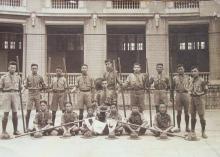
Hugh Braga, the fifth son and seventh child of José Pedro Braga and Olive Pauline Braga née Pollard, was educated at St Joseph's College, Hong Kong, and was awarded the Ignes Soares Scholarship to study Engineering at Hong Kong University. A keen sportsman, he was awarded University Blues in Football and Athletics. As a young Scoutmaster he was decorated for gallantry in saving life during the Po Hing Fong disaster in 1925. In 1935 he was appointed Works Manager of the Hongkong Engineering and Construction Co., and was responsible for what became the Kadoorie Avenue Estate. On 8 August 1935 he married an Englishwoman, Nora Bromley. She and their two children Sheila and Stuart were evacuated to Australia in July 1940, when Japanese occupation threatened. Hugh followed a year later and became Chief Civil Engineer of Timbrol Ltd in Sydney. He returned to Hong Kong in 1945 with the British Military Administration and from 1949 ran his own engineering and architectural firm, Hugh Braga & Co., which embarked on a series of large residential developments. He was very active in community service, being interested in the Rotary Club, the Kowloon Residents’ Association, the Fanling Babies’ Home run by Mildred Dibden, the Salvation Army and Protestant missions.
In 1951 he returned to Australia and resumed his employment at Timbrol Ltd, later Union Carbide Australia. He continued his interests in community affairs, especially youth work and education. For close to 20 years he was a Council member of two leading schools. He was Chairman from 1957 to 1960 of the Crusader Union, a Christian organisation working among young people. Following his retirement in 1975, Hugh and Nora were the inaugural wardens at St David’s, Forestville, an Anglican retirement village, establishing a tradition of caring service to the residents. In 1981 they nominated Hugh as New South Wales Senior Citizen of the Year in recognition of his many years of community service. He died on 2 June 1987.
Hugh Braga was a business and professional man and community leader of high principle. He was generous with his time, money and professional expertise, especially in his long association with young people and in his great loyalty to his family. He was a blessing to the community, both in Hong Kong and in Australia.
Stuart Braga (son) April 2024
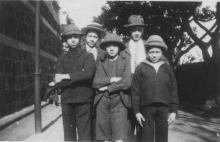
Photos that show this Person

Comments
Hugh Braga's work as an architect, 1933-53
Hugh’s work as a civil engineer included the design of more than merely basic works in the Dept. of Public Works. When he joined the Hongkong Engineering and Construction Company, there was greater scope for his skills and interests. Accordingly, his appointment as an Authorized Architect was announced in the Hong Kong Government Gazette in 1933.
Hugh Braga graduated as a Bachelor of Science in Engineering with Second Class Honours from the University of Hong Kong in 1929. He worked in the Public Works Dept for several years then joining the Hongkong Engineering and Construction Co. Between 1934 and 1941 Hugh was General Works Manager for the company, which developed what came to be known as the Kadoorie Ave Estate. His father, the Hon. J.P. Braga, was Chairman of Directors of the company; the main road in the Estate was Kadoorie Avenue; other road was named Braga Circuit in honour of J.P. Braga. Of the approximately 89 houses on the Estate in 2012, 21 were still the original houses designed by Hugh Braga.
After World War II, Hugh Braga became a significant civil engineer, architect and community leader in Hong Kong. In 1949 he established his own firm, Hugh Braga & Co., which embarked on a series of large residential developments across Hong Kong during the post-war boom. The most important was the Jardine’s Lookout development, for which he imported two of the earliest bulldozers in Hong Kong. By 2026, according to an article in Wikipedia, “it came to have Hong Kong's most expensive landed single houses, more valuable than ones on Victoria Peak.” Hugh named several of the roads after former Directors of Public Works, some of whom he had known as a recent graduate in the early 1930s.
The five roads he named are:
The remaining four he would have known personally:
Another development was the Headland Road estate, a group of luxury houses situated south-east of Repulse Bay with fine views out to sea.
In the late 1940s and early 1950s, Hugh came to have a significant role in the Kowloon Residents’ Association and the Hong Kong Rotary Club, of which he was Community Services Director. In these roles, he urged the government to embark on community housing for the large number of refugees coming to Hong Kong to escape from the civil war in China. He became widely recognised as a prominent community leader.
From the South China Morning Post, 25 January 1953:
“A few days ago Lady Grantham, in laying the foundation stone of the new Kowloon Girl Guides Headquarters, thanked him officially for his role as the honorary architect. He will also be missed by the Kowloon Residents’ Association, which has profited from his advice since 1948, when he became a member of the committee. He was also continually active in several other committees connected with social welfare work.
“Mr Braga is the fifth son of the late Mr. and Mrs. J.P. Braga. He escaped the war years in Hongkong by leaving for Australia just before hostilities broke out, not really knowing, at that time, how lucky he was. He returned after the war as an officer with the British Military Administration. He has had a varied career in local engineering projects, social welfare work and University work. A letter from the Vice-Chancellor’s office addressed to him last week took official cognizance of valuable work rendered by him on the University Council on which he served four years.
“Engineering works for which he was responsible include the Kadoorie Avenue development project, the Headland Road development, Jardine’s Lookout and Kowloon Tsai. Only recently he was engaged by the Christian Children’s Fund to prepare plans for the development of a large centre for 600 orphans in the New Territories.”
In addition to his very busy work-load, Hugh used his professional expertise as honorary architect for several organisations. As a university student in the 1920s, he was a resident at Morrison Hall. It had suffered severe damage during the war, so Hugh offered his services as honorary architect for the repairs. He was also honorary architect for the Boy Scouts, the Girl Guides, the Salvation Army, the Deaf and Dumb School, the Blind School and St John’s Ambulance. He was a keen and active member of St Andrew’s Church, Kowloon.
Invited by the Governor of Hong Kong, Sir Alexander Grantham, who was also the Chancellor of the University of Hong Kong, he served as a Member of the Council of the university for four years. When the university reopened after devastating wartime damage, he gave lectures on architecture, drawing on his extensive experience of local conditions.
In 1949 he won a competition open to graduates of the University of Hong Kong for the design and supervision of construction of Lady Ho Tung Hall, the first hall of residence for women students at the university.
Hugh Braga had a significant and lasting role as architect, engineer, property developer and community leader in the built environment and in the Hong Kong community from 1934 until 1941 and again from 1946 until 1953.
Stuart Braga (son), 20 October 2026