[Updated 29/11/25]
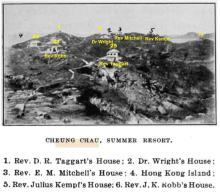
European House #7 was built in the early 20th century when Cheung Chau was found to be an ideal alternative to The Peak as a site for holiday villas. There was a flurry of building in 1909-10, and it may have been built then. It can possibly be seen in an early Mission photo of 1911, marked as the residence of missionary Rev E M Mitchell.
House #7 was a bungalow, sturdily built of locally quarried granite blocks, secure enough to withstand the typhoon season in its exposed position, with a tiled timber roof, reinforced with a course of masonry. By 1963 it had exchanged its tiled roof for a flat concrete roof.
Unlike most other villas, it faced west, with a three-arched verandah at the front. A cottage for domestic staff stood by it. Standing on the top of Fa Peng with House #8, it enjoyed superb views in all directions.
In 1938 its owner was recorded as Mr J. J. Lossius (85), who was a retired ship's captain, born in Norway. He also owned House 15, and one other prior to 1938. See his page for more info on his houses and his life.
In 1940 No. 7 House was described as 'the country residence' of Mr D O Silver, a HK insurance agent, in a report by the Hong Kong Telegraph (see Jacob Lossius, moddsey's post). His main residence was in Kowloon. In this year he was elected President of the Cheung Chau Residents' Association.
The 1963 aerial photograph of Cheung Chau shows the house intact.
Today the site has been redeveloped and is occupied by the Salvation Army Bradbury Camp complex, a residential camp for groups and families.
Photos that show this Place

Comments
Resident in1935
In 1935, the owner of House 7 was one Daniel Oscar da Silva, insurance agent with Sun Life Assurance Co. of China.
See moddsey's post on D O da Silva.