[Updated 15/Sept/2026]
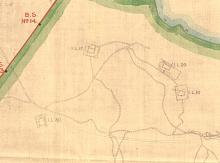
The land lease for House #2, CCIL17, Kwun Yam, took effect on July 1, 1898. It was granted by the British colonial government to build a missionary villa after the signing of the Hong Kong Extension Convention between the Qing and British Empires.
The original building is believed to have been constructed by 1908. First, the heavy exterior walls were constructed and reinforced with buttresses. Large blocks of granite, common in Cheung Chau, were cut into rough stone by local stonecutters. On the inside, the walls were rendered and whitewashed.
On top was a timber double-tiled roof, weighted with a concrete course against the typhoon season.
Inside were concrete floors, which, owing to the condensation, were never dry, 'no matter how hard I tried with a mop,' said Doris Ekblad Olson.
In the 1950s the home had 'fluorescent light tubes suspended from the high ceiling by wires, and in the kitchen, there were two individual kerosene burners for the cook stove.'
'The water supply came from rainwater caught on the flat* roof and stored in a tank above the ceiling. The water was then piped down to a concrete sink in the kitchen. A pipe from the ceiling delivered water to a tiny porcelain sink in the bathroom (see pic), which drained into a bucket below to be reused for flushing the toilet. The toilet water was recycled yet again, flowing into a tank in the garden below to water and fertilise the luxuriant vegetables and flowers.'
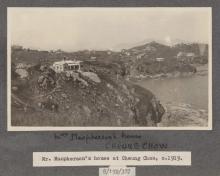
The single-storey house is approximately five meters high. It has a solid verandah with 3 arches at the front. This was added in 1925 (see post below) when the house changed hands. And the 'servants' quarters' were extended at the rear.
It stands on a hill with a steep approach path, close to the beach, with 'fantastic views', and is 'blessed with sea breezes.'
Four concrete dormitory bedrooms and storage rooms were added in the 1950s.
In the 1973 records, the basic infrastructure of Cheung Chau Island Rest House at that time included the 'stone building, a concrete roof, water, electricity, and a septic tank.'
The house has a long history (see next post) and operates today as the Bradbury Retreat Centre. Its first forty years were closely linked to the Covenant Church's (Reformed Presbyterian) missionary work in China. It is believed to have served missionaries and the church for over 110 years.
*The original timber roof of the house was replaced at some point by a flat concrete roof, which can be seen in the 1963 aerial photo of the area.
Owners of House #2
1908 Drs Ida Scott, Kate & Jean McBurney
1925 Rev Ernest C Mitchell
1938 Rev Frank T N Woodward
1949 Rev Arthur G N Lindquist
1956 Presbyterian Church (USA)
1970 Chinese Episcopal Church, Hong Kong Synod.
1978 Rev Dr Wendell P. Karsen
1983 Hong Kong Christian Council
Today Hong Kong Christian Service funded by the Bradbury Foundation
The House today - 15 photographs.
Sources:
Any Bush Will Do by Doris Ekblad-Olson.
Photos that show this Place
Comments
Dateline of the owners of House #2, CCIL17.
[Updated 14/Sept/2026]
Very unusually, we have a history for the lifetime of this house from the Bradbury Retreat Centre website:
1898: The land lease for Cheung Chau Inland Lot No. 17 (House #2) is granted by the British colonial government after the Hong Kong Extension Convention between the Qing and British Empires.
Owner(s) #1
1908: Construction of the original villa is completed, with local stonecutters using granite from Cheung Chau. Ida M. Scott, Kate McBurney, (later BCMS) and Jean McBurney (Covenanter Church, North America), become the joint owners, serving as medical missionaries in Deqing and Luoding, South China.
1911–1912: The Xinhai Revolution brings turmoil in mainland China, leading Reverend Ernest and Mrs. Mitchell, and Dr. Jean McBurney to seek refuge at House #2, and other missionaries such as Julius A. Kempf went to their villas. The villa becomes a hub for meetings, intelligence gathering, and annual church report preparation.
Owner #2
1925: Official transfer of House #2 to Reverend E C Mitchell and Mrs. Mitchell, who continue using it as a vacation and support home for missionary families. They extend the domestics' accommodation and add a substantial verandah on the front.
Pre-1938: Pastor Frank T. Woodward, his wife Mabel, and his family, Southern Baptist missionaries, frequently vacation in Cheung Chau. It is not certain if they resided specifically at House #2.
Owner #3
1938, September: Rev Frank and Mabel Woodward take over ownership of House 2* from the Mitchells. Apart from during the war, they own the house until they are expelled from China in 1949.
Owner #4
1949-1955: Badly damaged by the Japanese in the War, House #2* is purchased cheaply and rebuilt by senior missionary Rev. Arthur G. Lindquist, Evangelical Free Church of America, founding president of the Evangel Theological Seminary HK.
1953: Lindquist offers House #2** to new missionary Doris Ekblad Olson, of the Evangelical Free Church of America. Olson stays for 9 months, learning the language from a village teacher and teaching Sunday School in Kowloon at weekends. After her, others possibly live there.
Four concrete dormitory bedrooms and storage rooms are added to the house.
1954 & 1973: The lease for House #2 is renewed as a charitable institution, supporting missionary and church communities. Infrastructure upgrades are documented in 1973.
Owner #5
1956: Miss Yan Luyi purchases House #2 as a trustee for the Presbyterian Church (USA) for use as a rest house for missionaries.
Owner #6
1970: Management is transferred to the Hong Kong Synod of the Chinese Episcopal Church.
1975–1998: Rev Dr Wendell P. Karsen, a missionary with the Reformed Church (USA), resides at the house.
Owner #7
1983: Ownership is transferred to the Hong Kong Christian Council...
Owner #8
...and then to Hong Kong Christian Service. Major renovations are funded by the Bradbury Foundation, and the centre is renamed the Bradbury Retreat Centre.
Present: The centre accommodates theological students from mainland China attending Kin Tao Theological Seminary. It continues to serve as a site for theological education and spiritual formation on Cheung Chau.
*Conflictingly, the Bradbury history also says this re ownership in 1938 - 'In September 1938, House 2 passed to Dr. Frank Woodard Scott, a Baptist missionary stationed in Wuzhou, Xijiang. Missionaries like Dr. Scott returned to Deqing to continue their service after World War II. However, in 1949, due to a change in the situation, Dr. Scott officially retired and returned to Japan. He died in 1955.'
**According to Ekblad-Olson's account Any Bush Will Do, the house was House #23. In addition, The Evangelical Beacon Magazine of 1953 gives the address of Doris Ekblad as House #23, Cheung Chau. However, Olson talks of bathing in the sea below the house, which fits House #2 better.
Sources:
Bradbury Retreat Centre
Any Bush Will Do by Doris Ekblad-Olson
'Trip Advisor'quotes from missionaries holidaying on Cheung Chau
In the early 20th century, many missionaries from abroad used Hong Kong as a stopover on their way to mainland China. As it was uneconomical to return to their lands of origin to holiday every year, Cheung Chau became a favoured place to own property for vacation purposes, and the island saw a flurry of building activity in at this time.
Around 1938, Southern Baptist pastor Frank T. Woodward and his wife, Mabel, working in Wuzhou, Guangzhou, were regularly taking their annual vacations in Cheung Chau.
His impression of Cheung Chau was this: "Every year, I loved going to Cheung Chau Island near Hong Kong. We could relax in the small-town atmosphere or take a short trip to Hong Kong, an interesting city with many museums and shops. The boat left Cheung Chau early every morning and returned at 3:30 p.m. The beach was very lively in the afternoons. Our children loved the sand and water there. When my wife or I played with them, they would happily wade in the water."
After the war, relations between local Chinese and foreigners were good. Among them, Miss Doris Ekblad Olson, an Evangelical missionary to China, once stayed at House #2, CCIL 17. Her experience was of the friendliness of the Cheung Chau residents, as well as the fact that some missionaries would learn the Chinese language in Cheung Chau and serve in church on weekends, eg with the children/ youth work.
Rev. Szeto Fai, Superintendent of the Hong Kong and Macau District of the Chinese Methodist Church recuperated at Rev. Lindquist's residence: "...the church gave me leave, and I was able to recuperate at Rev. Leung Kwai Man's residence in Cheung Chau. It was spring, and the night-time sounds of frogs and insects harmonized with the sounds of my asthma, adding a particularly beautiful touch to the natural music. Over twenty years have passed, and God has preserved my health beyond compare. Not only has my asthma, which Chinese and Western doctors declared incurable, been cured, but my weight has also steadily increased, from a meager 103 pounds to 138 pounds."
Source: Bradbury Retreat Centre
1925 Improvements to European House #2
"No. 2 cottage has changed hands, having been sold to a former old resident, who is making improvements to the property, in the shape of additional servant's quarters and a verandah." China Mail 22 September 1925 refers.