[Updated 06/Apr/2026]
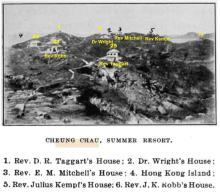
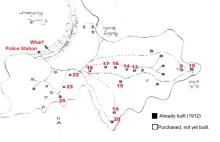
European House #6 was built in the early 20th century when Cheung Chau was found to be an ideal alternative to The Peak as a site for holiday villas. There was a flurry of building in 1909-10, and Cheung Chau got a 'Peak' of its own. House #6 seems to be present in a Mission photo of 1911 (qv).
House #6 originally may have been a bungalow, but latterly it was an extended two-storey building, sturdily built of locally quarried granite blocks, with a flat concrete roof, secure enough to withstand the typhoon season in its exposed position. Like the other villas, it faced south, with a domestics' annex at the rear. It looks to have had a verandah on two sides, possibly three, and enjoyed superb 360 views in all directions.
In 1926 it was purchased by a missionary (see post below).
In October 1937, the occupants of House #6 were Free Church missionaries, the Arthur G Lindquists. He was founding president of the Canton Bible Institute, and a Swedish American colleague of Rev Hugo Rodine (House #17). Lindquist may have been the purchaser mentioned in 1926, as he started in Hong Kong in 1923.
They also had some refugees from Shanghai staying with them, who were fleeing the Japanese invasion, and the Lindquists were having to sleep in their dining room. The house had likely been extended by this time.
Also on Cheung Chau was fellow missionary Miss Anna W Ericsson, and young missionaries Opal Anderson and Millicent Johnson, to continue with their language studies at the language school, which had just moved to Cheung Chau from Canton (1937). They were in another 'small' house, and they were next door to a Baptist family named Snuggs (House #3A). In September, they suffered from the 1937 typhoon, which took away the Snuggs' roof in the night, causing them to take refuge with the missionaries.
All this, Mrs Annie Lindquist wrote in a letter from Cheung Chau to their missionary magazine, the Evangelical Beacon, back in America, with an update on things in Canton. Very auspiciously for our benefit, she signed off her letter - House No 6, Cheung Chau, Hongkong.
In 1938 the house's owner was recorded as Mr P N Anderson.
In December 1939, the occupants of House #6 were again the Lindquists, who were on Cheung Chau for Christmas 1939 and Rev Lindquist wrote a report on the work in Hong Kong, which he sent for publication in the Evangelical Beacon. He signed off the report with his address - 6 Cheung Chau Island, Hong Kong. This would suggest continuous occupation. Why Mr Anderson is recorded as the owner in 1938 is not clear. Perhaps they were renting from him.
By the time the war came, House No #6 had been extended to three times its original size, but it was badly damaged during the war, as its wood was stripped out by the locals for fuel, and the Japanese blew it up as being western-owned.
In the 1963 Cheung Chau aerial photograph, House #6 may be seen intact.
Since then, the site has been redeveloped and today the site is occupied by the Salvation Army Bradbury Camp complex, a residential camp for groups and families.
Photos that show this Place
Comments
Facebook post and pic
Interesting pic and post on house #6 from the Facebook group HK in the Colonial Era. Is this view taken from House #5?
European House #6
"House No. 6 has changed hands, being purchased by a missionary now residing on the island." China Mail 4 August 1926 refers.