[Updated 29/11/25]
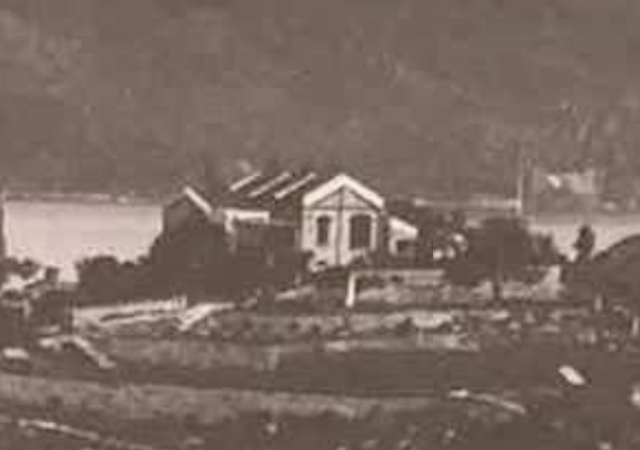
We see the concrete ribs on the roof securing the roof and tiles, as on Houses #27 and #8. Stone gable ends protecting the tile edge.
There seems to be a building beyond house 23, to the right.
Date picture taken
1920s
Shows place(s)
Comments
European House #23, crop 1920s cheung chau
The European House on this property was labeled as '23' on the map of 1938's European Reservation. The confusion to me is a bit ambiguous, because the European House number is always different from the I.L.(Island Lot) number.
Since the 'I.L.' seemed to be erased off the 1938 map, it is quite OK to call it European House #23. However, when more houses or buildings rise up within the same lot, their individual mailing addresses could be changed again.
A mailing address change did happen to my home in 1956 too.
The mailing address assigned to this particular bungalow in the 1920s could likely be different in the 1950s as more houses and buildings appeared.
However, I could share some stories solely based on this physical bungalow.
Tung
I have to say
I have to say, Tung, I don't always understand your posts. Sorry.
European House #23, 1920s Cheung Chau
I agree that the archive states much better than my own searching or head scratching!
I attempt to share materials with my past surroundings, as soon as they catch my attention. The disadvantage is so obvious. I could only be helpful to offer certain brainstorming from my own memory.
For instance, my home was in a private village, the CLCY enclave with several family houses. All the mail would be delivered to the CLCY village only at the gate. So we must put up different mail boxes for the respective houses over there. But one day, we suddenly found a new address plate nailed next to each of the house doors with the new house number and new name of the street address I had never ever heard of. I didn't even understand why.
However, I may be the only few people who are really familiar with the places and houses mentioned in the context of our discussions, based on the witness viewpoint.
So, for the house in question, it bothered me for quite a while too and may temper my accuracy during an attempt to problem-solve. My sincere apology.
So recently I re-read the autobiography of the missionary whose name is Ruth Hitchcock. Her parents sponsored her gospel ministry, starting in a poor district in South China. About a dozen years later, she bought a property as a birthday gift from her parents, just before the end of 1926. The address is 25 Peak Road in Cheung Chau. That house was also being opened up as a retreat or holiday resort for other missionaries.
The house mentioned above is neither the same one in the photo nor as one of my church friends' and I had been singing the Christmas Carols for a few years at her assumed residence. So I mean at the time, when it was the mid 1950s.
A piece of valuable information is that the substantial property size of House # 23 was very big indeed. The remaining yards and hillside terraces were eventually integrated to form the huge expansion site of the Bible seminary, a significant campus of high education. The moderately dense forest of pines and other greenness surrounding House #23, which had been known as the home residence of Missionary Miss Ruth Hitchcock, could be the coolest bungalow of the Nam Tam Wan area in the hottest days in summer as we knew it then.
In the autobiography, it clearly mentioned that Mr. Newbern of the seminary, eagerly invited Miss Hitchcock, when she had already returned to California for the sake of staying there by the side of her ailing mother, to join the faculty to teach, as soon as she was available, with residence readily provided. She did take the job around 1959, because I have seen her quite often in the town market lanes since then. She was so humble and friendly to so many different diversities.
So the Christmas Carols singing had to be held on the front porch of House # 23, while she was away afar from Cheung Chau. The main portion of the residence remained empty and was held on a reservation solely for her return to work at the seminary.
To me, I don't really know more about the end story of House #25, the one Miss Hitchcock had bought in 1926 as written in her book.
Looking at the 1920s photo, there is an attached living quater at the back, as on the right side of the house. It is a much smaller living quarter for the housekeeper's family and for tools storage as well. Our Christmas Carol Singing naturally went to this family too. The most memorable visits to the front porch were when my college teacher, Miss C, held a few weekends of bible study fellowship meet-up with some of my classmates there. She lived in the room on the east side. We all consider that this is the home residence of Miss Ruth Hitchcock on the campus of the Alliance Bible Seminary.
Sounds Better?
By the way, Mr. Newborn's name was on the attendees list of the 1940s Concert at the Assembly Hall, as on Gwulo's Cheung Chau Assembly Hall pages.
Tung
European House #23
The autobiography was first published in the US in 1975, a few years after her official retirement, and leaving Cheung Chau and China with fruitful happiness. The Good Hand of Our God is the title.
Tung.
European House #23, 1920s Cheung Chau
The 1940 Concert at the Assembly Hall that took place on Cheung Chau is clearly historic as a proof. The purpose of the establishment of the European Reservation was solely for the European missionary workers to have the least expensive districts and convenience during their stay in colonial Hong Kong.
Tung