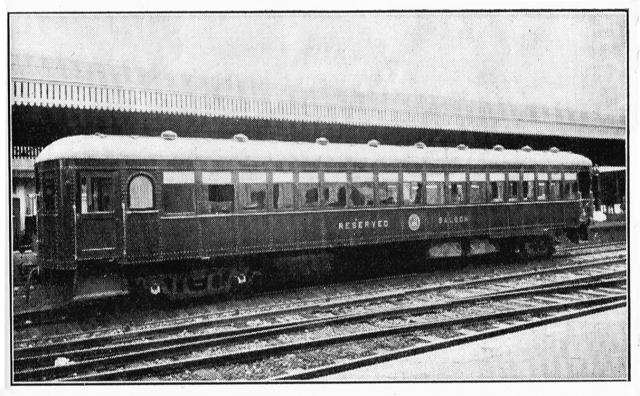
Photograph of one of the "RESERVED SALOON" carriages of the Canton-Kowloon Railway's express trough trains introduced in 1935.
(From an original 'Canton_Kowloon Railway' brochure of 1935. This forms part of the P. A. Crush Chinese Railway Collection- Catalogue Reference :- Timetables-T-62)
Date picture taken
1935
Shows organisation(s)
Comments
This reserved saloon coach…
This reserved saloon coach was likely converted from the trailer car of the Hall-Scott motor coach of the KCR British-section in 1934.
CKR Reserved Saloon
The reserved saloon in this photograph, in my opinion is unlikely to have been the converted KCR 's Hall-Scott motor coaches since both were modified to form the streamlined 1st Class railcars. First, was the "Taipo Bell" and next the "Canton Belle" between 1936 and 1937.
The Chinese-owned Canton-Kowloon Railway had a 1st Class Saloon car on their books according to their annual reports from the 1930's and this was likely upgraded to form this "new" Reserved Saloon carriage. However, there was also a single motorized trailer car which was delivered with the KCR's Hall-Scott motor coaches and since this had seldom been used, there is a record that this was also converted by KCR into a "Reserved Saloon".
I am, however, still inclined to think that the photo above is more likely the CKR's saloon and not the KCR's because (a) this brochure was promoting the CKR and not the KCR and (b) the number of windows and rooftop ventilators do not appear to match those of the Hall-Scott trailer car....... although the pictures are very grainy and, I could be wrong.
CKR Saloon Car
The photo of a special saloon coach of the CKR with an open area platform. Both interior and exterior of the car looks different from the "Reserved Saloon". According to the Railway Almanac (鐵道年鑑) of China 1933, CKR owned only one saloon car. Did CKR acquired more saloon cars in the late 1930s?
Luxery !
I wonder how much it cost from TST to Guangzhou in 1930s ?
Kowloon to Canton Fares -1936
First Class : Return HK$7.50 Single $4.00 Children half fare
2nd Class Single $2.00 " " "
3rd Class Single $1.00 " " "
These fares were for the thrice-daily through trains, the "Flying Arrow","Up Fast" & "Flying Star" from Tsim Sha Tsui, Kowloon and the "Flying Eagle", "Down Fast" & "Flying Dragon" from Tai Sha Tou ( 大沙頭 ) in central Guangzhou. Journey times varied between 2 hrs : 55 mins and 3 hrs : 20 mins. So 90 years later train times (including the high speed rail) are not that much quicker when the necessity of getting to stations well ahead of departure times is factored in. Moreover, the stations are no longer in the city centres as they were back in 1936.
Some thoughts about the CKR brochure and the Reserved Saloon
1) Article 43 of the 1934 Railway Working Agreement stated that the cost of advertisement and printing related to through traffic were shared by both the British (28%) and Chinese (72%) Sections. I suggest the brochure is a joint publication to promote overall service of the railway, not limited to the Chinese-Section.
2) If this Reserved Saloon belongs to the Chinese Section, it's unlikely that there is only English lettering but not any Chinese characters on the bodywork. In case it was modified in the mid-1930s, using Chinese characters or bilingual is a common practice on the rolling stock of Chinese National Railways.
3) When comparing a photo of a KCR carriage from Leeds Forge (on p.125 of the KCR history book by Robert J. Phillips), the blurry circular marking on the middle of the Reserved Saloon looks a bit similar to the pre-war KCR emblem that is found on the same position of most British Section carriages.
4) A Hall-Scott built trailer car, Oakland, Antioch & Eastern Railroad No. 1020, is preserved at the Western Railway Museum in California.
https://www.wplives.org/sn/1020.html
https://www.wrm.org/visit/car-roster/passenger-cars/interurban/item/76-oakland-antioch-and-eastern-1020
Its interior design is almost identical to the 1st and 2nd class compartment of the KCR Hall-Scott motor coach illustrated in the "Far Eastern Review". Meanwhile, its arch window, overall body style, and the pattern of rivets on the steel bodywork, align closely with the Reserved Saloon.
5) When zooming the photo of the Reserved Saloon, a potential trace of modification can be seen. A narrow protruding structure, apparently with rivets, is visible along the bottom of the bodywork beneath the 13th to 16th windows (near the right bogie). Could this indicate that the door and footboard (also the triangular structures beside it) originally present on the KCR Hall-Scott trailer car were removed and replaced by windows and steel plates?
6) According to p.151 of "Guangdong Provincial Gazetteer: Railway Gazetteer" (广东省志·铁路志), a CKR saloon car had been in service since the opening of the railway (and based on our recent discussion, appears to have been the only one until mid-1937). It was probably a wooden carriage acquired among other CKR carriages from either the Metropolitan Amalgamated Railway Carriage and Wagon Company of Birmingham or the Tangshan Locomotive and Rolling Stock Works. Given the poor financial situation of CKR which suffered long-term losses throughout the 1920s and 1930s and experienced difficulties purchasing new railway equipment, it is unlikely that the administration would have undertaken an expensive conversion of a wooden saloon car into a steel car copying a Hall-Scott design.
In conclusion, I am confident that this Reserved Saloon coach belongs to KCR rather than CKR.
Wow! well done
w thanks