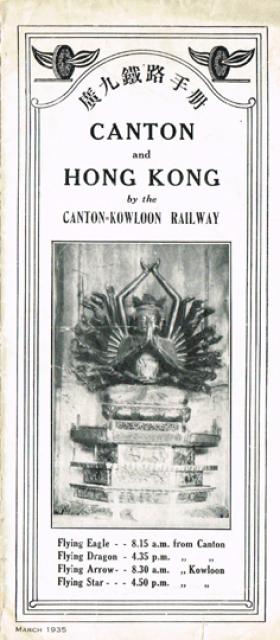
Front cover of a promotional tourist brochure printed in March 1935 for the Canton-Kowloon Railway. This was issued by the Chinese-owned and operated section of this railway, not the Hong Kong Government-owned 'Kowloon-Canton Railway (British Section)' The two separate organizations had recently signed and ratified an agreement for through traffic, formally titled as:-
Canton - Kowloon Railway – Working Agreement for Through Traffic between the Chinese and British Sections.廣九鐵路華英兩荗度叚聯運合同 .
When the line first opened in 1911 an unofficial “temporary” agreement (although never signed or ratified) covered the operation of through trains and specified how revenue would be divided. This agreement, which is bilingual, was re-negotiated in 1934 and the new conditions as printed in this agreement were formally ratified on 1st October 1934. The result of the new agreement gave additional benefit to the Chinese Section whose share of revenue from through traffic rose to 72% from 65%. The text of the agreement is printed in both English and Chinese.
(This original brochure forms part of the P. A. Crush Chinese Railway Collection — Catalogue Reference :- Timetables-T-62)
Comments
Canton-Kowloon Railway Express Trains-1935
Following the ratification of the revised "Through Train" agreement in 1934. The CKR rapidly planned and put into operation four express trains between Canton and Kowloon. The four trains were :
Flying Eagle 飛鷹 departing Canton 8:15 a.m.
Flying Dragon 飛龍 " Kowloon 8:30 a.m.
Flying Arrow 飛箭 " Canton 4:35 p.m.
Flying Star 飛星 " Kowloon 4:50 p.m.
The photo shows the train headed by one of three Kitson Locomotive Works 4-6-0 express engines purchased by KCR ( British Section) in 1930. These were intended for the Chinese-owned Canton-Kowloon Railway, but due to a lack of financing, the locomotives were first purchased by KCR and operated on a loan-lease basis until they could be transferred onto CKR's books.
The journey time for the 111-mile journey with only two short stops ( one at the Shum Chun border ) was accomplished in only 2 hours and 45 minutes. Not bad at all for a steam-pulled train rarely exceeding about 40 miles an hour. Today's so-called modern "High Speed Railway", with trains capable of exceeding 300 km per hour, have journey times still taking one hour and 45 minutes and these trains first require passengers to make their way to the Kowloon West station and then dump them at either Guangzhou South station ( 13 miles [ taking almost 40 minutes by subway] from central Guangzhou) or at best to the Guangzhou East station which is still a full 6 miles from the former centrally-located Guangzhou station. I cannot describe this as real "progress." Please bring back the steam trains.
This is the exterior view of the luxury "RESERVED SALOON" carriage used for passengers who reserved their own private coach on the Canton-Kowloon Railway's express through trains in 1935.
Canton-Kowloon Railway Express Trains-1935
This is the interior of the Canton-Kowloon Railway's special "Reserved Saloon" carriage for those passengers on the 1930's express through trains who could afford to reserve a private carriage on these trains.
( All photos from original brochure forming part of the P. A. Crush Chinese Railway Collection- Catalogue Reference :- Timetables-T-62)
Kowloon Canton Railway - Taipo Station & Pier
Although the through express trains did not stop in Taipo the slower stopping trains all called at Taipo Station.with its adjacent Pier. From here, passengers could change between the trains and launches, providing regular services across Mirs Bay to the Chinese mainland. Later, Taipo station was renamed Taipo Kau to distinguish it from the much busier Taipo Market station.