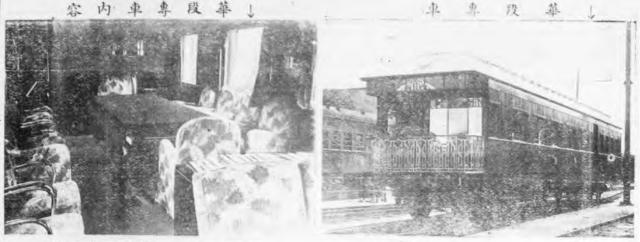
Captions: The interior and exterior of a special coach of the Chinese-Section (The Canton-Kowloon Railway).
Photo source: Railway Semi-Monthly (鐵道半月刊), Volume 2, Issue 2. Published by the Secretariat of the Ministry of Railways of China, January 16, 1937. Collection of National Library of China.
Date picture taken
1937 (year is approximate)
Comments
Canton-Kowloon Railway (CKR) Rolling Stock
The Official Annual Reports of the Canton-Kowloon Railway contain lists of Rolling Stock . The reports issued from 1919 up until a combined 1936 -mid 1937 report indicate no additions of Saloon cars or 1st. Class passenger carriages . The totals were 1 ( only) saloon car and three 1st Class cars fo.all these years. The new "Reserved Car" photo I have posted must have been acquired during 1937 or sometime soon afterward. I would suggest the photo above captioned a "special coach" is a very early carriage ( with a wooden body) and probably purchased for the opening of the railway.
Reserved Saloon
If this special coach was the only saloon car listed in CKR records before the mid-1937, I am more inclined to believe that the Reserved Saloon belongs to the British-Section, since the brochure was dated March 1935.
CKR or KCR "Reserved Saloon"
Concerning the photo you have posted above : I do not personally think that the 'platform roof ' or 'safety rails' on the open platform at the end of this carriage matches any of the surviving photographs of either KCR or CKR's early rolling stock. I understand the origin of this very poor print is from a railway journal published in Beijing in about 1936-1937. During this era the government of China was in disarray. Chiang Kai Shek's Nationalist Government had moved its "capital;" to Nanking and "Peking " was then referred to as "Peiping". The 1920's "War Lord" era had still not played out and the country was far unified with several competing military factions still controlling large areas of the country. Beijing was in 1936 under the control of the Chinese National Revolutionary Army (NRA) but the Japanese were all around and the situation was tense. The Nanjing administration had little influence.
Guangzhou Province at this time was not under the strong control of the Nanjing government, nor was it entirely independent. While officially under the Nationalist government's control from 1928 to 1937, Guangzhou was actually governed by independent leaders who openly criticized Chiang Kai-Shek's dictatorship and threatened secession from the Nationalist government in Nanjing.
What I am getting around to suggesting is that this Beijing railway journal cannot be trusted for accuracy as to what was going on in Canton at this time. Most of central China's railways' passenger rolling stock had been destroyed during fighting or seized and taken to Manchuria by the warlord Chang Tso Lin (Zhang Zuolin) and kept there... and later (following his assassination in 1928) by his son, Chang Hsueh-Liang (Zhang Xueliang). Any surviving rolling stock in central China could end up end up anywhere where there were still railway tracks which had not been ripped up. Since it was not possible for any rolling stock to reach Canton from the north until 1937, I suggest this photo was probably not taken in Canton or Hong Kong. It has been misidentified.
The photo source
I would like to clarify that the photo source, the "Railway Semi-Monthly", is a government publication printed and distributed in Nanking, not Beijing. Many detailed articles and photos within its issues were provided by the management and staff of various Railway Administrations across the country, including figures like Li Lu-Chao (Managing Director, Canton-Kowloon Railway) and Ling Hong-Xun (Managing Director and Chief Engineer, Canton-Hankow Railway). I consider the contents to be credible, though misuse or inaccuracy of contents are possible.
This photo was published alongside a series of CKR photos taken in Canton, including the exterior view and the nearby street view of the Tai Sha Tou Terminus, and a through express train departing from the station. However, given the limited information currently available, I agree that the background of the special coach requires further studies.