There's a common misconception that Mr Rennie committed suicide by hanging himself, giving the chinese name of the area. You can see I've been guilty of making the same mistake.
Fortunately, reader Zerocube wrote in to correct me:
Alfred Herbert Rennie did not hang himself. In fact, he jumped off a boat. He had a boat for him to commute between central and his factory. The name has been there before Rennie died.
This website has more on the story, and says:
The Mill started operation in 1905 and closed in April 1908 because of high production cost and poor quality of product. The failure in business had made Mr. Rennie so disappointed that he jumped into the sea and drowned himself at Lei Yue Mun, 3 km from his flour mill on 14 April 1908.
The details of Rennie's death are confirmed in the April 14, 1908 edition of the China Mail. It had an article 'Death of Mr Rennie. Body found in Harbour" which includes the text:
Just as we go to press we learn that the body of Mr. A. H. Rennie, manager and founder or the Junk Bay flour mills, was found floating in Lyeemoon Pass this afternoon.
And:
Later.
We now understand that Mr Rennie accidentally fell overboard from his launch, Canada, whilst going to Junk Bay, and his body was picked up by the launch after a search.
I've used the dates 1905-8 given above, though they may need to be corrected later. A map dated 1939-40 (Plate 2-12, Mapping Hong Kong) still shows a building at this location, labelled "Rennies Flour Mills".
[Update 2019-10-02: Herostratus has found the buildings were demolished in 1935, details in the comments below.]
If you can add any more information, please leave a comment below.
Regards, David
Photos that show this Place
Comments
Alfred Herbert Rennie
Here are a few more details about AH Rennie and his "Hongkong Milling Company". He was born on 17th November 1857 in Ontario, Canada.
He arrived in Hong Kong in 1890 as sales representative for an American company Portland Flouring Mills whose principal stockholder was TB Wilcox. Rennie went into partnership with Paul Chater and H.N. Mody and persuaded them to invest in what became Rennie’s mill. He also invested money he had saved during his time with Portland Flouring Mills.
His mill failed for a number of reasons. There was too large a capital investment and the mill was too big (“a two thousand barrel mill”). There was no demand in China for millfeed, a byproduct which provided much of the profit for the American millers. Rennie tried to use this to feed several hundred pigs most of which died. Buyers in China remained loyal to Wilcox’s brands, therefore sales of the Hong Kong mill were slow. A cargo of Indian wheat introduced weevils into the mill which proved difficult to get rid of. Finally, Rennie issued false financial statements showing large profits which caused great scepticism amongst those in the business.
He committed suicide on 14th April 1908 on his way by boat to the mill in Junk Bay. Apparently he did this by throwing himself overboard with a dispatch box tied to his neck.
1.HKBRAS Journals Vol. 28, 1988 “The HK Milling Company's Failure”
2. pp366-367 “Dictionary of Hong Kong Biography”, Ed.M Holdsworth + C.Munn
HK University Press, 2012
3. http://www.onlinebiographies.info/or/wilcox-tb.htm
A H Rennie & the flour mills
Hi Hugh,
Thanks for the extra information. I've just been looking at the newspaper reports from that time, and they add a bit more to the story.
As regards the suicide, there was mention (The Hong Kong Telegraph, 1908-05-01, pg. 13) of the large tin box tied around his neck. But it also notes the tin floated, and that Rennie also floated. In fact a boatman from his ship was able to get to him with a lifebuoy, but Rennie kicked him away.
Later there's mention (China Mail, 1908-4-16, pg. 5) of one of the main business problems. Rennie had been buying wheat in advance, which seemed a wise move as the prices were rising. But then the price collapsed, and it was clear that milled flour could be delivered to Hong Kong at a cheaper rate than the mill had bought wheat for shortly before:
"Heavy losses appeared to be ahead of the Company on the cargoes purchased, those coming forward, and those arranged for, and this fact preyed upon Mr. Rennie's mind that, failing to see a way to avert disaster, he committed suicide."
Regards, David
'Rennie's Farm'
According to the Wikipedia article 'Shun Lee' (http://en.wikipedia.org/wiki/Shun_Lee), 'Rennie's Farm' is the name for that area in Kowloon where Shun Lee Estate and a few other public housing estates with names beginning with 'Shun' are (this area is identified as 'Cha Liu Au' on Google Maps). Is this place also named after Albert Rennie and related to Rennie's Mill? Is this piece of information credible?
Completion Date
These mills, properly called the Hong Kong Milling Co, started operations in late 1906.
Source PWD report 1906 (No 22)
The 1905 PWD report gives the location as Junk Bay
Hong Kong Flour Mills
Demolition Date
203. Demolition of Rennie’s mills: - The work of demolition which was commenced in February and completed in September was carried out by Messrs. Koon Tai & Co. A credit of $14,560.00 was received from them for the old materials
Source: 1935 PWD Report
Rennie's Mill and Fat Tung Chau
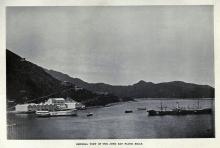
I cleaned up and zoomed in on this old photo of Rennie's Mill.
A few things of interest here are the two large villas on the hillside. Was one of these Rennie's house?
The other is Ma Wu Shan tower which was a Qing dynasty lookout for the China Customs Station on Fat Tong Chau/Junk Island. A beacon would have been lit at night, or smoke during the day, to send signals to the customs station.
Marker
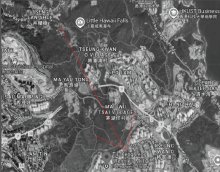
The marker should be moved a bit to the east where today’s Choi Ming Court is located. Compared to 2011 when the place was created, we have better maps today.
Rennies Mill
This is an article published in the Twentieth century impressions of Hong-kong, Shanghai, and other Treaty Ports of China : Wright, Arnold.
The publishing date is 1908, therefore the article was likely written in 1907 which was before the company's troubles.
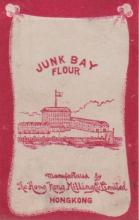
THE JUNK BAY FLOUR MILLS.
One of the largest and most important industries, not only in Hongkong but throughout the East, is that carried on at the Junk Bay Flour Mills by the Hongkong Milling Company, under the management of Messrs. A. H. Rennie & Co. The story of the establishment of the mills is an interesting chapter in the development of the Colony. The scheme had its origin in the mind of Mr. A. H. Rennie, who, as agent for an important American milling company, was for many years the leading man in the flour business in the East. Grasping the fact that, with the spread of Western ideas in China, the demand for flour must increase tremendously, Mr. Rennie perceived the immense possibilities underlying the establishment of such a concern in the Colony. The necessary capital ($ 1 ,000.000) was privately subscribed, several of the most prominent business men in Hongkong, including Sir Paul Chafer, K.C.M.G., and Mr. H. N. Mody, taking a large share in the venture. With untiring energy Mr. Rennie personally superintended every detail of the erection of the magnificent pile of buildings and the installation of the intricate and scientific plant, which make up the mills to-day. Many ingenious devices in the equipment of the mills for the saving of time and labour bear striking testimony to the fertility of Mr. Rennie's invention.
The Company having acquired some 435 acres of land on the shores of Junk Bay, with a sea frontage of 2½ miles, Mr. Rennie turned the first sod in May 1905, and the work was pushed forward with such rapidity, in the face of many difficulties, that in January 1907, the mills were ready for formal opening by the Hon. Mr. F. H. May, C.M.G., at that time the officer administering the government. The magnitude of the enterprise is clearly shown by the fact that the mills are capable of producing 8,000 bags of the highest-grade flour every twenty-four hours, which means that about 6,000 tons of wheat pass through its machines every month. This entitles them to rank with the largest flour mills in the world. The godowns are substantially built of brick, with steel stanchions and principals and iron roofs, and have a storage capacity of about 26,000 tons of wheat, 250,000 bags of flour, and 10,000 bags of bran. Elaborate apparatus has been installed to facilitate the handling of wheat and flour, and very particular attention has been given to ventilation. The mill is a five-storey building, and the machinery is of the most approved and modern roller plant, with complete washing apparatus and electric bleachers. The motive power consists of two 250 horse-power and one 150 horse-power Diesel engines. Electric light is used throughout, and special precautions have been taken against fire, the buildings being shut off from each other by fire-proof doors, while an abundant supply of water at about double the pressure of that in the Hongkong mains is procured from the Company's own reservoir situated about 2½ miles away.
Both in the godowns and in the actual milling processes the utmost cleanliness is insisted upon, and the result is shown in the excellent quality and colour of the flour produced, which is in great demand not only in China but also in Japan, Indochina, the Straits, Burmah, and India.
The mills run throughout the whole twenty-four hours, except on Sundays. As Mr. Rennie appreciates to the full the wisdom of looking properly after good servants, every possible consideration is given to the employees, who are housed in bungalows on the hill side and on the hulk Maple Leaf, formerly a sailing ship, moored off the mill, which is electrically lighted and supplied with fresh water from the shore. Strict precautions are taken to ensure healthful conditions on board, and there has been practically no sickness among the employees, who number about 125, since the mills started.
The Company does not confine its attention to flour, for a plant is in course of erection which will produce 24 tons of the best quality clear ice every twenty-four hours, and the establishment of a brewery and aerated water factory is also under consideration.
The mills are a valuable addition to the assets of the Colony, for they could at any time, if necessary, supply the entire population, including naval and military forces, with food for a period of at least four months
Here's a photo from the…
Here's a photo from the publication mentioned above: