For years, I have stumbled across pages describing the lives of soldiers and the activities of their units across Hong Kong, but the pages especially concerning physical remnants they left behind across the territory have caught my attention more than once, so I thought I would make a post compiling as many of these ‘marks’ they left behind.
There are many posts about the barracks, camps, training exercises, military ruins that the British army troops used or did here in Hong Kong, so this post is mostly concerning the more ‘symbolic’ elements of their legacy as garrison troops for the empire.
Cap Badge Hill
In its prime, this Sheung Shui hill in the backdrop of Gallipoli Lines/San Wai Camp bears striking resemblance to the green hills of Fovant, England, the desert landscape of former garrison town Gebeit, Sudan, and Cherat, Murree and the Khyber pass, where British/Commonwealth army units used white rocks or chalk to carve out their regimental emblems for posterity, many of which survive to today.
As garrison battalions in Hong Kong, soldiers followed this tradition, creating their unit emblems as means to pass time and enshrine their legacy for others appreciative of the military presence. The following regiments known to have made their mark on Cap Badge Hill will be described in more detail in this article: The Middlesex Regiment, the Argyll and Sutherland Highlanders, The Royal Hong Kong Regiment (The Volunteers), the Royal Lincolnshire Regiment & the Queen’s West Surreys. More have existed on the hill in the past, but either me being lazy or insufficient documentation have precluded me from diving further into them.
Sources:
https://www.hows.org.uk/personal/hillfigs/foreign/sahk/hk.htm

(The hillside badges in 1979 alongside their inspirations, credit to Watershed HK)

(Cap Badge Hill unknown date, the description reads: “There were at least 6 badges, left to right 1 - Somerset Light Infantry, 2 - Kings Own Scottish Borderers or the Cambridgeshire regiment, 3 - Unknown, 4 - Queens Surrey Regiment or 22nd or 24th County of London regiment, 5 - Royal Engineers, 7th City of London Regiment or Lothians and Border Horse Yeomanry Royal Armoured Corps, 6 - Royal Lincolnshire Regiment.” taken from https://www.hows.org.uk/personal/hillfigs/foreign/sahk/hk.htm)

(San Wai Camp and Cap Badge Hill in 1936, showing the addition of another badge. Gwulo post from moddsey https://gwulo.com/media/15506)
Click here to view a 1982 aerial colourised view of the four visible badges https://hkmaps.hk/?c=114.15216,22.51406&z=19&l=d510d9164b824d2993abce5857ac3c38
Middlesex Regiment (Duke of Cambridge’s Own)
Both the 1st and 2nd battalions of the Middlesex Regiment spent considerable time in Hong Kong, taking postings in 1917-18, 1937-41, 1949-50 and 1951-52. The Middlesex were also heavily involved in the Battle of Hong Kong in December 1941, and suffered in POW camps during Japanese occupation. In 1952 before final departure from the colony,
“each Company has been given a special C.O.’s task: “ A ” Company, the making of a Regimental crest on Cap Badge Hill.
[...]
The Regimental badge which will take its place on the hill overlooking San Wai Camp was designed by Pte. Pragnell of Support Company. Alongside it are those of the Argylls and 27 Infantry Brigade, while below is the crest of the Lincolns. Cap Badge Hill, though not high, has a practically vertical gradient and provides an excellent test for our hill climbing muscles.
The badge is being fashioned from rock which has first to be fragmented by L/Cpl. Galvin of the Assault Pioneer Platoon, who delights in filling the valleys with the noise of his explosions. The fragments are then placed in a shallow trench which has been cut out in the form of the badge, bound together with cement and kept in position with small pickets and finally painted white. We hope, when it is finished, to persuade the Air Force to take a photograph of the hill.” (Pages 237 & 238, December 1952 issue of The Die Hards, The Journal of the Middlesex Regiment, taken from David’s post on gwulo https://gwulo.com/node/51481)

(Argyll’s badge to the left, Middlesex to the right. Credit to RHQ Argylls. https://argylls1945to1971.co.uk/AandSH_HongKong1951to52.htm)

(The faint remains of the Middlesex Badge after a presumed forest fire in the late 2010s, credit to Watershed HK https://www.facebook.com/photo/?fbid=574510552883717&set=a.273181766349…)
Argyll and Sutherland Highlanders (Princess Louise’s)
The Argyll and Sutherland Highlanders were stationed in Hong Kong in 1931, as well as 1949 to 1950, where they did a stint in the Korean War afterwards, and once again back from 1951 to 1952. The 2nd Battalion carved the crest, and it was reported to be still in full glory when the 1st battalion did their post-war tour and were accommodated next to the former barracks of 2 bat (Lo Wu).

(Credit to RHQ Argylls https://argylls1945to1971.co.uk/HongKong1951-15.jpg)


(Article describing the Argyll badge alongside the abandoned attempts of 7 gurkha Rifles to create their own. Credit to Michael Yiu & David Allison, Facebook post https://www.facebook.com/groups/dresshk/permalink/1617286536125177/)
The Argylls were back in Hong Kong in 1979 on an emergency tour, where the jocks did a clean-up of the sporran badge.


(1979 pictures of the badges, Facebook post by Michael Yiu https://www.facebook.com/groups/dresshk/permalink/1427151635138669/)
Sources:
https://argylls1945to1971.co.uk/AandSH_HongKong1949to50.htm
Royal Lincolnshire Regiment
The Lincolnshires were Hong Kong’s resident battalion from 1932 to 1936, during this time they etched their distinctive sphinx onto the hillslopes. This emblem is known to have survived at least up until the late 1970s.

(Inter-war picture of soldiers at Gallipoli Lines, with the faded Lincolnshire badge behind. Credit to George Best, taken from Facebook post in HK in the Colonial era group https://www.facebook.com/groups/ColonialHongKong/permalink/33676498948661347/)

(National servicemen in Hong Kong for a group picture, with the Lincolnshire sphinx behind. Screenshot taken from https://www.reddit.com/r/wherewasthistaken/comments/1ounu2u/my_grandfathers_national_service_photos_i_know_he/)

(Interwar photo of four badges, including the Lincolnshires and the Queen’s West Surreys. Screenshot taken from sherlogica’s reply to https://www.reddit.com/r/wherewasthistaken/comments/1ounu2u/my_grandfathers_national_service_photos_i_know_he/)
Click here to see a 1963 view of the Lincolnshire badge and other hillside crests https://hkmaps.hk/?c=114.15221,22.51408&z=19&l=53414a31b8314998b03bd167b3b1b794
Queen’s Royal Regiment (West Surrey)
The Queen’s West Surreys were in Hong Kong 1927-28, during which time they added their emblem on the slopes of Cap Badge hill. The photos suggest that they were one of the first regiments, if not the first, to partake in this tradition in the New Territories. Klaus’ post on gwulo, taken from the regimental website which has trouble accessing, states: “.....This training took place in Sun Wai Camp in the north of the New Territories, and in the surrounding hills a very large Paschal Lamb cap badge was painted. Unfortunately this did not survive the Japanese Occupation from 1941 to 1945.”

(San Wai Camp and the badge in 1927. Credit to coastyHK, taken from gwulo post https://gwulo.com/media/49191)
Sources:
https://www.queensroyalsurreys.org.uk/1661to1966/hongkong_china/queens-…
Royal Hong Kong Regiment (The Volunteers)
The only visible crest on the hillside today, the Volunteers badge was created by members of the regiment in late August 1995 under Major Chan Ho Yim, who used concrete and paint rather than the traditional chalk/white rocks of badges prior, presumably for longevity and ease of maintenance. It was completed a day prior to the disbandment parade of the regiment. It continues to be maintained by the regimental association, and people down in the valley can have a good look in the distance.

(The badge in 1995 in the vicinity of the deteriorating Argylls and Middlesex badges. Credit to Michael Yiu & David Allison, Facebook post https://www.facebook.com/groups/dresshk/permalink/1617286536125177/)

(The badge in full glory 2025, Facebook post by Wan Cheung Kwai https://www.facebook.com/photo/?fbid=10233319956915483&set=gm.101629177…)
This CoastyExplores video explores the badge
https://www.youtube.com/watch?v=2GNCoYakiGo&list=LL&index=54
Sources:
https://www.facebook.com/groups/rhkrthevolunteers/posts/101629177037576…
Crest Hill
Scots Guards
Arguably one of the more well known cap badge markings in Hong Kong, the 2nd Battalion Scots Guards created their chalk badge on the Southward facing slopes of Lo Wu/Crest Hill in 1927, during their two year stay in Hong Kong. Repainted in the 1970s (credit to Raedz59) by guardsmen, it has since once again fallen into disrepair, however, forest fires in the 2020s once again made it visible to hikers, sparking a minor hiking craze amongst Hong Kong’s hiking groups.

Credit to moddsey https://gwulo.com/media/29087

(Scots Guards officers and NCO on the refurbished badge in the 1970s. Credit to IWM Museums, taken from Gigi Rita GiGi’s post https://www.facebook.com/groups/dresshk/permalink/1619729689214195/)

(2014 view from hikers of the decayed emblem, taken from blog post by no-body https://www.arrse.co.uk/community/threads/scots-guards-mystery-hill-art.210794/)

(Before and after photos of the Scots Guard badge, Facebook post by Francis Lee https://www.facebook.com/groups/308617469269780/permalink/2750245041773665/)
These nice YouTube videos here shows drone footage of the badge.
https://www.youtube.com/watch?v=_40FbGvFMg0&list=LL&index=67
https://www.youtube.com/watch?v=OMFSRIT08zo&list=LL&index=68
Click here to view a 1982 colourised aerial of the badge:
Sources:
https://catthui.blogspot.com/2014/05/45.html
https://www.hkhikers.com/Tai%20Shek%20Mo%202014.htm
https://www.facebook.com/groups/dresshk/permalink/1416917862828713/
Rifles
One of the more mysterious crests in Hong Kong, this badge exists on the Western slopes of Crest Hill, presumably made in 1939, where only the Royal Scots, Middlesex, or Seaforths were stationed in Hong Kong, none of which had rifle regimental traditions. The text below the bugle spells ___ BATTALION RIFLES. My belief is that a tossup of one of the many territorial/reserve army units, the Duke of Cornwall’s Light Infantry, or the Cameronians (Scottish Rifles) created the badge, but all of these are far fetched.

(Unknown Rifles crest in 2001-2, the distinct rifles bugle, regimental inscription, marker stone, and a range safety sign for Lo Wu shooting range can be seen.
Credit to samalbahaykubo, taken from blog post https://envirohk.wordpress.com/2012/08/15/ho-sheung-heung-hill-art/)

(Marker stone with inscription ‘MADE DURING THE COMMAND OF LIEUT COLONEL J MOFFATT OBE DEC. 1939’, this stone can be faintly seen in the above photo just atop the crown. Credit to hkhikers, blog post https://www.hkhikers.com/Tai%20Shek%20Mo%202015.htm)

(The Rifles bugle badge in a 1982 aerial, screenshot taken from hkmaps.hk)
Click here to view a 1948 aerial of the badge, look to the whiter rock on the center left of the view. I believe the East Surreys badge can be seen too https://hkmaps.hk/?c=114.1062,22.51593&z=21&l=d510d9164b824d2993abce5857ac3c38,fc740e5486df4e49829cc6748c10193d&lang=zh
Sources:
https://envirohk.wordpress.com/2012/08/15/ho-sheung-heung-hill-art/
https://www.hkhikers.com/Tai%20Shek%20Mo%202015.htm
Royal Regiment of Wales
The Royal Regiment of Wales, a result of the amalgamation of the South Wales Borderers and the Welch Regiment (both of which spent stints in Hong Kong), was Hong Kong’s resident garrison battalion from 1990 to 1992, being one of the last British infantry units to take post in the colony. A major deployment undertaken was Op Culex, aimed at “stemming the tide of illegal immigrants” (Credit to Torfaen Corvine on Flickr https://www.flickr.com/photos/16498755@N07/41747035614/), where RRW members were stationed at Lo Wu camp, along with Yung Shue Au camp which will be discussed later. This allowed them to restore their regimental emblem on Crest Hill built a decade prior during a six-month emergency tour, as seen in the news clipping below.

(Credit to Benben Bentam, taken from Facebook post https://www.facebook.com/groups/dresshk/permalink/1598415578012273/)
Click here to view a 1982 aerial colourised view of the RRW Badge, alongside the remains of the Rifles badge https://hkmaps.hk/?c=114.1062,22.51593&z=21&l=d510d9164b824d2993abce5857ac3c38,fc740e5486df4e49829cc6748c10193d&lang=zh
Sources:
East Surrey Regiment
The East Surrey regiment was Hong Kong’s resident British infantry battalion from 1923 to 1926. One place they camped and exercised around was Lo Wu/Crest Hill. The regimental journal mentions that in February 1925, he was able to identify the East Surrey encampment through a “large Regimental badge made of whitewashed stones laid by pioneers and measuring 40 feet from top to bottom”.

(Lo Wu Camp 1925, Credit to coastyHK, gwulo post https://gwulo.com/media/49192)

(Lo Wu Camp in 1910s, (a decade which would make little sense with the timetable of overseas deployments) Credit to Watershed HK, facebook post https://www.facebook.com/photo/?fbid=273182003016575&set=a.273181766349…)
(The Rifles and East Surrey Badges, screenshot taken from hkmaps.hk)
Source:
https://www.queensroyalsurreys.org.uk/1661to1966/hongkong_china/two-weeks-in-lo-wu.html
https://www.queensroyalsurreys.org.uk/1661to1966/hongkong_china/surreys…
Fanling Commando Badge
I was only able to find mention of this carving in two websites. The Royal Marines museum details that it was cut in 1946 by 44 Royal Marine Commando, refurbished by 42 RM Commando, and has since fallen into obscurity.
Si Biggs’ blog post mentions that ‘Early in 1946 Royal Marines cut their cap badge the Globe and Laurel in a 2ft deep outline 80ft by 54ft on the hill side at Fanling, facing the Chinese border with Hong Kong.’
After some research and map scrolling, I found out that the badge was erected on Stables Hill/Wu Tip Shan, very close to Tsing Kei Hang/Volunteer Slopes, where the Police Tactical Unit (PTU) is based.

(Credit to George Best, taken from Facebook post in HK in the Colonial era group https://www.facebook.com/groups/ColonialHongKong/permalink/336764989486…)

(Stables Hill/Wu Tip Shan with the RM crest just below the center, screenshot taken from hkmaps.hk)
Click here to view the same aerial on the HK Maps website https://hkmaps.hk/?c=114.13678,22.49011&z=17&l=265c3bac037240f19a14f77d021cd9ad
Sources:
https://www.royalmarineshistory.com/post/re-occupation-of-hong-kong
https://gallery.commandoveterans.org/cdoGallery/v/units/Royal+Marine+Co…

Yung Shue Au
Yung Shue Au is a centuries-old Hakka village on the Northeast extremity of Hong Kong, which is now deserted, but a strong village association aimed at conservation and heritage is present. Being on the edge of Starling Inlet and the entrance to Mirs Bay, heavy illegal immigrant activity was present for decades, leading the British to establish a small camp manned by British troops as a staging point for patrols. Chestnut Journal mentions British presence in the early to mid 1980s, with up to 60 soldiers being present before a 1985 departure (https://chestnutjournal.com/2020/the-abandoned-village-of-yung-shue-au/).
Hidden behind the government pier lies a painting presumably done by a jock belonging to the Queen’s Own Highlanders (Seaforth and Camerons) regiment, stationed in the vicinity of the village on Illegal Immigrant patrol duties. They were in Hong Kong from 1980 to 1981. It is also interesting to note that the painting was done covering a painting from the Royal Regiment of Wales, the unit preceding QO HLDRS in Yung Shue Au camp.

(QO HLDRS painting in 2014, showing the regimental badge, along with the map and flag of |Scotland. Credit to Happy Valley, taken from gwulo post https://gwulo.com/media/16509)

(Powerpoint slide about the painting. Screen shot taken from https://cco.gov.hk/documents/projects/27-re-telling-the-yung-shue-au-story-co-creating-rural-place-with-experimental-communal-hub-and-eco-cultural-trail/ect-project-story-_eng.pdf)

(Heritage plaque describing the QO HLDRS painting, taken from https://www.daydreamer.hk/en/hiking/hiking-022-lai-chi-wo-and-so-lo-pun/attachment/hiking-022-waypoint-55-06/)

(Heritage plaque detailing the overall military history of the village, taken from https://www.daydreamer.hk/en/hiking/hiking-014-cheung-pai-tau-sky-pool/)
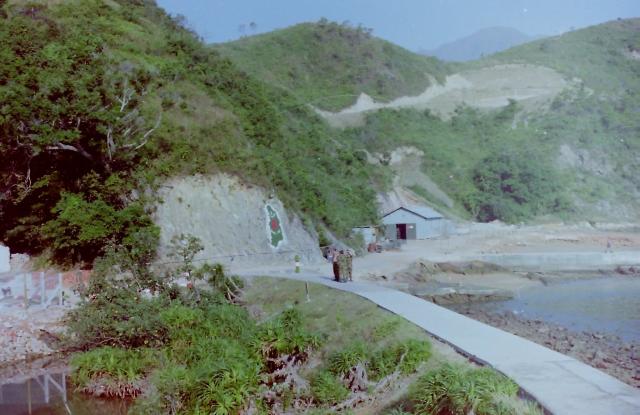


(Various views of the first painting, inscriptions saying “D COY 1 RRW”, followed by “CROESO Y TOLO”, with a Welsh dragon painted in the backdrop of the outline on Wales. Credit to Stewart Milner, Facebook post on Old Hong Kong group https://www.facebook.com/groups/1639311162816368/permalink/25786117374375743/)

(Yung Shue Au camp under RRW occupation. Credit to Chan Tse Leung, Facebook post on Royal Hong Kong Regiment RHKR(V) group https://www.facebook.com/groups/rhkrthevolunteers/permalink/10158740221822652/)
Sources:
https://spur.cuhk.edu.hk/research-project/re-telling-the-yung-shue-au-story/
Notable Mentions
Tyndareus Stone
Formerly near the intersection of Hatton & Harlech roads up on the peak, the stone encompasses yet another legacy of the Middlesex Regiment, the stone carving of “25th Battn Middlesex Regt. “Tyndareus” Feb 6th 1917” is a legacy of the saga when their HK bound troopship, the SS Tyndareus, struck a naval mine laid by raider SMS Wolf off South Africa. None were killed and the soldiers conducted themselves gallantly. The rock is mentioned in Martin Booth’s Gweilo, being a part of his childhood adventures around HK Island. It was extant until 1993, when the Queen’s Gurkha Engineers controversially removed it to the United Kingdom, where it is on display in the National Army Museum of London.

(The Tyndareus Stone, with the Antiquities & Monuments Board plaque still attached. Credit to George Boote https://gwulo.com/media/32729)
A link to a 2009 SCMP article about the stone and the fight to bring it home: https://www.scmp.com/article/674974/fight-citys-own-stolen-relic
Source:
Martin Booth’s ‘Gweilo’, 2004
Royal Warwickshire Regiment stone
All the way in the remote countryside of Lamma island, a stone inscribed with “3 PLATOON A COY 1.R.WARWICK SEPT 1961” sits next to a footpath between the villages of Mo Tat Wan & Tung O.

(R Warwickshire stone in Lamma, credit to Happy Valley https://gwulo.com/media/16506)
There is a photo of an additional larger stone carved by Warwickshire soldiers, but its present location and status is a mystery.

(Larger stone, credit to T Pratt, gwulo post https://gwulo.com/node/42450)
Sources:
Hiram’s Highway
Hiram’s Highway is one of the major connections between the town of Sai Kung and the roads leading to Kowloon, Tseung Kwun O, and beyond. The road was formerly a jeep track built on existing village pathways postwar, and later developed into the highway it is today. A large stone marker commemorates the building of the highway, inscribed “HIRAMS HIGHWAY OPENED BY H E MAJOR GENERAL F W FESTING (numerous orders and commendations) GOC HONG KONG 1945”. The interesting story of how the highway came to be named can be read in further detail here: https://gwulo.com/hirams-highway

(Inspector Chris Wynne-Potts of the RHKP with the marker, credit to HK Bill and Colin Aitchison https://gwulo.com/media/25147)
Source:
Jat’s Incline
Jat’s Incline is a road between Kowloon & the New Territories scaling Kowloon Peak/Fei Ngo Shan. The marker stone at the base of the road near the intersection with Clearwater Bay Road, explains that the road was constructed in 1907 by 2/9 Jat Regiment, and later repaired in 1932 by 3/9 Jat Regiment, both British Indian army units. The sides are inscribed with ‘CUSTOM’S PASS’ and ‘(TATE’S) CAIRN’, the English names of the mountains and passes nearby.

(Marker stone, credit to moddsey https://gwulo.com/media/14581)
Source:
Conclusion
I hope this helped pique at least someone’s curiosity, I just wanted to try to make a big compilation of all the separate pages discussing places like Crest Hill or Jat’s Incline where the British military had a role to play. This is my first gwulo forum post so hopefully its alright. I know that somewhere in the New Territories, there exists a marker for a serviceman who died in a road accident, along with a separate road marker crediting the Gurkhas or Royal Engineers for constructing said road. If someone knows anything about those, or anything else related to this post’s topic for that matter, especially the regimental identity of some of the other badges, I would love to hear about it!