[Updated 22/01/2025]
In the early 20th century Cheung Chau was found to be the perfect setting for a holiday home for missionaries serving in China and other Europeans, avoiding the expense of returning to the homeland for a summer holiday each year. Cheung Chau properties offered all the advantages of the Peak at a fraction of the cost, and in 1908-10 cheap plots and labour saw a flurry of building on the island.
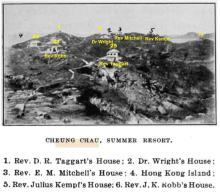
House #5 may have gone up at this time, as it can be seen in a Mission photo of 1911. Solidly built of local granite, it had a pitched tiled roof, with the stone walls at the gable ends raised above the level of the tiles as a protection against the typhoon season. In the same way, fascias protected the tiles along their drip edge.
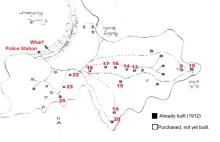
The house was south-facing, and at the rear it had an annex for domestic staff. Situated in splendid isolation on top of a hill in the NE part of the European Reservation, it had terrific views all round.
In 1925 a verandah was added on its south side (see post below). At some point it was extended to show three windows at the side instead of two.
In 1938 the owner of House #5 was recorded as T W Pearse (London Mission), which may have been Thomas William Pearce, (different spelling), who served in China and Hong Kong for the London Missionary Society at that time.
House #5 may well have suffered during the war what other European houses suffered, ie being stripped by the locals of all wood for fuel, and then blown up by the Japanese as being western-owned.
By 1963 it was marked as a ruin on the survey done that year.
The site is now the home of the Caritas Jockey Club Ming Fai Camp, a charity whose aim is to offer campers (youths, adults, families) activities that support their physical, mental, and social well-being.
Source:
Photos that show this Place
Comments
European House #5 Improvements
"Considerable levelling and embanking has been carried at No.5; the workmen are busy putting up a verandah on the south front." China Mail 20 June 1925 refers.