HKU Recruit

lausanching
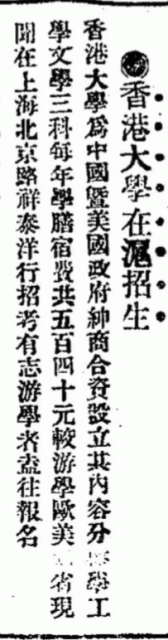
The provided clipping is an early historical newspaper reporting on the advertisement detailing student recruitment for the University of Hong Kong (HKU) in the same day of Sen Poa. The editor mistaken British as American.
The text reflects fascinating early 20th-century geopolitical narratives and historical marketing strategies aimed at mainland Chinese elites.
 
📰 Full Transcription of the Text
 
「香港大學在滬招生」
「香港大學為中國暨美國政府紳商合資設立,其內容分醫學、工學、文學三科。每年學膳宿費共五百四十元,較游學歐美為省。現開在上海北京路祥泰洋行招考,有志游學者盍往報名。」
 
The Fascinating Geopolitical "Error": Why Mention the US Government?
The most striking element of this ad is the claim that "the University of Hong Kong was jointly established by the Chinese and US governments, gentry, and merchants".
Historically, this is factually incorrect. HKU was incorporated in 1911 as a British colonial institution, heavily funded by the British government, Hong Kong merchants (like Sir Hormusjee Mody), and the Governor of Guangdong, Cheung Pak-fai.
  1. The Budget Angle: The ad explicitly leverages this by stating that at 540 Chinese Silver Dollars per year (including tuition, room, and board), studying at HKU provides an elite Westernized education that is "much more affordable than traveling to Europe or America".


*Might be that is why the editor make the mistake.*

 
🏢 The Recruitment Hub: "Xiangtai Yanghang" (祥泰洋行)
The examinations and registrations were held at Xiangtai Yanghang located on Beijing Road, Shanghai.
  • Known in English as Gilman & Co. (or closely associated with the massive timber/merchant firm China Import & Export Lumber Co.), this prominent Western trading firm acted as HKU's official corporate registrar in Shanghai.
  • Because HKU did not yet have a physical campus or administrative office in mainland China, it utilized established British trading networks (Yanghangs) to distribute entry exams, interview candidates, and collect tuition deposits from wealthy families.
Date picture taken
20 May 1914

Comments

Submitted by
lausanching
on
Wed, 09/02/2026 - 11:12
In 1915, the University of Hong Kong (HKU) matriculated exactly 10 students who were recruited from and sponsored by the Peking (Beiyang) Government. [1]
This small, highly elite cohort was part of a broader, fascinating geopolitical arrangement between the British colonial government and the newly formed Republic of China:
 
🎓 The 1915 Peking Cohort
  • The Sponsoring Body: Unlike students from Hong Kong or Shanghai who paid their own way (via merchant agencies like the one in your advertisement), this group was personally selected and funded via government scholarships issued by the Ministry of Education in Peking.
  • The Elite Pipeline: Because the Beiyang Government wanted western-trained engineers and administrators to modernize China's national infrastructure, they sent top graduates from northern preparatory academies down to Hong Kong.
  • Total Campus Size: To put this number into perspective, HKU opened in 1912 with only 71 to 72 total male students. By 1915, the entire student body was still under 200 students. Therefore, a group of 10 students from Peking represented a very substantial and visible provincial contingent on campus. [1, 2]
Life at HKU: The "Peking Student" Identity
According to historical memoirs from early alumni—such as the famous Chinese aesthetician Zhu Guangqian (朱光潛), who arrived shortly after this cohort—the students sent by the Peking Government formed a distinct, tightly-knit micro-community: [1]
  • Housing: They primarily resided together in May Hall (梅堂), which newly opened in 1915.
  • The Cultural Contrast: These northern students stood out prominently on campus. They spoke Mandarin in a predominantly Cantonese-speaking colony, wore traditional northern scholars' robes, and spent their afternoons hiking up the trails of Victoria Peak to look down at the South China Sea, acclimating to a completely foreign colonial environment. [1, 2]