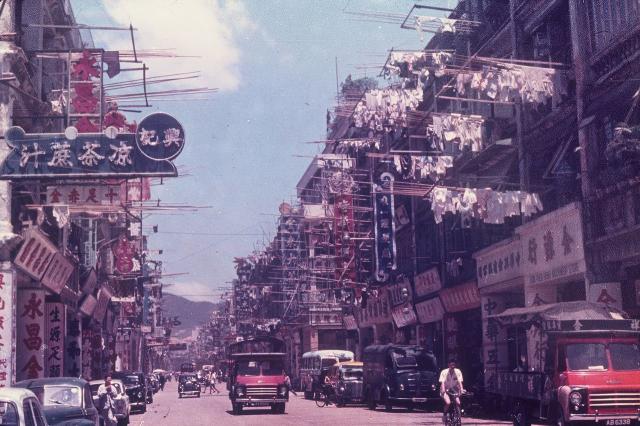
Don't recognise any "place" in this photo and can't date it accurately.
Please see https://gwulo.com/node/62741 for full details.
Date picture taken
unknown
Shows place(s)
Don't recognise any "place" in this photo and can't date it accurately.
Please see https://gwulo.com/node/62741 for full details.
Comments
Re: flipped
Hi there,
Based on the business signs, this photo had been flipped.
T
Thanks Tom
All these slides came back horizontally flipped when they were scanned! I've since put them back the correct way, but this one automatically flips back again when uploaded. Tried again, but same problem. Working on it. Thanks again.
Re: Shanghai Street
Hi There,
After flipping the photo and blowing it up, I spotted the following business signs and quite a few others:
永昌金舖 (Wing Cheong Gold Merchant)
興記涼茶蔗汁 (Hing Kee Herbal Tea Sugar Cane Juice)
雲來大荼樓 (Wan Loi Restantant). Coloured blue, right in the middle of the photo, behind the scaffoldings.
Wan Loi was at the Junction of Shanghai Street & Soy Street till 1982, thus confirmed it was Shanghai Street.
T
I've flipped the photo.
I've flipped the photo.
Before 1965
Some findings after a quick search in the directories of the Hong Kong Year Books published by Wah Kiu Yat Po:
Kam Yuen Hong (金源行): The hardware store on bottom right, located at 468 Shanghai Street, has been listed in directories since the 1st issue in 1948. It was moved to 441-443 Reclamation Street in 1965 and has been in business ever since.
Wing Cheong Gold Merchant: Located at 473 Shanghai Street, it was listed from 1948 to 1971.
Kee Wah Bakery (奇華餅家): Located at 480 Shanghai Street (marked by the vertical red sign on the right). It was the bakery's first branch and was listed from 1948 to 1970.
Wan Loy Teahouse was closed in 1992. The opening scenes for John Woo's movie "Hard Boiled" (辣手神探), which was released that same year, were shot there shortly before its was demolished.
Btw, the red lorries featured a cab design similar to the Austin LD van (also sold as Morris LD) that was first launched in 1954. That design was commonly used for Hong Kong ambulances in the 1960s.