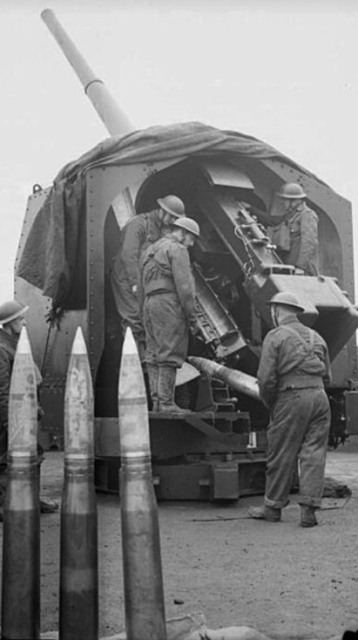
The British 4.5 inch anti-aircraft gun was a World War II medium-calibre weapon adapted directly from the Royal Navy's QF 4.5-inch Mk I – V naval gun and manufactured by Vickers-Armstrongs.
Approved for land service in 1938, it was deployed to defend domestic target areas and naval bases before being largely replaced by 1944–1945.
Technical Specifications
•Manufacturer: Vickers-Armstrongs (Crayford, Kent)
•Bore Length: 45 calibres
•Propelling Charge: ~14 lb of cordite
•Effective Ceiling: 34,500 ft
•Maximum Horizontal Range: 22,800 yd
•Ammunition Types: High explosive, semi-armour-piercing, shrapnel
Operational History
•Adoption: Chosen for the British Army because a planned 4.7-inch land gun faced production delays, and sharing a naval caliber ensured secure ammunition logistics near coastal installations. [1]
•Service Roles: Employed in static land defense batteries (such as during the Blitz) and dual roles for coastal defense. [1, 2]
•Retirement: Phased out of frontline use by 1944–1945 in favor of larger systems like the 5.25-inch gun, and formally declared obsolete in 1951
source - wiki