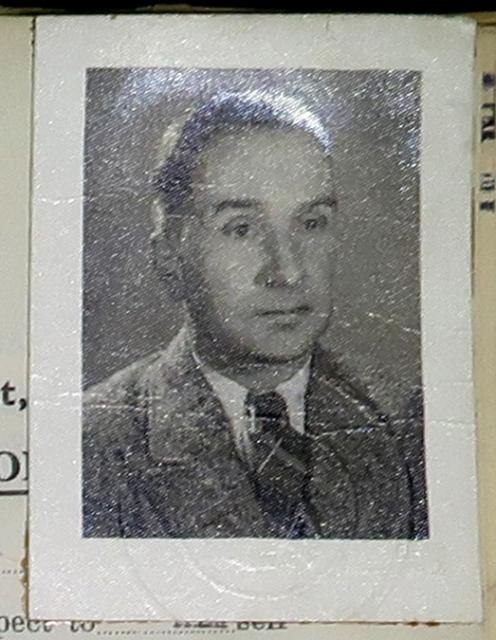
This photo is attached to his Naturalisation Certificate, held at the UK National Archive, their ref: HO 334/256/3890
Date picture taken
1947
Shows person / people
Shows organisation(s)
This photo is attached to his Naturalisation Certificate, held at the UK National Archive, their ref: HO 334/256/3890
Comments
White Russians (Belarus) in Hong Kong
Before and after World War II, a large number of "White Russians" (Belarus) who fled the Soviet Union ended up in China, and after the change of regime in China in 1949, they flooded into Hong Kong.
These stateless refugees brought the famous borscht to Hong Kong, where they worked as police officers, dancers, and construction workers, and with the assistance of the United Nations, gradually emigrated to Europe and America.
Background as a Refuge
After the October Revolution in Russia, over a million Russians loyal to the Tsar or opposed to the Bolshevik regime went into exile. Hundreds of thousands of them settled in Northeast China (such as Harbin) and Shanghai. With the outbreak of World War II and the turmoil in China, they were forced to flee again, and Hong Kong became an important safe haven and transit point for them.
Life in Hong Kong
Since most of these Russian refugees were stateless, they faced many difficulties living in Hong Kong.
The British Hong Kong government even established a special "E" police officer number for them in 1930 to recruit them for anti-piracy duties.
Many worked as domestic helpers, musicians, dancers, and construction workers.
Post-war Resettlement
In the decades following World War II, approximately 20,000 Russian refugees passed through Hong Kong. Hong Kong served as a transit point for them on their way to third countries such as Australia, the United States, Brazil, and Canada.
By the early 1960s, under the arrangement of the United Nations High Commissioner for Refugees (UNHCR) and churches, most Belarusian refugees had left Hong Kong, and their community in Hong Kong gradually disappeared.
Cultural Imprints Left Behind
Although Belarusian refugees only stayed in Hong Kong briefly, they left a profound cultural impact.
Hong Kong-style Borscht: They brought traditional Russian borscht to Hong Kong, and after localization, it became the famous "red soup" (borscht) found in Hong Kong's tea restaurants today.
As the number of Russian converts increased, they established a church in Hong Kong as early as the 1930s. Today, walking through the Hong Kong Cemetery (Happy Valley), one can still find historical tombstones inscribed with Russian and Orthodox crosses.
Peter and Paul Church
Is there some missing text that links the Church to the Russian community in HK?
I'm just wondering if there is a mix up between this church and the synonymous Russian Orthodox one in Sheung Wan?
Thanks philk
Please refer to the following website w thanks !
https://orthodoxy.hk/parish/history_of_parish/
Catholic v Russian Orthodoxy
Hi, the website refers to the Russian Orthodox Church, now located on the 12/F at 32 Des Voeux Road West. The Church in Yuen Long is a Catholic Church and is not part of the Russian Orthodox parish even though it has a similar name.
Correct, please read the text
in the website, it explained the background of the Church in NT and the Church in Sheung Wan.
Website
I'm now confused as I only see mentions of the following locations. I can't find any mention of the NT at all:
Any mention of the church after the war and up to 1970 refers to the Church at 12 Essex Crescent. (1970 maps show the property marked as a church but not which denomination).
Dig deeper
The URL have 16 sighting of the word "Ss Peter and Paul "
It was a turbulent era, the Russian refugees came and went, narratives got lost somehow, very interesting indeed.
SS Peter and Paul
Indeed. Very interesting link. However, of the many mentions of SS Peter and Paul, none of them refer to the Catholic Church in Yuen Long. I think this is definitely a case of mistaken identity.
Dear philk, indeed you are correct !
Corrected w thx.
Orthodox Christians originally lived in Northeast China, later moving south to Shanghai, and then to Hong Kong to make a living. As the Russian expatriate population in Hong Kong increased, the missionary group in China sent a high priest to Hong Kong in 1934 to pastor them, while also overseeing ministries in Guangzhou, Macau, and Manila.
This priest was Dimitry Uspensky, who had served in Beijing for seven years. He obtained permission from St. Andrew's Church of the Anglican Church to hold worship services there, and later established a prayer house at No. 8 Middle Road, named "St. Peter and St. Paul's Church of Hong Kong."
After the Japanese invasion of China, another group of Russians came to Hong Kong. In the early 1940s, Father Dimitry planned to build a permanent church, but this was shelved due to the outbreak of the Pacific War.
After the war, Orthodox Christians moved their worship to
12 Essex Crescent, 12 Essex Cres, Kowloon Tong
At this time, the Russian missionary group in China was placed under the jurisdiction of the Moscow Patriarchate, but the Hong Kong expatriates were unwilling to align themselves with the Soviet Union, and many emigrated as a result.
Father Dimitri passed away in Hong Kong on January 17, 1970, just one day before his 84th birthday, and was buried in the Hong Kong Cemetery. The parish council decided not to seek financial assistance from the Moscow Patriarchate and to close the church in Hong Kong. The remaining funds were allocated for charitable purposes, and icons and religious items were shipped to Australia. The 36-year Orthodox Church in Hong Kong thus came to an end.
Ss. Peter and Paul Church in Hong Kong
This parish in Hong Kong is officially registered as the Orthodox Brotherhood of Apostles Saints Peter and Paul in 2004 to provide for the spiritual needs of Orthodox expatriates and local Chinese living and working in Hong Kong. The Brotherhood through the able leadership of its parish priest Fr Dionisy Pozdnyaev is dedicated to assist the revival of the Chinese Autonomous Orthodox Church. Through donations the Brotherhood is sponsoring many missionary activities including Chinese translation and publication of Orthodox books.
The original parish of Ss Peter & Paul was located at 12 Essex Crescent, Kowloon Tong, and eventually closed in 1972 shortly after the repose of its rector Fr Dmitry Uspensky in 1970, who faithfully served in Hong Kong since his arrival in 1933.
The Orthodox Brotherhood of Apostles Saints Peter and Paul (Moscow Patriarchate) finds new home in the Sheung Wan neighborhood on Hong Kong Island. The new facility on the seventh floor of Arion Commercial Centre can now accommodate the growth of both the parish community and the Centre of Russian Language.
https://orthodoxy.hk/