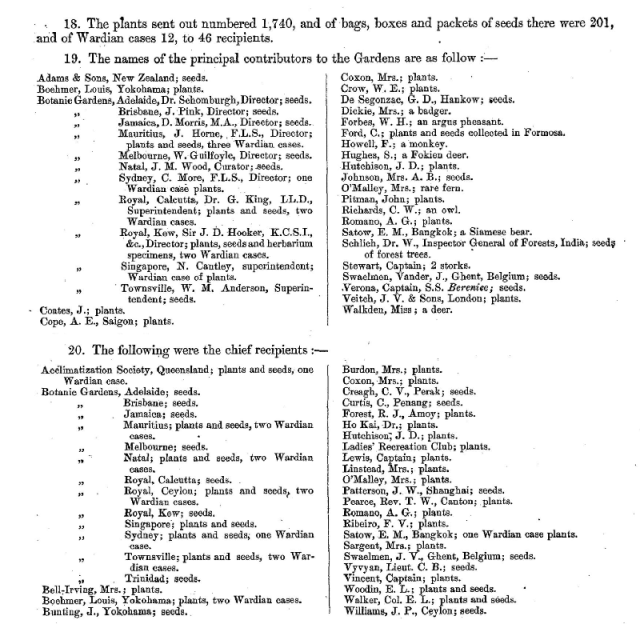
This is from the annual report of the Superintendent of the Botanical and Afforestation Department for 1884, published in Jan. 1885. 1
Botanical and Afforestation Department might begin from 1881 and it continued up to c.1904. 2
It was replaced by Botanical and Forestry Department, whose first report issued in 1906 for the year 1905.
As above, the connections of Botanical Gardens span five continents already :
Asia,
Australasia,
Europe (UK, Belgium),
Africa (Mauritius, Natal),
America (Caribbean - Jamaica, Trinidad) [+]
One specific communication is noteworthy. Hong Kong has connected with Penang from the earliest days of their botanical garden. 3
Curtis, C. on the 1884 report is in fact Charles Curtis, Assistant Superintendent of the then Forest Department of Penang. 4
The 'Waterfall Gardens' was designed and prepared by Curtis back in 1884. In time, this became the Penang Botanical Gardens. (link)
Wardian case is an interesting way for plants transport to me also. Refer here.
In the realm of botany, what a connected and communal world we have been even in the 19th century. And so peaceful.
[+] other countries :
e.g. in 1889, Guiana; USA (Royal Palm Nurseries; in Florida)
1. Sessional Papers, 1885
2. before that, 'Government Gardens, and Trees Planting Department' (1872) and Government Gardens and Plantations Department (from 1873) are mentioned on the reports.
Charles Ford had been the Superintendent of these since 1872, published its first annual report in Feb. 1873. (link) In it, it was suggested that
the Government Gardens was a fitting place for the establishment of a herbarium of dried plants, which became a reality in 1878.
3. Gov. Admin Reports, e.g. 1884, 1885, 1888
4. Gov. Gazette, 1886; Penang Heritage Trust Newsletter Issue 74, 2004
Comments
Waterfall Gardens, ongoing connection with HK - 1889 and beyond
Mr. Curtis appeared to receive a large shipment of plants from Botanical Gardens of Calcutta and Hong Kong in 1889, as New Strait Times retold in 2019. (link)
As no specific reference was quoted, this could not yet be substantiated with the Straits Gazettes, or papers otherwise.
In February 145 cuttings of seedling sugar canes were received from Mr. C. Curtis, F.L.S., Assistant Superintendent of Forests, Penang, and about one-half of
these were planted in the Sookunpó Nursery and the rest at Ha Ts'ün. Only 15 plants were obtained in all, as the whole of the cuttings put in at Ha Ts'ün failed.
Similarly of 318 cuttings received in July from Mr. E. A. B. Brown, Province Wellesley (+), only those planted at Sookunpó have done well, being as regards size a great
improvement on the ordinary Chinese cane. Cuttings from them. were taken in this spring so that by next winter there should be a sufficient quantity of mature canes to test their sugar producing qualities. [1]
... (note : obtained also from other countries)
The quantity of land under sugar cultivation in the New Territory is estimated at over 7,000 acres. (*)
(+) Province Wellesley is what currently the mainland portion of the state of Penang covers
(*) unsure if such a large area includes hillsides and slopes
source : Hong Kong Annual Administration Reports 1841-1941 (R.L. Jarman), Volume 2 p.320;
[1] this botanical and afforestation report is for 1900
HK Herbarium during WWII, 1940-1948
More actual details are on Singapore publications.
... The cases of plant specimens from Hong Kong were in Penang when the Japanese over-ran Malaya. [2]
During the occupation, Japanese botanists were persuaded to ship the Hong Kong herbarium to Singapore for safe keeping. The specimens were taken from their cases and incorporated with the Singapore specimens.
Now they are withdrawn from the Singapore herbarium. The specimens are ready for shipment to Hong Kong when a new herbarium building becomes available. [3]
And more details from the 1948 Singapore annual report.
The Hong Kong herbarium, which was sent to Penang for safe keeping in 1940, brought to Singapore by the Japanese ... was returned intact to Hong Kong in 1948.
... The building in which it had been housed in Hong Kong was destroyed during the war. [4]
It was recorded on HK Herbarium website that the specimens were temporarily put in Supper Room of the Government House when they were brought back.
notes and references
photos of the Hong Kong Herbarium in 1970s
Some photos are kept by the Public Library on MMIS.
This is an example photo of the Hong Kong Herbarium c.1975 (link).