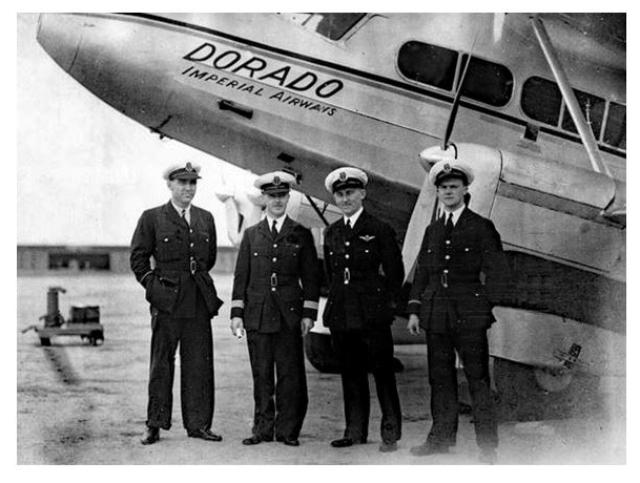
The earlier posting of the first Imperial Airways scheduled flight arriving at Kai Tak hides the fact that six months of survey flights preceded this event. https://gwulo.com/media/37300
Captain Armstrong and his crew (First officer N. Richardson, engineer D. Hands and wireless operator W. Chapman) left London’s Croydon airport on 16 September 1935 with a mission to explore territory by striking off the well-established Imperial Airways ‘Trunk’ route to Singapore. The aim being to reach Hong Kong and create a viable mail and passenger ‘branch-line’ service to the territory. Mail would be the primary cargo, passengers carried only if space was available.
The UK’s Air Ministry would have preferred an “All Red Route” variously explored by 1930s’ Royal Air Force flying boat ‘Cruises’ from Singapore to Hong Kong via territories in which the UK had well-established interests. Imperial Airways, however, preferred to explore shorter land plane routes through French Indo-China.
The DH86 crew set off from their Penang base heading for Saigon. Over the next few months, they tested the viability of airfields/aerodromes during everchanging weather while heading north. After which they had to tackle a long overwater route to an airfield at Fort Bayard in the French leased territory of Kwangchowan. From there it was simple case of following the coast for 300 miles to Hong Kong.
The government of China had barred all foreign aircraft from its airspace due to ongoing Japanese aggression.
Six months of route testing culminated in a viable route, although this later changed over time with experience. Interestingly, later research revealed that Shanghai appears on some Imperial Airways graphic maps as the route’s prospective terminus, and a Manila extension was mentioned in Hong Kong newsprint.
For a first-hand account of the exploratory flights see a chapter in the book “Pioneer Pilot” by Captain William Armstrong. Captain John Lock subsequently took over the scheduled flights.
In 1940, Japan’s aggressive incursion into Indo-China ultimately caused these Imperial Airways routes to be extinguished. A new route from Rangoon through north-east Burma to Kunming China was explored along with C.N.A.C. but was soon overtaken by events. Only C.N.A.C. used it.
Uniquely for a serviceable Imperial Airways aircraft, DH86 “Dorado” never returned to the UK after arriving in the Far East for the 1935 survey fights. Its service life ended in March 1943 while based in Egypt when requisitioned by the military for Air Ambulance duties.