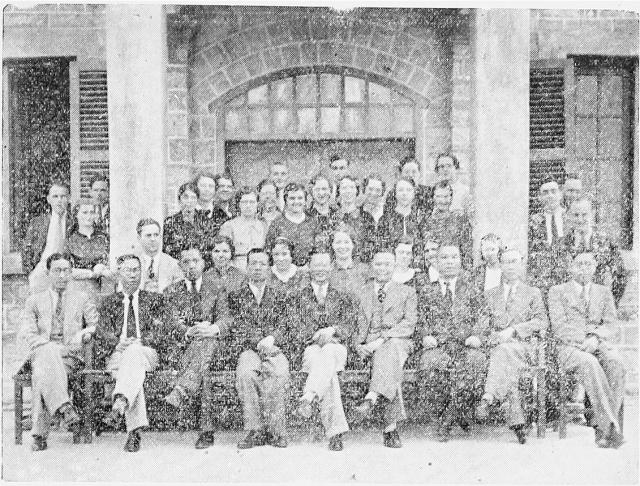
Do we have any names to go with faces in the picture above?
The Language School moved from Canton to the Cheung Chau Assembly Hall in 1937 when Japan invaded China and attacked Canton.
In the early years of missionary activity in China, missionaries learned the language wherever they were placed in the field, often from nationals with very little English.
This 1938 picture marks a more organised attempt to train staff in the language. New missionaries did two years language study at the language school on Cheung Chau before going into the field.
Eventually language schools grew up in the countries of origin and missionaries arrived in the country of service ready to work.
In Britain, formal university studies were limited until after WWII. Oxford, Cambridge, and SOAS (London) were key centres in 1945, with academic studies expanding after governmental reviews in 1961, 1986, and 1999.
Chinese language teaching in UK schools developed significantly in the early 2000s with Mandarin Chinese on offer.
This was written of the Canton Language Institute before it moved to Cheung Chau, but it gives us an idea of how things were for missionaries learning Cantonese Chinese.
In the study of Chinese, there was never a dull moment.Still, six hours of concentration on Chinese and Chinese characters often left one with an ache from head to foot!The teachers knew no English; the pupils no Chinese.Yet there was a system by which they could be taught.The principal of the school would hop, wave arms, twist face, body, or limbs into any contortion, if only he could put the meaning across.The blackboard served, too, as a substantial means of making the meaning clear by crude pictures when other means did not succeed.This principal was adept at using clumsy drawings to good purpose.
Page 6: "I did not have to leave British waters because my destination was the South China Language Institute which had escaped from Canton in time and found refuge on an island by the name of Cheung Chau (Dumbell Island)."
Page 12: "Roughly at the middle of a long line of shacks was the community hall which served as a mess, concert hall and church. A stream had been tapped higher up and the water piped as far as the community hall. A pool a short way down one of the slopes had been deepened as a swimming pool. One owner then retired, had even built a stone wall outside his shack which sheltered a bit of a garden. The normal approach was by a trail from Mooi Wooh, a village on the eastern shore where a ferry called daily and brought mail and food and other necessities for the village...." (appears to be referring to Lantau)
'The students at the Language Institute represented a number of countries – USA, Canada, New Zealand, Australia and Great Britain come to mind, and a number of missionary families were there in safety, having left the husband to carry on his medical, educational, church work, or whatever in the more troubled parts of China.
But we had work to do.We had to learn to read and write Chinese characters, a few each lesson, and later on there were the ‘Thousand Characters’, which I believe were collected during the First World War.'
Nine Teachers
'There were nine teachers, all Chinese of course.They were a patient lot with us ‘foreigners’, and they had to be because we were not in a Chinese-speaking environment.
Even more important, we had to learn to speak Cantonese, which meant mastering the nine ‘tones’, which are a particular difficulty of the Cantonese dialect.'
Be reborn!
'So we were plunged into Chinese at the shallow end. The students at the Language Institute produced their own magazine of which I have only one copy left. Someone wrote, perhaps a little despairingly, ‘There is only one way to learn Cantonese perfectly and that is to be strapped to the back of a Cantonese mother at an early age.’ Too true!'
Speak Mandarin!
Despite efforts by the Chinese Government to promote exclusive use of the 'national language' (often called 'Mandarin') for both speaking and writing, Cantonese has remained widely spoken. Mandarin was adopted as the standard written and spoken form, especially among educated individuals in the South. However, Cantonese and other regional dialects like Fukien and Wenchow continue to persist, used by local communities and overseas Chinese, such as those in restaurants abroad.
Comments
Learning the Chinese languages
Do we have any names to go with faces in the picture above?
The Language School moved from Canton to the Cheung Chau Assembly Hall in 1937 when Japan invaded China and attacked Canton.
In the early years of missionary activity in China, missionaries learned the language wherever they were placed in the field, often from nationals with very little English.
This 1938 picture marks a more organised attempt to train staff in the language. New missionaries did two years language study at the language school on Cheung Chau before going into the field.
Eventually language schools grew up in the countries of origin and missionaries arrived in the country of service ready to work.
In Britain, formal university studies were limited until after WWII. Oxford, Cambridge, and SOAS (London) were key centres in 1945, with academic studies expanding after governmental reviews in 1961, 1986, and 1999.
Chinese language teaching in UK schools developed significantly in the early 2000s with Mandarin Chinese on offer.
Annie Hall-Lindquist on the Language School
This was written of the Canton Language Institute before it moved to Cheung Chau, but it gives us an idea of how things were for missionaries learning Cantonese Chinese.
In the study of Chinese, there was never a dull moment. Still, six hours of concentration on Chinese and Chinese characters often left one with an ache from head to foot! The teachers knew no English; the pupils no Chinese. Yet there was a system by which they could be taught. The principal of the school would hop, wave arms, twist face, body, or limbs into any contortion, if only he could put the meaning across. The blackboard served, too, as a substantial means of making the meaning clear by crude pictures when other means did not succeed. This principal was adept at using clumsy drawings to good purpose.
The Tale of Two Steamer Rugs II by Annie Hall-Lindquist
South China Language Institute
Page 6: "I did not have to leave British waters because my destination was the South China Language Institute which had escaped from Canton in time and found refuge on an island by the name of Cheung Chau (Dumbell Island)."
Page 12: "Roughly at the middle of a long line of shacks was the community hall which served as a mess, concert hall and church. A stream had been tapped higher up and the water piped as far as the community hall. A pool a short way down one of the slopes had been deepened as a swimming pool. One owner then retired, had even built a stone wall outside his shack which sheltered a bit of a garden. The normal approach was by a trail from Mooi Wooh, a village on the eastern shore where a ferry called daily and brought mail and food and other necessities for the village...." (appears to be referring to Lantau)
(Reference - Snippet views of "Too-Hot-for-Comfort: War Years in China 1938-50" by Bill Ream)
More from Bill Ream
Different Countries represented
'The students at the Language Institute represented a number of countries – USA, Canada, New Zealand, Australia and Great Britain come to mind, and a number of missionary families were there in safety, having left the husband to carry on his medical, educational, church work, or whatever in the more troubled parts of China.
But we had work to do. We had to learn to read and write Chinese characters, a few each lesson, and later on there were the ‘Thousand Characters’, which I believe were collected during the First World War.'
Nine Teachers
'There were nine teachers, all Chinese of course. They were a patient lot with us ‘foreigners’, and they had to be because we were not in a Chinese-speaking environment.
Even more important, we had to learn to speak Cantonese, which meant mastering the nine ‘tones’, which are a particular difficulty of the Cantonese dialect.'
Be reborn!
'So we were plunged into Chinese at the shallow end. The students at the Language Institute produced their own magazine of which I have only one copy left. Someone wrote, perhaps a little despairingly, ‘There is only one way to learn Cantonese perfectly and that is to be strapped to the back of a Cantonese mother at an early age.’ Too true!'
Speak Mandarin!
Despite efforts by the Chinese Government to promote exclusive use of the 'national language' (often called 'Mandarin') for both speaking and writing, Cantonese has remained widely spoken. Mandarin was adopted as the standard written and spoken form, especially among educated individuals in the South. However, Cantonese and other regional dialects like Fukien and Wenchow continue to persist, used by local communities and overseas Chinese, such as those in restaurants abroad.
Too Hot for Comfort by Bill Ream
re: South China Language Institute
The quote from page 12 looks to be describing the huts up on Lantau's Sunset Peak.