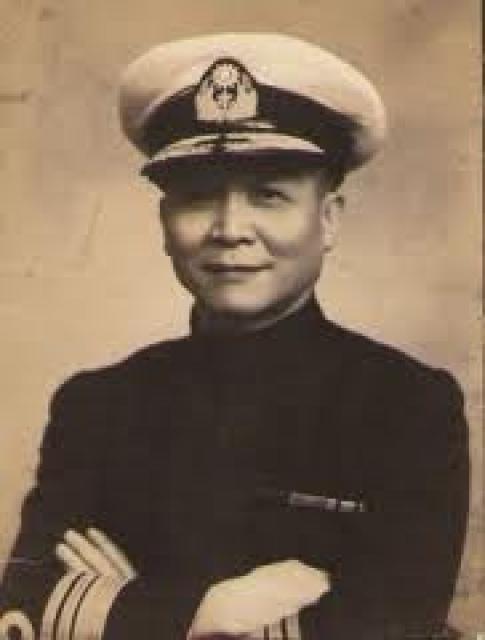
Chan Chak KBE (Chinese: 陳策; born Chen Mingtang; 陳明唐; 2 April 1894 – 31 August 1949), was a Chinese admiral of the Republic of China Navy, best known for his role in a breakout in five Royal Navy torpedo boats from the Japanese occupation of Hong Kong on Christmas Day 1941.
Chan flee to Hong Kong during WW2, and was given command of the five remaining Royal Navy Motor Torpedo Boats. In Aberdeen Harbour he and his entourage boarded the motor launch Cornflower II; while on the way to a rendezvous with the torpedo boats waiting south of Ap Lei Chau it was fired upon by Japanese forces.
Chan ordered “Abandon Ship”, threw off his artificial leg, only to be shot at the left wrist; barely able to swim with one arm and one leg, he was dragged ashore by his aide-de-camp, Lieutenant-Commander Henry Hsu. The torpedo boats came to their rescue, then headed towards Mirs Bay at high speed. From there the escapees, with the help of Chinese guerrillas, walked for four days through Japanese-occupied territories towards Huizhou in unoccupied China.
Altogether sixty-eight British, Chinese and Danish intelligence, naval and marine personnel were saved in the breakout, including David Mercer MacDougall, who had worked with Chan on intelligence matters. For aiding in the escape of these British military personnel, Chan was made an honorary Knight Commander of the Order of the British Empire on 19 August 1942.
At the risk of being labelled as pedantic, It was technically incorrect to caption this photo as ‘Admiral Sir Chan Chak’.
Admiral Chan, a citizen of the Republic of China, had been granted an honorary British knighthood. However, as a foreign national, and not holding dual British (or British Commonwealth) Citizenship it is inappropriate to be addressed as “Sir”.
I learned something today, corrected with thanks !
Non-British subjects who receive a KBE (Knight Commander of the British Empire) cannot officially use the title "Sir" before their first name. Because they are not citizens of a Commonwealth country where the British monarch is head of state, the award is considered "honorary".
The Order of the British Empire has five ranks, and the top two grant Knighthood or Damehood. The highest rank is the Knight or Dame Grand Cross (GBE).
Global Cap: This rank is statutorily limited to 100 living members worldwide (73 in the civil division and 27 in the military division) to maintain its exclusivity.
Foreign Recipients: Non-British citizens can receive this honor as "honorary members," and they do not count toward the 100-person limit.
Comments
Escape from Hong Kong 1941 - Admiral Chan Chak (KBE)
Chan Chak KBE (Chinese: 陳策; born Chen Mingtang; 陳明唐; 2 April 1894 – 31 August 1949), was a Chinese admiral of the Republic of China Navy, best known for his role in a breakout in five Royal Navy torpedo boats from the Japanese occupation of Hong Kong on Christmas Day 1941.
Chan flee to Hong Kong during WW2, and was given command of the five remaining Royal Navy Motor Torpedo Boats. In Aberdeen Harbour he and his entourage boarded the motor launch Cornflower II; while on the way to a rendezvous with the torpedo boats waiting south of Ap Lei Chau it was fired upon by Japanese forces.
Chan ordered “Abandon Ship”, threw off his artificial leg, only to be shot at the left wrist; barely able to swim with one arm and one leg, he was dragged ashore by his aide-de-camp, Lieutenant-Commander Henry Hsu. The torpedo boats came to their rescue, then headed towards Mirs Bay at high speed. From there the escapees, with the help of Chinese guerrillas, walked for four days through Japanese-occupied territories towards Huizhou in unoccupied China.
Altogether sixty-eight British, Chinese and Danish intelligence, naval and marine personnel were saved in the breakout, including David Mercer MacDougall, who had worked with Chan on intelligence matters. For aiding in the escape of these British military personnel, Chan was made an honorary Knight Commander of the Order of the British Empire on 19 August 1942.
Not truly "Sir" Chan Chak
At the risk of being labelled as pedantic, It was technically incorrect to caption this photo as ‘Admiral Sir Chan Chak’.
Admiral Chan, a citizen of the Republic of China, had been granted an honorary British knighthood. However, as a foreign national, and not holding dual British (or British Commonwealth) Citizenship it is inappropriate to be addressed as “Sir”.
The UK Honours System
Dear Chinarail,
I learned something today, corrected with thanks !
Non-British subjects who receive a KBE (Knight Commander of the British Empire) cannot officially use the title "Sir" before their first name. Because they are not citizens of a Commonwealth country where the British monarch is head of state, the award is considered "honorary".
The Order of the British Empire has five ranks, and the top two grant Knighthood or Damehood. The highest rank is the Knight or Dame Grand Cross (GBE).
Global Cap: This rank is statutorily limited to 100 living members worldwide (73 in the civil division and 27 in the military division) to maintain its exclusivity.
Foreign Recipients: Non-British citizens can receive this honor as "honorary members," and they do not count toward the 100-person limit.