Greeks in Hong Kong [????- ]

Submitted by Nikolaos on

I am conducting a study on the Greek population of Hong Kong from the 19th to the 20th century. If you have any information, photographs, memoirs, documents please let me know!

Nikolaos

Type
Other
Status
Active
Photos of this organisation:
(see more)

Photos of this organisation:

1949
1954
1990

Comments

Mostly transient (sailors, brokers, merchants) so in the 20th century census their numbers appear slim. But still there were shipping companies, a consulate, associations, and nowadays, an Orthodox metropolitan church. The majority of them settled in HK after 1950 when the Greeks, among other foreigners, had to flee the mainland and find safe refuge. The Greek Foreign Ministry Archives help us trace their routes. I am currently working on that, and I am happy to share my findings with you!

Although I have collected official documents and reports I still need personal testimonies such as diaries and memoirs and this is why I reached out to the Gwulo community! 

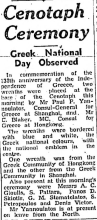
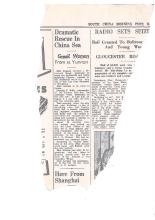
On 30 Aug 1945 the British fleet sailed in to Hong Kong harbour for the first time after the Japanese surrender. In the afternoon, Admiral Harcourt visited the Stanley Internment where there was a flag raising ceremony, including a Greek flag. The events were reported in the next day's newspapers:

Hong Kong, lost to the British for almost four years, was recovered in August 1945. On the thirtieth of that month the raising of the Union Jack at Stanley Internment Camp officially signalised the restoration of British control.
 

Thus may some historians record yesterday's ceremony, but, as usual, the history books will offer a dry-as-dust record of one of the most stirring ceremonies in the Colony's history - certainly the most stirring experience in the memories of Stanley's relieved internees, numbering over two thousand who were its witnesses.

Attended by a bodyguard, whose sturdiness was the admiration of the recently famished internees, Rear-Admiral Cecil Harcourt, Senior British Naval Officer, China Coast, drove into Camp just before 5 p.m. With him came Mr F.C. Gimson, His Britannic Majesty's Representative in Hongkong, and other Government officials. Together Rear-Admiral Harcourt and Mr Gimson took their place in an enclosure distinguished by a tall flag pole and nine attendant flag poles against the lines of which crowded excited internees.

Quiet followed a call by the Bugler, J.D. Pester, and the Union Jack was immediately raised to the head of the main flag pole. After the singing of the National Anthem the flags of the United States, China, Russia, Norway, Holland, Belgium, France, Greece and Poland were broken from the remaining flag poles.

For a few impressive moments the flags were then lowered to half-mast while the Revd. W.L. Martin and the Revd. A.P. Rose commemorated the war dead in a short prayer.

The flags were then raised and Rear-Admiral Harcourt, stepping forward called for three cheers for His Majesty. These were given exuberantly and Rear-Admiral Harcourt found himself the subject of three further spontaneous cheers. Three cheers were also accorded the Air Force before the gathering subsided into a decorous chorus of 'Oh God Our Help,' led by the Choir of the United Churches in Camp. The National Anthem was then repeated...

The only Greek person I've found among the internees in Stanley Camp is Mr Dracoulis. Mr Patara was also in Hong Kong at this time, but seems to have stayed out of the camp.

This is a photo taken during the flag raising ceremony:

Flag raising ceremony at Stanley Camp, by David