[Updated 26/Apr/2026]
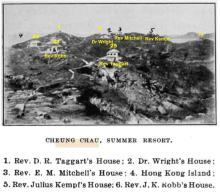
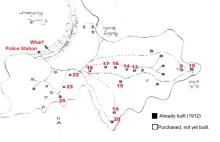
House #17 was built early in the 20th century when Cheung Chau was found to be an attractive alternative to The Peak for holiday villas. It looks to be in an early photo of the missionary houses taken in 1911. At least a dozen of the European houses were missionary-owned, and served as holiday homes or refuges when there was trouble where they served on the mainland.
From the photographic evidence, House 17 was a south-west facing bungalow built on the west side of Fa Peng, with views over the island and the sea with islands to the south. It was built of rendered granite blocks, with a small porch at the front, and a domestics' cabin at the rear. Like House #14 it was built on a substantial platform.
It was topped off with a timber tiled roof and a reinforcing course of cement against the typhoon season.
Looking at the 1962.1 survey plan, it appears that at some point, the main building was extended backwards and the domestics' cabin as well, and all brought under one roof.
In the 1938 list of European owners of houses on Cheung Chau, the owner of House #17 is given as Mr N G Wright. He may have been a missionary or wealthy Hong Kong individual, and the house may have been a holiday cottage or permanent residence.
Today the house is still in use. It has a flat concrete roof and is named Bethany House. It's a holiday venue for Christian workers, making a trio with Bethany Cottage (17A) and Bethany Lodge (12). This may well be the original house. Buttresses can be seen in the walls and these were certainly a feature of the original houses.
Photos that show this Place