[Updated 13/Apr/2026]
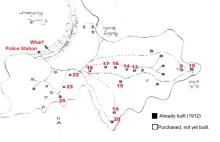
This house was very similar in build to European House #10 nearby. Both houses were owned by the Canton Villages Mission, and both houses enjoyed splendid isolation at this remote end of Cheung Chau, as pictures attest.
Built in 1913-14, when plots were cheap, there was a flurry of building at this time, as Cheung Chau offered all the benefits of the Peak for a fraction of the cost.
The house was sturdily built with large blocks of rendered granite, quarried locally, with a double-tiled timber hip roof. Hip roofs offer superior stability, durability, and wind resistance due to their four-sloped design, making them ideal for high-wind or hurricane-prone areas. The roof was strengthened against the typhoon season with a concrete course, the house being set about 170 feet above sea level. Windows had to be of heavy plate glass.
The house was south-west facing to catch the sun, with great views of islands to the south, Lamma to the east, and all the shipping that passed through going to and from Hong Kong.
There were two bedrooms, each with its own bathroom, with a living room and lobby in between.
Servants' quarters and kitchen were in an annex at the rear.
In the 1938 list of European owners of Cheung Chau houses, houses 9 and 10 were marked as NZ Presbyterian Mission, and were built for and owned by them from the start. Houses ('Cottages') were available for rent to members (seniority took precedence) for $25 for the months of July and August, $15 for the months of June and September, and free at all other times.
In the early years, the occupants of CVM cottages were Rev and Mrs Mawson, Dr E W Kirk, Misses McEwan, Prentice, and Wright, Dr and Mrs Paterson, and Rev. P Milne. The McNeurs used House 10 and the Davieses used House IL10, 'the Davies House'.
In May 1940 there was concern at damage done to CVM properties from stray mines exploding at the foot of the cliffs.
During the war, these houses were stripped of all wood by locals and bombed by the Japanese due to being western-owned.
Today it is the HKSKH Anglican House of Prayer. It is available for its clergy, laity, staff, and groups to go on retreat, or for students of the Clinical Pastoral Education course. The address of the property is 16 Ming Fai Road, Cheung Chau.
Source: Presbyterian Research Centre, New Zealand.
Photos that show this Place