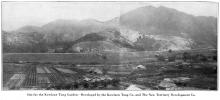
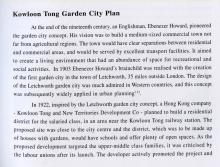
The Kowloon Tong Garden City Estate was initiated by Montague Ede in 1921 and was built between 1922-1932 as a type of "garden city" development of middle class housing in Hong Kong. The site covered one hundred acres and included 250 detatched "garden houses" as well as other amenities such as parks and playgrounds. There were 4 main housing types with standardized layouts - common type was a two-storey house with a verandah in the front of the building constructed of reinforced concrete, red brick and iron joists for beams, and the interior layout included a living room, dining room, kitchen and servants quarters on the ground floor, and one large bedroom and two small bedrooms on the upper floor. Every house had electrical lights, and flush toilets. All the street names in the area referred to English countires such as Surrey, Essex, Norfold, Rutland and Cornwall. I beleive the architects for the KTGC Estate were Adams, Little and Woods and E. D. Shanks. For references see PhD by Prudence Lau, CUHK 2013 "Adaptive Modern and Speculative Urbanism: The Architecture of the Credit Foncier d'Extreme-Orient in HK and China's Treaty Ports, 1907-1959" and the listing on Kowloon Tong Garden City Estates by Cecelia Chu in "DOCOMOMO Mapping Modern Architecture in Hong Kong".
Would it be useful for me to post here a list of all the Kowloon Tong properties and their occupants mentioned in the Jurors Lists from 1925 onwards? (I've only gone through the 1925-1935 lists so far, but could maybe do up to 1941 if I get around to it) it is a fairly basic list at the moment, just the address, year of first mention in the jurors list, and the relevant person's name for each property, but I could hopefully add more to it later.
If you see any benefit to me doing this, how do I add a word document that is a few pages long?
As it will be a large document, I recommend you make its own page (https://gwulo.com/node/add/forum/2) then I'll link it in under this one.
You should be able to cut & paste from word into your page on Gwulo. The 6th button from left in the top row of the editor (a liitle clipboard icon with a 'w') can help when pasting from Word.
I have noticed that a research project, titled "Speculative Urbanism: Modernist Planning and Housing Practices in Colonial HK, 1912-1939", is being undertaken from early 2015 until mid 2017, led by Dr Cecilia L. Chu at the Division of Landscape Architecture, HKU. According to the website (see link below), the project may be considering the Kowloon Tong Estate development, and there are a couple of photos and maps to be seen on the website.
looking at the research link above - fascinated to see the two house type plans as in my Grandma's photographs - the curved balcony facade and the 'filled in' balcony facade ...
...as they also appear on the Docomama link (http://www.docomomo.hk/site/kowloon-tong-garden-city/), courtesy of "Nathan Cho and Bosco So" from HKU. But I agree, it's very interesting to see these two models. Only a very few houses in Kowloon Tong actually retain those original features now, from what I can tell. I have seen perhaps two or three such houses, but it's difficult to know what is behind some of the high walls and trees of other places, so there could be more.
sad that so much of it has already been demolished though obviously the original houses would have to be adapted - also sad that the concept didn't really work out - perhaps it might have given time and no war ... perhaps all this will be addressed by the research.
Further information on the Garden Estate is below. The link also provides some photos and layouts of houses on the development, together with a map of the estate from 1947, which shows the approximate position of buildings on each plot.
"The Kowloon Tong Garden City Estate is one of the few remaining examples of “garden city” development in Hong Kong in the early 20th century. The project was initiated in 1921 by Montague Ede, a British entrepreneur, with the aim to provide a healthy, suburban living environment affordable to Hong Kong’s emerging middle class. Developed by Kowloon Tong and New Territories Development Company, the project was the first major attempt at modern town planning in Hong Kong. It covers one hundred acres and includes two hundred fifty detached “garden houses” as well as ample public parks and playgrounds for children. It was also the first large-scale housing project that adopted mass production building methods, incorporating ideas of efficiency and standardization in the construction process.
The Kowloon Tong Estate originally consisted of four main housing types with standardized layouts. The most popular type was a two-storey house that contains a living room, dining room, kitchen, and servant quarters on the ground floor, and one large bedroom and two small bedrooms on the upper floor. Every house was equipped with modern amenities, including electrical lighting and flush toilets. To invoke an imagined English countryside, all the new streets in the area were named after England’s counties, such as Surrey, Essex, Norfolk, Rutland and Cornwall.
In the postwar period, the neighborhood districts of Kowloon Tong, including those to the north of Cornwall Street and east of Waterloo Road, were redeveloped into high-rise residential blocks. By the 1970s, the arrival of the Mass Transit Railway turned the area into a major transit hub. Many original residents began to move out, and an increasing number of houses were used as kindergartens, primary schools, motels, and other businesses. Despite these changes, Kowloon Tong remains zoned as a low-rise residential district, a condition that has prevented it from being further developed as in other parts of the city. While many of the houses have been remodeled or demolished, a number of original ones remain, along with the site’s original layout. These elements serve as a reminder of the Kowloon Tong Garden City Estate’s significance as an early example of the modern movement in architecture and city planning in Hong Kong."
Comments
Kowloon Tong Garden City Estate
The Kowloon Tong Garden City Estate was initiated by Montague Ede in 1921 and was built between 1922-1932 as a type of "garden city" development of middle class housing in Hong Kong. The site covered one hundred acres and included 250 detatched "garden houses" as well as other amenities such as parks and playgrounds. There were 4 main housing types with standardized layouts - common type was a two-storey house with a verandah in the front of the building constructed of reinforced concrete, red brick and iron joists for beams, and the interior layout included a living room, dining room, kitchen and servants quarters on the ground floor, and one large bedroom and two small bedrooms on the upper floor. Every house had electrical lights, and flush toilets. All the street names in the area referred to English countires such as Surrey, Essex, Norfold, Rutland and Cornwall. I beleive the architects for the KTGC Estate were Adams, Little and Woods and E. D. Shanks. For references see PhD by Prudence Lau, CUHK 2013 "Adaptive Modern and Speculative Urbanism: The Architecture of the Credit Foncier d'Extreme-Orient in HK and China's Treaty Ports, 1907-1959" and the listing on Kowloon Tong Garden City Estates by Cecelia Chu in "DOCOMOMO Mapping Modern Architecture in Hong Kong".
A basic list of some early occupants of Kowloon Tong
Hi David/Phil,
Would it be useful for me to post here a list of all the Kowloon Tong properties and their occupants mentioned in the Jurors Lists from 1925 onwards? (I've only gone through the 1925-1935 lists so far, but could maybe do up to 1941 if I get around to it) it is a fairly basic list at the moment, just the address, year of first mention in the jurors list, and the relevant person's name for each property, but I could hopefully add more to it later.
If you see any benefit to me doing this, how do I add a word document that is a few pages long?
Cheers
Liz
re: A basic list of some early occupants of Kowloon Tong
Hi Liz,
As it will be a large document, I recommend you make its own page (https://gwulo.com/node/add/forum/2) then I'll link it in under this one.
You should be able to cut & paste from word into your page on Gwulo. The 6th button from left in the top row of the editor (a liitle clipboard icon with a 'w') can help when pasting from Word.
Let me know if you run into any trouble.
Regards, David
Current HKU research project looking at Kowloon Tong
I have noticed that a research project, titled "Speculative Urbanism: Modernist Planning and Housing Practices in Colonial HK, 1912-1939", is being undertaken from early 2015 until mid 2017, led by Dr Cecilia L. Chu at the Division of Landscape Architecture, HKU. According to the website (see link below), the project may be considering the Kowloon Tong Estate development, and there are a couple of photos and maps to be seen on the website.
Link: http://www.arch.hku.hk/research_project/speculative-urbanism-modernist-…;
Although admittedly there is not much more information at the moment, it will be interesting to read any research output from the project.
Kowloon Tong house types
looking at the research link above - fascinated to see the two house type plans as in my Grandma's photographs - the curved balcony facade and the 'filled in' balcony facade ...
I think they are modern drawings...
...as they also appear on the Docomama link (http://www.docomomo.hk/site/kowloon-tong-garden-city/), courtesy of "Nathan Cho and Bosco So" from HKU. But I agree, it's very interesting to see these two models. Only a very few houses in Kowloon Tong actually retain those original features now, from what I can tell. I have seen perhaps two or three such houses, but it's difficult to know what is behind some of the high walls and trees of other places, so there could be more.
Remaining original facades?
I think the sole survivors in Kowloon Tong (in terms of original facades) could be 29 Kent Road and 16 Cumberland Road, but there may be more.
sad that so much of it has
sad that so much of it has already been demolished though obviously the original houses would have to be adapted - also sad that the concept didn't really work out - perhaps it might have given time and no war ... perhaps all this will be addressed by the research.
Notes on the Kowloon Tong Garden Estate
[Admin: notes moved here from duplicate page]
Further information on the Garden Estate is below. The link also provides some photos and layouts of houses on the development, together with a map of the estate from 1947, which shows the approximate position of buildings on each plot.
Extract from Cecilia Chu (2013) (link available here: http://www.docomomo.hk/project/kowloon-tong-garden-city-estate/) :
"Adams, Little and Woods Architects; E.D. Shanks
Kowloon Tong, 1922-1932"
"The Kowloon Tong Garden City Estate is one of the few remaining examples of “garden city” development in Hong Kong in the early 20th century. The project was initiated in 1921 by Montague Ede, a British entrepreneur, with the aim to provide a healthy, suburban living environment affordable to Hong Kong’s emerging middle class. Developed by Kowloon Tong and New Territories Development Company, the project was the first major attempt at modern town planning in Hong Kong. It covers one hundred acres and includes two hundred fifty detached “garden houses” as well as ample public parks and playgrounds for children. It was also the first large-scale housing project that adopted mass production building methods, incorporating ideas of efficiency and standardization in the construction process.
The Kowloon Tong Estate originally consisted of four main housing types with standardized layouts. The most popular type was a two-storey house that contains a living room, dining room, kitchen, and servant quarters on the ground floor, and one large bedroom and two small bedrooms on the upper floor. Every house was equipped with modern amenities, including electrical lighting and flush toilets. To invoke an imagined English countryside, all the new streets in the area were named after England’s counties, such as Surrey, Essex, Norfolk, Rutland and Cornwall.
In the postwar period, the neighborhood districts of Kowloon Tong, including those to the north of Cornwall Street and east of Waterloo Road, were redeveloped into high-rise residential blocks. By the 1970s, the arrival of the Mass Transit Railway turned the area into a major transit hub. Many original residents began to move out, and an increasing number of houses were used as kindergartens, primary schools, motels, and other businesses. Despite these changes, Kowloon Tong remains zoned as a low-rise residential district, a condition that has prevented it from being further developed as in other parts of the city. While many of the houses have been remodeled or demolished, a number of original ones remain, along with the site’s original layout. These elements serve as a reminder of the Kowloon Tong Garden City Estate’s significance as an early example of the modern movement in architecture and city planning in Hong Kong."