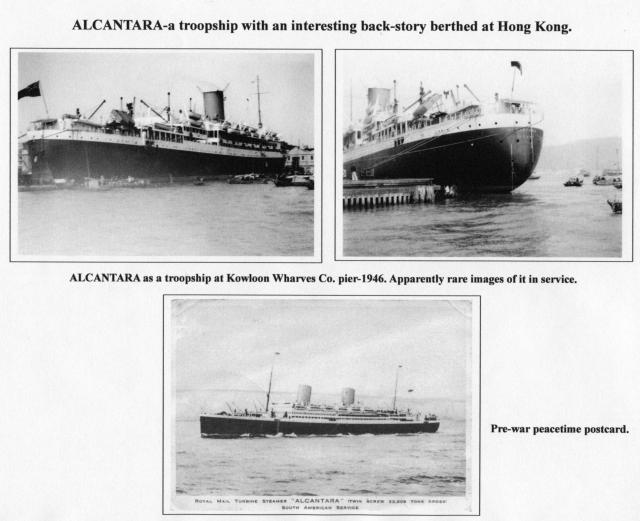
Two photographic prints surfaced recently from a batch passed to me 30 years ago by an ex-RAF marine operative who had served in Hong Kong just after liberation, servicing RAF flying boat moorings and taking part in air-sea rescues via hi-speed launches.
The vessel in these prints was unidentified, but with a bit of photo manipulation, the stern lettering ‘BELFAST’ could be made out and a fainter selection of letters that seemed to make up the name ‘ALCANTARA’.
This turned out to be the ex-R.M.S. ALCANTARA serving as a troopship which in this case is presumably repatriating people from Hong Kong in 1946.
Built for UK-South America liner service, Alcantara and Asturias were two new ships powered by pairs of eight-cylinder four-stroke double-acting diesel engines built by Harland and Wolff to a Burmeister & Wain design. The engines gave each ship 10,000 ihp or 7,500 bhp, and at the time they were the world's largest motor ships. However, their cruising speed was only 16+1⁄2 knots (30.6 km/h), which was less than that of competing ships on routes between European ports and the South American east coast. They were subsequently re-powered with steam-turbines and their associated boilers, which is an unusual conversion, in opposition to the usual one of diesel engines superseding steam turbines or triple expansion steam engines.
In 1939, the Admiralty requisitioned Alcantara and Asturias and converted each ship into armed merchant cruisers. Their mainmast and forward dummy funnels were removed to increase the arc of fire for their anti-aircraft guns. However, in 1943 Alcantara was converted into a troop ship.
Alcantara remained a troop ship until after the end of the war, presumably with at least one visit to Hong Kong as per these photographs, not returning to civilian service until October 1948, resuming its old route between Southampton and South America. In April 1958 she was withdrawn from service and sold to Japanese ship-breakers renaming her Kaisho Maru, taking her to Japan for breaking up the same year.
The vessel is believed to have not been a regular visitor to Hong Kong.