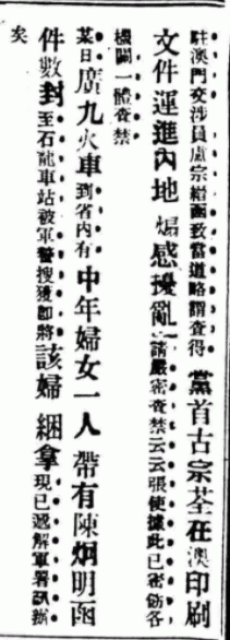
This short intelligence brief from the February 22, 1916 issue of Shenzhou Ribao (神州日報) details a cross-border smuggling bust involving a female revolutionary courier transporting highly sensitive political letters across the border from British Hong Kong into mainland China.
📰 Verbatim Transcription and Translation
The text contains two interconnected intelligence bulletins tracking the movement of subversive materials from the European colonies (Macau and Hong Kong) into the mainland:
Bulletin 1: The Macau Printing Press Intel
- Chinese Text: 「駐澳門交涉員盧宗韜函致當道,略謂查得黨首古宗荃在澳印刷文件運進內地煽惑擾亂,請嚴密查禁云云。張使據此已密飭各機關一體查禁。」
- English Translation: The resident diplomatic envoy stationed in Macau, Lu Zongtao, sent an official letter to the ruling authorities stating that intelligence has identified the revolutionary rebel leader, Gu Zongquan, printing subversive documents within Macau and smuggling them into the mainland to incite public disturbances. He requests a strict and thorough ban. Governor-General Zhang, acting upon this intelligence, has secretly ordered all state departments and checkpoints to enforce a comprehensive ban.
Bulletin 2: The Hong Kong-Canton Railway Courier Arrest
- Chinese Text: 「某日,廣九火車到省,內有一中年婦女一人,帶有陳烱明函件數封,至石龍車站被軍警搜獲,即將該婦捆拿,現已遞解軍署訊辦矣。」
- English Translation: On a certain day, upon the arrival of a Kowloon-Canton Railway (廣九火車) train into the province, a middle-aged woman was found on board carrying several secret letters written by Chen Jiongming (陳烱明). When the train reached the Shilong Station (石龍車站), military police searched her and uncovered the documents. They immediately tied up and arrested the woman, and she has now been escorted directly to the military headquarters for interrogation and prosecution.
🔍 Historical Significance: The Smuggling Pipeline Revealed
This snippet is a remarkable micro-history piece that perfectly matches your previous research on the Guichou Press Disaster and cross-border censorship:
- The Role of Chen Jiongming: The letters belonged to Chen Jiongming, one of the most powerful revolutionary military figures in Southern China. Having participated in the failed Second Revolution against Yuan Shikai, Chen was using British Hong Kong as a command base to funnel letters, financing, and military commands to underground cells across Guangdong via train routes.
- The Kowloon-Canton Railway (KCR) as an Espionage Artery: The KCR (廣九鐵路) had only been fully completed a few years prior, in 1911. This clipping demonstrates that it instantly became the premier technological highway for both commerce and political espionage. Rebel networks systematically weaponized the train's speed to run contraband directly from Tsim Sha Tsui into the heart of Guangdong.
- Women as Political Couriers: In early 1916, military customs at mainland border stations heavily targeted young Chinese men suspected of being revolutionary soldiers or radical student journalists. To bypass this, the underground railroad heavily relied on middle-aged women disguised as ordinary market traders or family travelers, banking on the assumption that imperial guards would not search them. As Shilong was a major checkpoint along the East River branch line, the military police clearly acted on precise tip-offs from their spy network in Hong Kong.
Date picture taken
22 Feb 1916