Title: The Lost Po Kong Village and Imperial Scholar Chan Hop-to: A 1926 School Graduation Clipping
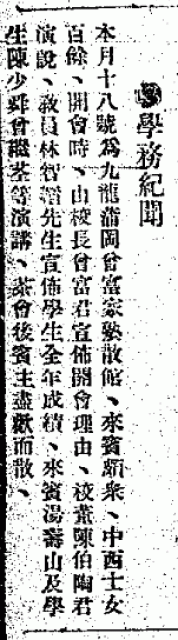
I recently came across a short but highly revealing snippet from The Chinese Mail (Hong Kong Wa Tsz Yat Po, 香港華字日報) dated 3rd February 1926. Titled "Educational News" (學務紀聞), it records the end-of-term closing ceremony of a village school in Kowloon.
While it looks like a standard local news brief on the surface, it contains two fascinating links to Kowloon's vanished pre-war history: the obliterated Po Kong Village (蒲崗村) and the legendary Qing Imperial scholar Chan Hop-to (陳伯陶).
Here is the translation of the clipping:
Educational News (學務紀聞)
On the 18th of this month, the Po Kong Hui Fu Family School (九龍蒲崗會富家塾) in Kowloon held its San Guan (散館 - formal end-of-term closing ceremony / graduation assembly).
The event drew a distinguished crowd of over a hundred local and international guests, both ladies and gentlemen. The ceremony commenced with the school head, Mr. Tsang Fu (曾富君), announcing the opening objectives. This was followed by an address from school director Mr. Chan Hop-to (陳伯陶). The instructor, Mr. Lam Chi-to (林智韜), then announced the academic achievements of the students for the full year.
Further speeches were delivered by guest speaker Mr. Tong Shau-shan (湯壽山), as well as student representatives including Chan Shiu-ngai (陳少羿) and Tsang Shu-ming (曾樞茗). Following the conclusion of the formal assembly, the patrons and financial benefactors enjoyed a celebratory gathering, and the event concluded in high spirits.
Historical Context & Points of Interest:
1. The Ghost of Po Kong Village (蒲崗村) The school was located in Po Kong Village, which sat in the lowlands between modern-day Kowloon City and Diamond School. At the time of this clipping in 1926, it was an active, historic agrarian village. However, during the Japanese Occupation (1941–1945), the Japanese military forcefully evicted the villagers and entirely demolished Po Kong to expand the runways of Kai Tak Airport.
After the war, the area south of the old village footprint was developed into an industrial zone and renamed San Po Kong (新蒲崗)—meaning "New Po Kong." This 1926 snippet provides a rare, vivid window into the community life and village literacy that existed right before the airport swallowed the land.
2. The Imperial Connection: Chan Hop-to (陳伯陶) The most remarkable name on the roster is the school director, Chan Hop-to. Chan was an elite scholar-official of the late Qing Dynasty, having scored third nationwide (Tanhua探花) in the 1892 Imperial Civil Service Examinations, eventually becoming a prestigious Hanlin Academician.
Following the fall of the Qing Empire in 1911, Chan moved to Hong Kong as a loyalist refugee, living in relative seclusion around Kowloon Walled City. He spent his twilight years dedicating himself to local history (he compiled the famous Dongguan County Gazetteer) and local education. This clipping confirms that in 1926 (just four years before his death), he was actively managing and mentoring small village schools like the Fu Family School in Po Kong, bringing top-tier classical academic oversight to rural Kowloon children.
3. Traditional Schooling in Transition Though labeled a traditional family school or private study hall (Gia Shuk家塾), the presence of an international audience ("over a hundred local and international guests, both ladies and gentlemen"), formal student speech representatives, and modern administrative roles indicates that by 1926, these village schools were rapidly adopting Westernized assembly formats while maintaining their traditional classical roots.
Title: The 1933 Douglas Castle Anti-Japanese Riot and the Tragedy of the Tsang Family
While looking into the genealogy of local education and property figures from this era, the records shed light on a violent anti-Japanese riot on September 26, 1931, which led to the brutal murder of a local Chinese manager, Mr. Tsang Fu (曾富), and his family right on the castle grounds.
Here is a summary of the historical event and its connection to the site:
1. The Commercial Footprint of Douglas Castle
By the late 1920s, Douglas Castle had ceased to be a purely residential estate. In 1928, it was opened up as a commercial plantation and dairy vendor colloquially known to locals as the Douglas Castle Plantation (德忌利士園). The overarching operations were leased and managed by a Chinese entrepreneur named Tsang Fu (曾富), who established a thriving business processing dairy and agricultural imports, trading under the company name "San Ho" (三和公司) or the "Douglas Castle Trading Company."
2. The Spark: The 1931 Mukden Incident
In September 1931, the Japanese military invaded Manchuria (the Mukden Incident). News reached Hong Kong by September 23, triggering a massive wave of anti-Japanese anger among the local Chinese population. Public fury quickly boiled over into city-wide boycotts, riots, and targeted attacks against anyone perceived to be cooperating or trading with Japanese businesses.
3. The Tragedy on the Mountain (September 26, 1931)
Because Tsang Fu’s trading company imported and distributed certain Japanese goods, his plantation became a prime target for radical agitators.
On the morning of September 24, a crowd traveled up the hill to confront the plantation. Though initially dispersed by police, tensions remained critical. On September 26, a massive mob stormed the isolated Douglas Castle grounds. The rioters breached the main house, overwhelmed the family, and hacked Tsang Fu, his wife, and their two daughters to death. Only their youngest son, a toddler under three years old, miraculously survived the slaughter.
4. The Aftermath and Legal Fallout
The colonial government took the massacre at Douglas Castle incredibly seriously. Governor William Peel declared a state of emergency, deploying the military alongside police forces to suppress the riots and enforce a strict curfew across Hong Kong and Kowloon.
Detectives raided nearby villages and matching hideouts, eventually arresting dozens of suspects connected to the assault. The slaughter of the Tsang family shocked the local community and effectively ended this specific commercial chapter of Douglas Castle, which was later acquired by the Paris Foreign Missions Society (Missions Étrangères de Paris) before eventually becoming part of HKU.
Seeing the name Tsang Fu (曾富) attached to Douglas Castle serves as a somber reminder of how global geopolitical conflicts violently shattered the peace of quiet suburban estates in pre-war Hong Kong.
Comments
The Lost Po Kong Village and Imperial Scholar Chan Hop-to
Title: The Lost Po Kong Village and Imperial Scholar Chan Hop-to: A 1926 School Graduation Clipping
I recently came across a short but highly revealing snippet from The Chinese Mail (Hong Kong Wa Tsz Yat Po, 香港華字日報) dated 3rd February 1926. Titled "Educational News" (學務紀聞), it records the end-of-term closing ceremony of a village school in Kowloon.
While it looks like a standard local news brief on the surface, it contains two fascinating links to Kowloon's vanished pre-war history: the obliterated Po Kong Village (蒲崗村) and the legendary Qing Imperial scholar Chan Hop-to (陳伯陶).
Here is the translation of the clipping:
Educational News (學務紀聞)
On the 18th of this month, the Po Kong Hui Fu Family School (九龍蒲崗會富家塾) in Kowloon held its San Guan (散館 - formal end-of-term closing ceremony / graduation assembly).
The event drew a distinguished crowd of over a hundred local and international guests, both ladies and gentlemen. The ceremony commenced with the school head, Mr. Tsang Fu (曾富君), announcing the opening objectives. This was followed by an address from school director Mr. Chan Hop-to (陳伯陶). The instructor, Mr. Lam Chi-to (林智韜), then announced the academic achievements of the students for the full year.
Further speeches were delivered by guest speaker Mr. Tong Shau-shan (湯壽山), as well as student representatives including Chan Shiu-ngai (陳少羿) and Tsang Shu-ming (曾樞茗). Following the conclusion of the formal assembly, the patrons and financial benefactors enjoyed a celebratory gathering, and the event concluded in high spirits.
Historical Context & Points of Interest:
1. The Ghost of Po Kong Village (蒲崗村)
The school was located in Po Kong Village, which sat in the lowlands between modern-day Kowloon City and Diamond School. At the time of this clipping in 1926, it was an active, historic agrarian village. However, during the Japanese Occupation (1941–1945), the Japanese military forcefully evicted the villagers and entirely demolished Po Kong to expand the runways of Kai Tak Airport.
After the war, the area south of the old village footprint was developed into an industrial zone and renamed San Po Kong (新蒲崗)—meaning "New Po Kong." This 1926 snippet provides a rare, vivid window into the community life and village literacy that existed right before the airport swallowed the land.
2. The Imperial Connection: Chan Hop-to (陳伯陶)
The most remarkable name on the roster is the school director, Chan Hop-to. Chan was an elite scholar-official of the late Qing Dynasty, having scored third nationwide (Tanhua 探花) in the 1892 Imperial Civil Service Examinations, eventually becoming a prestigious Hanlin Academician.
Following the fall of the Qing Empire in 1911, Chan moved to Hong Kong as a loyalist refugee, living in relative seclusion around Kowloon Walled City. He spent his twilight years dedicating himself to local history (he compiled the famous Dongguan County Gazetteer) and local education. This clipping confirms that in 1926 (just four years before his death), he was actively managing and mentoring small village schools like the Fu Family School in Po Kong, bringing top-tier classical academic oversight to rural Kowloon children.
3. Traditional Schooling in Transition
Though labeled a traditional family school or private study hall (Gia Shuk家塾), the presence of an international audience ("over a hundred local and international guests, both ladies and gentlemen"), formal student speech representatives, and modern administrative roles indicates that by 1926, these village schools were rapidly adopting Westernized assembly formats while maintaining their traditional classical roots.