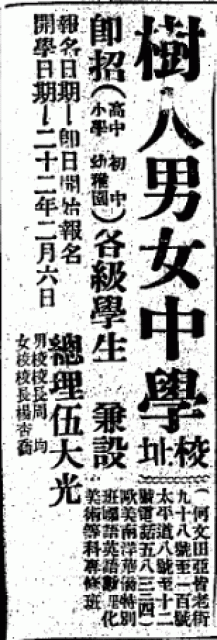
Now Recruiting Students for All Levels (Senior Secondary, Junior Secondary, Primary School, and Kindergarten).
Specialized Classes Offered Concurrently: Special classes for Overseas Chinese from Europe, America, and Southeast Asia; intensive courses in Mandarin, English, Mathematics, Physics, and Chemistry.
Director (Manager): Wu Da-guang (伍大光) Headmaster (Boys' Section): Ju Jun (局均) Headmistress (Girls' Section): Yang Xing-qiao (楊杏喬)
Registration Date: Commencing immediately. School Commencement Date: 6th February, Year 22 (Republic of China calendar, corresponding to 6th February 1933).
School Addresses:
Nos. 98–100 Argyle Street, Ho Man Tin
Nos. 8–12 Peace Avenue Telephone: 58534
Title: Wu Da-guang (伍大光) – The Prominent Diplomat and Educator Behind Shu Yan Co-educational School
Born in Xinhui, Guangdong in 1887, Wu Da-guang (also known by his courtesy name Taoruo 韜若) was exceptionally well-educated for his time. He graduated from the prestigious Imperial University of Peking (now Peking University) before travelling abroad to study in the United States, earning a degree from American University. [1]
Upon his return to China in 1918, he quickly rose through diplomatic and governmental ranks: [1]
International Diplomacy: He served as a secretary for the Beiyang Government's delegation to the historic Paris Peace Conference. [1]
State Governance: He became the Secretary-General of both the Guangdong Military Government and the President's Office, serving closely as a secretary to Dr. Sun Yat-sen in the Guangzhou Grand Marshal's House in 1922. [1]
Civil and Educational Leadership: He held the positions of Secretary-General of the Guangzhou Municipality and Director of the Guangzhou Education Bureau. Later, he served as the Secretary-General of the Judiciary Yuan and a counselor for the Chinese legation in the United States. [1]
By the early 1930s, Wu was active in higher education, teaching as a professor at Jinan University and Guangdong Xiangqin University. It was during this phase of his life that his name appeared as the General Manager/Director of the Shu Yan Co-educational Secondary School branches on Argyle Street and Peace Avenue in Kowloon. Given his background in international relations and his education in the US, it completely aligns that the school prominently advertised specialized intensive classes for overseas Chinese from Europe, America, and Southeast Asia. [1]
Tragically, his highly active career was cut short when he passed away in Guangzhou in July 1936 at the relatively young age of 49. [1]
Seeing his name on a local Hong Kong school advertisement from 1933 highlights how deeply intertwined Hong Kong's early educational institutions were with prominent global scholars and political figures fleeing or working across the border during the turbulent Republican era.
1. 98–100 Argyle Street (亞皆老街九十八至一百號)
The Plot Layout: In 1933, this plot consisted of a pair of classic 3-to-4 story pre-war European/Chinese-style tenement buildings (Tong Lau) or semi-detached suburban villas.
The School Setup: This location served as the primary base for one gender division (likely the Boys' School or the upper secondary sections). The dual street numbers (98 and 100) indicate the school had acquired two interconnected adjacent buildings to double its classroom capacity.
Geographical Context: This exact pocket of Argyle Street sits on the border of Mong Kok and the western foot of Kadoorie Hill / Ho Man Tin. During the early 1930s, this area was undergoing rapid residential development, transitioning from rural plots into a premium grid of residential houses.
Later Evolution: Post-WWII, as Kowloon’s population exploded, these low-rise 1930s plots were systematically acquired by developers. Today, the original low-rise blocks have been entirely replaced by modern high-rise residential and commercial structures typical of the bustling Mong Kok/Ho Man Tin corridor.
2. 8–12 Peace Avenue (太平道八至十二號)
The Plot Layout: Spanning three street numbers (8, 10, and 12), this plot was a larger contiguous row of low-rise pre-war buildings.
The School Setup: This was the second campus listed in the ad, functioning as the alternate gender campus (likely the Girls' School, Kindergarten, and Primary sections). Utilizing multiple street lots allowed a clean layout to separate different age groups and genders, fulfilling the co-educational layout under separate leadership (Headmaster Ju Jun vs. Headmistress Yang Xing-qiao).
Geographical Context: Peace Avenue (Tai Ping Road) runs parallel to the railway line and is just a short walk around the corner from the Argyle Street plot. In 1933, Peace Avenue was a relatively quiet, affluent residential street characterized by low-density housing—making it an ideal, sheltered environment for younger children and female students.
Later Evolution: Peace Avenue evolved into a dense urban canyon. The original low-rise residential rows at Nos. 8–12 were demolished and redeveloped in the mid-to-late 20th century. Today, the plot is occupied by high-density residential blocks with ground-floor commercial shops (famous locally for pet stores and clinics).
Comments
Shu Yan Co-educational Secondary School
Shu Yan Co-educational Secondary School
Now Recruiting Students for All Levels (Senior Secondary, Junior Secondary, Primary School, and Kindergarten).
Specialized Classes Offered Concurrently: Special classes for Overseas Chinese from Europe, America, and Southeast Asia; intensive courses in Mandarin, English, Mathematics, Physics, and Chemistry.
Director (Manager): Wu Da-guang (伍大光)
Headmaster (Boys' Section): Ju Jun (局均)
Headmistress (Girls' Section): Yang Xing-qiao (楊杏喬)
Registration Date: Commencing immediately.
School Commencement Date: 6th February, Year 22 (Republic of China calendar, corresponding to 6th February 1933).
School Addresses:
Nos. 98–100 Argyle Street, Ho Man Tin
Nos. 8–12 Peace Avenue
Telephone: 58534
Title: Wu Da-guang (伍大光) – The Prominent Diplomat and Educator Behind Shu Yan Co-educational School
Born in Xinhui, Guangdong in 1887, Wu Da-guang (also known by his courtesy name Taoruo 韜若) was exceptionally well-educated for his time. He graduated from the prestigious Imperial University of Peking (now Peking University) before travelling abroad to study in the United States, earning a degree from American University. [1]
Upon his return to China in 1918, he quickly rose through diplomatic and governmental ranks: [1]
By the early 1930s, Wu was active in higher education, teaching as a professor at Jinan University and Guangdong Xiangqin University. It was during this phase of his life that his name appeared as the General Manager/Director of the Shu Yan Co-educational Secondary School branches on Argyle Street and Peace Avenue in Kowloon. Given his background in international relations and his education in the US, it completely aligns that the school prominently advertised specialized intensive classes for overseas Chinese from Europe, America, and Southeast Asia. [1]
Tragically, his highly active career was cut short when he passed away in Guangzhou in July 1936 at the relatively young age of 49. [1]
Seeing his name on a local Hong Kong school advertisement from 1933 highlights how deeply intertwined Hong Kong's early educational institutions were with prominent global scholars and political figures fleeing or working across the border during the turbulent Republican era.
1. 98–100 Argyle Street (亞皆老街九十八至一百號)
2. 8–12 Peace Avenue (太平道八至十二號)