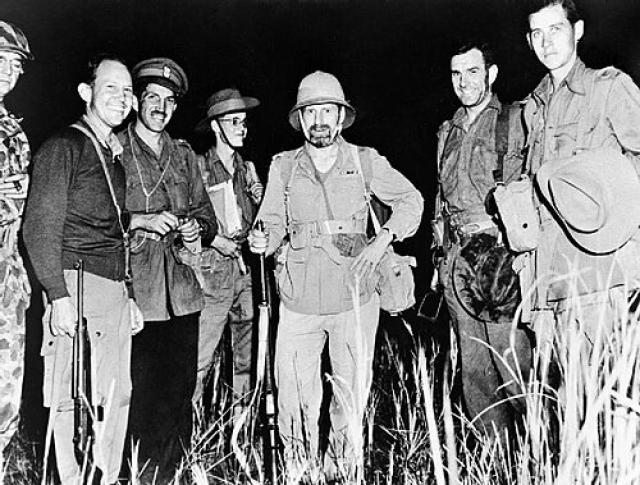
Brigadier Mike Calvert, third from left, with Orde Wingate (centre) and other Chindits at the "Broadway" airfield in Burma awaiting a night supply drop, 1944.
source
Date picture taken
1944
Shows person / people
Shows organisation(s)
Comments
Hong Kong Royal Engineers 1934
He was educated at Bradfield College and the Royal Military Academy, Woolwich, from which he was commissioned as a subaltern into the British Army's Royal Engineers as a professional soldier in February 1933.
In 1934 he returned to active service and was posted to the Hong Kong Royal Engineers, where he learned to speak Cantonese.
He also witnessed the Imperial Japanese Army's attack on Shanghai and the rape of Nanking, which made him one of the few officers in the British Army before the Second World War who fully appreciated the nature of the threat posed by Japanese imperialism.
Second World War
When the Second World War broke out in 1939, Calvert briefly commanded a detachment of Royal Engineers in the Norwegian campaign, then trained commando detachments in demolition techniques in Hong Kong and Australia.
In Australia, along with F. Spencer Chapman, he assisted with training Australian commandos who formed the first Australian Army Independent Companies at Wilsons Promontory, Victoria in 1941.
He was then appointed to command the Bush Warfare School in Burma, training officers and non-commissioned officers to lead guerilla bands in China for operations against the Japanese.
Brigadier Calvert
who served closely with Major-General Orde Charles Wingate. He was one of Wingate’s principal lieutenants and played a key role in the famous Chindits campaigns behind Japanese lines in Burma during World War II.
Major-General Orde Charles Wingate, DSO & Two Bars (26 February 1903 – 24 March 1944) was a senior British Army officer known for his creation of the Chindit deep-penetration missions in Japanese-held territory during the Burma Campaign of the Second World War.
The Chindits were a British-led jungle warfare force during World War II. Formed and commanded by Brigadier (later Major-General) Orde Wingate, they used unconventional, long-range penetration tactics to slip deep behind Japanese lines in Burma. They relied entirely on airdrops for supplies.
Wingate's creation, officially called Long Range Penetration Groups, took their name from the chinthe, a mythical Burmese temple lion. The force was primarily made up of the British Indian Army, Gurkhas, and British infantry.
They launched two major campaigns:
Operation Longcloth (1943): Wingate personally led about 3,000 men on a grueling 1,000-mile march deep into Japanese-held territory. While they sustained heavy casualties and endured severe physical exhaustion, the mission successfully proved that Allied troops could fight the Japanese on their own terms.
Operation Thursday (1944): Expanded into a force of six brigades dubbed "Special Force," the Chindits were flown in by gliders and transport planes to establish strongholds behind enemy lines. Shortly after this operation began, Wingate died in a plane crash in March 1944.