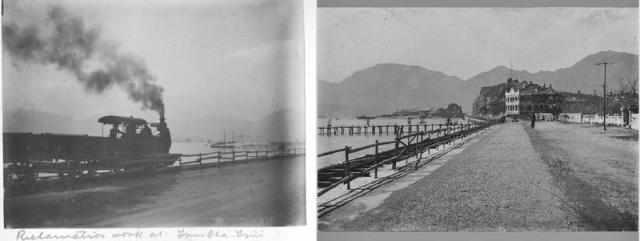
There appears to be very little information on the narrow-gauge railway running along the 1905 Kowloon East Praya or waterfront.
Photographs of a couple of the steam locomotives and wagons running along the Praya appear in HK “Old Photos” websites claiming to be‘1905’. But the images are no better than silhouettes. One print has a handwritten note saying “Tsimshatsui railway,” but whether the note is original or added later is not obvious. When did”Tsimshatsui” come into general usage rather than “Kowloon Point”?
See- https://www.uwants.com/viewthread.php?tid=15184666&extra=&page=25
However, contemporary postcards picturing the waterfront do show the tracks and adjacent fencing. In a south facing image the track appears to run from the photographer to under the face of Signal Hill.
The north facing coloured postcard image shows the track and fencing on the right heading north.
From a cropped image showing housing in the area, it is just possible to discern the track route heading north. Presumably to a “Fill” borrow area in the Homantin hills.
On-line sources appear to totally ignore this railway. I’m presuming it was reclaiming foreshore for the forthcoming KCR station.
Comments
KCR Reclamation at Hung Hom & Tsim Sha Tsui
This photo (REF: Album1-P9 from the P. A. Crush Chinese Railway Collection) shows the new reclamation for the KCR railway more or less completed . Centre-right in the photo is the Holt's Wharf warehouse .
KCR Reclamation
This is a scene overlooking Hung Hom Bay of the KCR reclamation almost completed. On the left is the 1st generation Kowloon Power station. On the extreme right in the distance is the site of Holt's Wharf.
The Silhouetted Locomotive
IDJ's photo above of a dark ,silhouetted steam locomotive is almost certainly one of two identical 2ft. arrow gauge construction locomotives supplied to KCR by Hudswell Clarke in 1906.
KCR narrow gauge
Chinarail
Thank you for your selection of KCR images.
If the permanent standard gauge track was built on the same base alignment as the narrow gauge, there must have been speedy work going on 'Fill' dumping on the extensive eastern area beyond the railway tracks eastwards to the permanent seawall. Although the area was of shallow depth.
The two narrow-gauge locomotives must have been very busy and worn out by the end of the contract! And, the coolie 'shovelers' of the ‘Fill’ materials into the wagons.
You will no doubt be aware of maps/diagrams of the section of line being discussed. Unfortunately, there is nothing illuminating to show concerning the narrow-gauge installation.
https://industrialhistoryhk.org/kowloon-canton-railway-british-section-3-kowloon-station/
.
KCR Narrow Gauge
@ "The two narrow-gauge locomotives must have been very busy and worn out by the end of the contract!"
Surprisingly, these two small 0-4-0 tank locomotives lingered on until they were scrapped in 1929-1930. They actually played a significant role in the construction and then later the operation of the early passenger trains on the Fanling-Sha Tau Kok Line until new locomotives were purchased for this line.
The Hung Hom Bay reclamation did not only rely on these two small locomotives. There were a number of other larger narrow-gauge locomotives owned by some of the subcontractors.
This Hunslet Locomotive Works 0-4-0 Saddle Tank locomotive appears to have been owned by a private construction company which secured work for Government-authorized reclamation projects. After completion of the Hung Hom Bay KCR reclamation it appears to have been engaged on reclamation work for the first Kai Tak airport reclamation.
As many Hong Kong historians…
As many Hong Kong historians will know, there is an excellent book about KCR history written by R. J. Philips and published by the Urban Council in 1990 . The book has a few omissions and is rather short on good photographic images, but this is forgivable, bearing in mind that Philips did not then have access to the extensive research facilities the worldwide web now provides.
This book is now rare and if found listed on antiquarian book dealers' pages it is expensive. Luckily, the Hong Kong Public Library has scanned the book and a pdf version of the book is readable online. The link for this book is https://sls.hkpl.gov.hk/digital-collection/p.html?cta_id=2c1745d09cb711ef9c2