Extracted from an Imperial Airways Gazette-1936 article highlighting Kai Tak airport’s control tower activities
Transcription: MODERN EQUIPMENT
The airport of course, does not depend on sight and sound for warning of an airliner’s arrival. Its departure is signaled from one stop to the next, in this case from Hanoi in French Indochina about 2 ½ hours distant, and after that Kai Tak remains in constant radio communication with the plane for the rest of its journey.
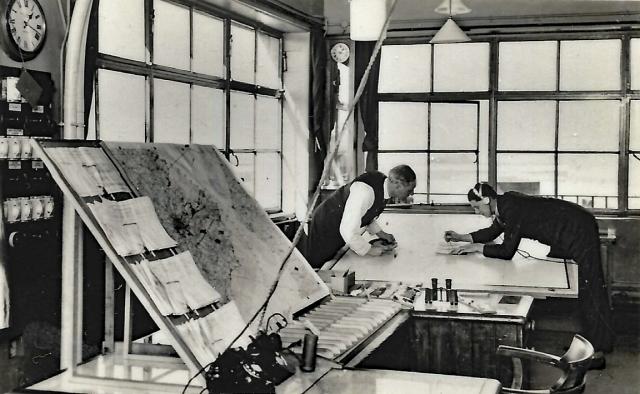
In the control tower at the top of the airport building there is always a number of Chinese operators in front of complicated looking instruments, headphones to ears, oblivious to the outside world, receiving and sending messages to various aircraft on the way to or from Kai Tak. One of the airport officials remains in the control tower tracing the path of the expected or departed plane with a blue pencil on the glass top of a huge map, until the plane reaches its first destination. In the case of an incoming plane, he does not leave his post until the pilot asks for the wind direction on the landing area. Then he knows all is well and goes down to join the throng awaiting the plane’s arrival.
Here the ground staff—mechanics etc. : porters with disembarking stepladders and luggage wagons: a gleaming red Royal Mail van with Post Office officials; reporters and representatives of the airline; coolies and hotel buses; friends with private cars; with the airport’s fire engine and ambulance striking a slightly sinister but reassuring note. The plane circles around to ascertain the wind force, then down until after a perfect landing it taxies along the ground and comes to a stop a polite distance away from the waiting crowds.
The Imperial Airways commander and his copilot, dressed in a Khaki uniform,(Summer dress, Winter-Navy blue), calmly climb out of their “office”, and shake hands with airport officials. The passengers disembark; the luggage is unloaded; Then the mail, bags and bags are checked into the mail van for distribution to eagerly awaiting recipients.
Comments
The scene would be similar in both control towers
Extracted from an Imperial Airways Gazette-1936 article highlighting Kai Tak airport’s control tower activities
Transcription: MODERN EQUIPMENT
The airport of course, does not depend on sight and sound for warning of an airliner’s arrival. Its departure is signaled from one stop to the next, in this case from Hanoi in French Indochina about 2 ½ hours distant, and after that Kai Tak remains in constant radio communication with the plane for the rest of its journey.
In the control tower at the top of the airport building there is always a number of Chinese operators in front of complicated looking instruments, headphones to ears, oblivious to the outside world, receiving and sending messages to various aircraft on the way to or from Kai Tak. One of the airport officials remains in the control tower tracing the path of the expected or departed plane with a blue pencil on the glass top of a huge map, until the plane reaches its first destination. In the case of an incoming plane, he does not leave his post until the pilot asks for the wind direction on the landing area. Then he knows all is well and goes down to join the throng awaiting the plane’s arrival.
Here the ground staff—mechanics etc. : porters with disembarking stepladders and luggage wagons: a gleaming red Royal Mail van with Post Office officials; reporters and representatives of the airline; coolies and hotel buses; friends with private cars; with the airport’s fire engine and ambulance striking a slightly sinister but reassuring note. The plane circles around to ascertain the wind force, then down until after a perfect landing it taxies along the ground and comes to a stop a polite distance away from the waiting crowds.
The Imperial Airways commander and his copilot, dressed in a Khaki uniform,(Summer dress, Winter-Navy blue), calmly climb out of their “office”, and shake hands with airport officials. The passengers disembark; the luggage is unloaded; Then the mail, bags and bags are checked into the mail van for distribution to eagerly awaiting recipients.