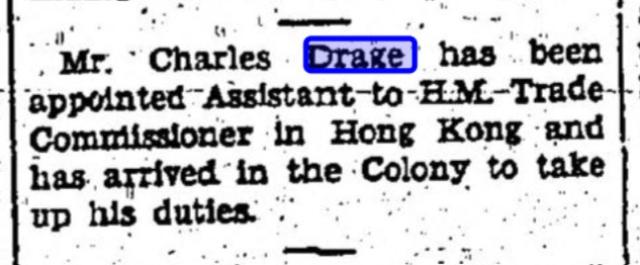
Michael Alderton notes that this notification was published in the 14 December 1934 edition of the Hong Kong Daily Press. The appointment as Assistant to H.M. Trade Commissioner, working from an office in the Hong Kong and Shanghai Bank headquarters building, was in fact the cover for his intelligence gathering activities.
In a 1982 interview conducted by the Imperial War Museum, it was revealed that, during 1934, Commander Charles Drage had been appointed to serve as an intelligence agent with Britain’s Secret Intelligence Service in the Far East. He had been personally recruited by Lord Hankey, Secretary to the Committee of Imperial Defence, and his mission was to penetrate the armed forces of Japan.
Date picture taken
14 Dec 1934
Shows person / people
Comments
Commander Charles Drage and General Two-Gun Cohen
Michael Alderton (essarem) notes that, according to the Hong Kong Daily Press list of passenger arrivals for 23 October 1934, Commander Charles Drage had arrived in Hong Kong from England, via North America and Shanghai, on Saturday 20 October 1934.
The newly arrived British Secret Intelligence Service agent recalls how, some six months later: Life had not been easy for me since my arrival in the Far East on a mission in which my interests were centred exclusively on Japan. I had made every kind of mistake and met with every sort of setback, while progress of any kind had been heartbreakingly slow. But gradually I had found powerful allies with a deep and steadfast loyalty to that nearly unified China whose very existence was now threatened by the Japanese Army. The first of these allies had been Two-Gun Cohen.
According to the China Mail’s list of guests staying at the Peninsula Hotel, General Two-Gun Cohen had been a hotel guest at the time of the 23 April 1935 Saint George’s Day celebrations.
Peninsula Hotel Ballroom - St George’s Day 1935
Commander Charles Drage continues: The scene was the ballroom of the Peninsula Hotel, and the occasion the Annual Ball given by the Hong Kong branch of the Royal Society of St. George. Morris talked to me of Chinese manners, customs, and ways of life. I listened with respect and with gratitude. No one in China was better qualified to speak on such a subject and no one – most certainly no one in official circles – had proved so friendly. Twelve years had passed since our first meeting during the Canton Customs Crisis of December 1923. In those years he had developed from a popular and trusted character into a figure who could only be described as famous and might almost be called fabulous. A figure, too, of extraordinary contradictions. His success in the crooked half-world of arms traffic had to be set against his reputation for absolute uncompromising honesty in money matters; his shrewdness in all business deals against his quixotic generosity to anyone in distress, and the fantastic lavishness and extravagance of his frequent parties in the great luxury hotels of Hong Kong. His name was on most men’s lips and, if his real place in Chinese revolutionary history was hard to estimate, his purely military prowess had not gone uncommemorated. Time had dealt harshly and yet not altogether unkindly with his appearance. A huge bald head was his most conspicuous feature; his fine beak of a nose had been partially flattened and bent well to one side of his face, while his cheeks and throat had begun to show the dewlaps of middle age. Yet he remained an impressive figure in any company. His enormous breadth of shoulder enabled him to carry with dignity his ever-increasing weight; his expressive eyes remained unchanged and his whole face radiated optimism and good humour – the face of a man utterly at peace with the world as he knew it. His unique knowledge of every figure on the Chinese political scene, his extraordinary insight into character, and his unrivalled experience of oriental affairs combined to supply exactly the background of which I was in need. Furthermore, it was impossible to spend an evening in his company without feeling the better for it.
Edited extracts taken from: 1954 - Drage, Charles, "Two-Gun Cohen", Jonathan Cape, London, March 1954 | Gwulo
Timeline taken from: 2020 - Maj.Gen. M.A. 'Two-Gun' Cohen - a 496 page life chronology..jpg | Gwulo