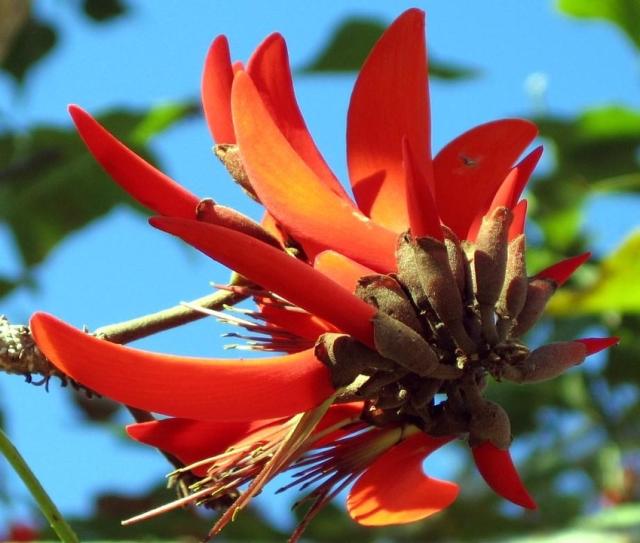
erythrina caffra flower bundle.jpg

Date picture taken
26 Dec 2014

Comments

This post is inspired 💡 and continued from Tung's notes before (link).

Below are some possible supports from the botany databases, for further exploration of a theory.

     For the period 1801 to 1911, distribution of the specimens showed that they are solely collected from South Africa. (reference link 1)

     Detailed list of the 11 specimens can be perused (reference link 2). The earliest one is dated 1888.

note : both the map and the list are zoomable, to view the breakdowns. We also know Portugual and South Africa are highly related in the 1800s.


Interestingly, one specimen was collected during the war years in 1943 by the South China Botanical Garden, botanist Woonyong Chun (陳煥鏞) who was born in Hong Kong. Probably it was collected within the Kwangtung province. (link)


Incidentally, years ago I found out that the given photo is from a clip of one of the Pitcairn island's YouTube videos. That is the closest Erythrina species, with flowers quite alike to the Twin Red Coral Trees located in my home garden in Cheung Chan since the 1950s.

They certainly originated somewhere in the Southern Hemisphere. 


Tung


There appears quite a number of variations in the Erythrina species.

But the description of Erythrina Caffra appears rather different from the others :

   A medium to large tree, usually 9 to 12 m in height, but reaching 20 m under favourable conditions; occurring in coastal forest and riverine fringe forest.

  • Bark : grey, often with short, sharp prickles.
  • Leaves : 3-foliolate, the terminal leaflet being the largest; leaflets broadly ovate to elliptic, 8 to 16 × 8 to 18 cm, the 
    lateral leaflets slightly smaller, without hairs or spines; apex tapering; base tapering, the base of the lateral leaflets asymmetric; margin entire.
  • Flowers : orange-scarlet, produced before the leaves, in large, spectacular, thickset racemes up to 10 cm long, the flowers 
    themselves crowded near the end; standard petal relatively short and broad, opening slightly to expose the stamens; cream-coloured flowers do occur (August to September).
  • Fruit : a dark-coloured, cylindric pod, up to 6,5 cm long, deeply constricted between the seeds, without hairs (October to December).
    The wood is greyish in colour, light, soft and spongy. 
    They are easy to propagate from seed or from truncheons and make splendid garden subjects; in fact, they are doubly desirable for,
    apart from their beauty, the nectar in the flowers attracts sunbirds.


Above excerpt is from the book Trees of Southern Africa (2nd Ed., 1983)

Thank you for your research on this Red Coral Trees of the old Cheung Chau island I mentioned. 

The description on the Trees is well agreeable to those in my childhood home garden, which is the same site of today's Grace Garden back in the 1960s.

I try to determine their age. 

Their origin from the South Africa is a very good one. BTW, I hope some New Gen CC Islanders may be able to join our research too. They may be able to find out any remaining Red Coral Trees there.

A possible clue is from today's Pitcairn Island, a very remote tiny island in the South Pacific Ocean.

If the Pitcairn Island's Erythrina Caffra tree was not randomly planted by the sea birds, it would be very likely being brought to the island by the mutineers of the Bounty in 1789, at a time trees are part of the valuable cargo

Apart from their beautiful flowering clusters, the wood from these trees is also good for natural floats, like for balance on the side of a canoe. The beans are for ornamentals

Without any evidence, in my case, the trees might not even be shipped by the British. Fairly, they could the Persian, the Dutch, or others. Nevertheless, we have the timeline that is more than two hundred years ago.

Tung


Hi Tung,

I just noticed this. Some of your kindergarten school mates still recall fragments of school life and persons there, 
as one gwulo reader has shared the CTK campus photo under the Erythrina tree in FB (with part of your post translated by deepseek). 

You may refer to the FB known as Footprint of CC, date of post 9 Sept. 2025.
See if you may catch up something more, from comments on that FB page.
 

Wonderful!

So good to know there are former CTK students remembering those winter flower clusters of the Twin Red Coral Trees.

Back then up to the late 1960s, there were more trees of this kind, a few of the same Red Coral Trees located quite sparsely along the pier area. They looked not very old, maybe just a few decades. 

I remember that one of them was at a spot right by or close to the entrance of a nice sleeper motel. People told me quite openly that many islander gossips were coming from this place. However, I saw most people, young or old, preferred to use this small shady spot as a smaller town square.

The other location was on the sand land of the Tung Wan, right along the roadside at the back of the St. John Hospital. Some of the trees were useful to the fishermen. With these trees, they gained the convenience in setting up their fishing net repairs infrastructures. But that was only during old time, it might need permission to do that. I wasn't sure about that.

The last location that I can remember was around the Kwun Yum Wan area. Here, some even were hiding in private properties and becoming part of the hillside greenery.

It is not hard to consider that all other Red Coral Trees on CC were possibly the offsprings of the Twin Red Coral Trees of the CTK garden. I once kept some of the beans after the blooming season. I also realized that they are fairly easily got geminated and grow as a seedling within just a few rainy days. But proper nursery planting care has to apply for their successful growth during the first year.


Tung,