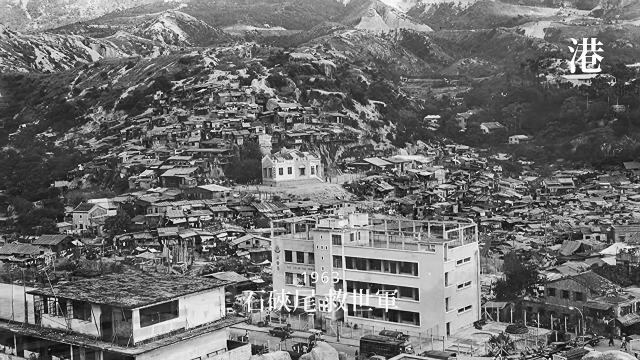
Film still from a YouTube video.
Squatter area on the hill nearby.
Can anyone identify the building behind the Salvation Army building?
Date picture taken
1963
Gallery
Shows place(s)
Film still from a YouTube video.
Squatter area on the hill nearby.
Can anyone identify the building behind the Salvation Army building?
Comments
School
Klaus, the 1970 survey map on hkmaps marks it as a school, but doesn't provide a name.
Thank you, Phil. The school…
Thank you, Phil. The school can also be seen here.
Chapel
I walked through that area 5-6 days a week for more than 10 years. It was generally referred to as the Salvation Army School.
The stone building in the center of the photo was a Maryknoll Fathers' chapel.
There were quite a few rooftop schools in that area. I don't think the rooftop school in the other photo had anything to do with the Salvation Army as it had another name.
Re: Chapel
The building seems to be quite old. In the 1922.1 survey sheet on hkmaps.hk, there seems to be a building at NKIL 78. No further information is given. The building can be seen in the 1977 aerial photograph, gone in 1980.
tkjho, just for curiosity: in which years did you walk by?
Chapel
Interesting - it looks like a very old building. There is some history about the Mary Knoll Father's school on wiki that mentions Fr Peter Reilly coming to HK in 1949 and setting up a wooden hut in Kowloon Tsai.
The current school website also says this:
I wonder if this small building was the initial school/study room/social centre that predated the construction of the current school in 1957 - hence why it is marked as a school on the later survey maps?
Maryknoll Fathers' chapel
Klaus, Philk,
From about 1960 - 1972, I passed through there on my way to Maryknoll Fathers' School just outside the lower right corner of this photo.
The chapel building (named 天主堂) was a solid stone structure, not a wooden hut. It was already there on my first day of school. The American Catholic Foreign Mission Society (popularly known as Maryknoll) was formed in 1911 in New York, and sent the first 4 priests to China in 1918. The structure in the 1922 survey sheet was unlikely the same building.
I think Fr. Reilly started off initially with schools for the refugees in the Tung Tau Tsuen area. After the huge Shek Kip Mei fire, the Tai Hang Tung area was flooded with homeless people, so he relocated to this area.
Father Peter A. Reilly
Maryknoll Mission Archives: https://maryknollmissionarchives.org/deceased-fathers-bro/father-peter-a-reilly-mm/
Chapel
Google Lens gives the name of St. Lawrence Chapel, but without any source. The building can also be seen on Hong Kong Memory. It is reported there:
These squatter huts are located in Kowloon Tsai near Tai Hang Tung Resettlement Estate. The stone building near the centre is a church, which has survived several squatter fires.
Again here.
Chapel
Interesting find. It would be nice to nail down the name though. Is it worth adding it as a separate place?
Mary Knoll chapel makes more sense because the current St Lawrence's is over in Lei Cheng UK.
Kowloon Tsai Chapel
Salient points.
2. Maryknoll Sisters commenced their religious work and teaching in Kowloon Tsai in 1961. One half of a one-storey stone building was used as a convent while the other half was utilized as a clinic for Maryknoll Fathers and catechumen rooms. The chapel was called "St. Peter in Chains".
3. The address of the convent was Lung Wah Street, Tai Hang Tung.
4. As time went on the catholic mission extended its outreach into medical care and social services. Maryknoll also operated a roof-top school in Kowloon Tsai. The Sisters house closed down in 1972.
Source: Maryknoll Sisters in Hong Kong 1921-1969 by Cindy Yik-Yi Chu: References to Kowloon Tsai are on Pages 119-122.
p119
I don't think p 119 is available for preview in the HK region, Moddsey, any chance of a summary?
Summary
Summary added in above. (please delete. )
summary
many thanks for adding it.
Chapel
Thank you moddsey for researching the chapel's history. I've copied your comment to the chapel's place on Gwulo.
St Peter's
There is a "St Peter's Church" very close to the location of the chapel on the 1968 surveys map (hkmaps.hk) but it is a different structure. I wonder if this is the "St. Peter in Chains" mentioned in the book? It was definitely adjacent (at the north end of where Nam Yiu House now stands). There is also another structure marked as "clinic" a short distance from St Peter's.
shifting all comments
David, I think it would be helpful if you move all comments regarding the chapel to its place "St. Peter in Chains" Chapel (Tai Hang Tung) [????-c.1977] .
St. Peter in Chains Chapel
A quick google: https://www.jstage.jst.go.jp/article/aijt/25/59/25_467/_pdf
The chapel may have had its origins in 1952, its initial location is not clear. Appears that the Maryknoll Fathers had established a presence in Kowloon Tsai prior to the arrival of the Sisters in 1961.
Chapel
From the source moddsey provided, the name could be Kowloon Tsai Chapel rather than St. Peter in Chains Chapel. If so, I will change the name of the chapel.
"St. Peter in Chains"
The name "St. Peter in Chains" rings a bell. I've been there a few times for first day of school ceremonies etc. The only inscription on the outside was 天主堂. There could be a foundation stone or plaque somewhere with the name on it, which I did not notice.
An interesting anecdote, the Catholic church used to dole out donated food products to the needy refugees, including powdered milk, bags of flour etc. As most of the people were from S. China, they had no clue what do do with the flour, and would take it to a bakery shop to exchange for a few buns. Monsignor John Romaniello, a Maryknoll father of Italian ethnicity, got wind of this and started to make noodles before giving them out. He even got a local machine shop to build him a noodle-making machine. He was referred to as the "noodle priest". Later on a lot of local churches would also have a noodle plant, such as St Peter's Noodle Plant, Cheung Sha Wan Caritas Noodle Plant (1961).
In the first few years of my primary school days. Students-in-need could receive these donated food products, but if and only if they got baptized, somewhat in the vein of The Doctrine Of Discovery. A lot of my schoolmates got baptized to take advantage of this, I remained an atheist to this day.
History of Maryknoll
https://maryknollsociety.org/maryknoll-history/
Maryknoll Fathers Seminaries in Ossining, NY and in Los Altos, California. The buildings are somewhat similar to the Stanley house in HK, built with local stone in NY, stucco in Los Altos, and brick in Stanley.
https://www.flickr.com/search/?text=Maryknoll+Fathers+seminary
Further to St. Peter in Chains, Kowloon Tsai
"St. Peter's Catholic Church, Kowloontsai"—refers to a chapel that was situated near the squatter settlement of Tai Hang Tung in Kowloon Tsai. Established in December 1952, the site was initially known as a "Catholic Center" (天主教公所) before being renamed "St. Peter in Chains" and subsequently elevated to an independent parish in 1957. During the early 1960s, as residents of the Kowloon Tsai squatter area faced profound hardship, clergy and nuns—working from within this humble, makeshift wooden chapel—dedicated themselves to supporting the local impoverished community, providing both material relief and educational services.
The chapel remained in service until the 1970s, when the squatter settlements in Kowloon Tsai and Tai Hang Tung were cleared and redeveloped. Having fulfilled its historical mission, the chapel was subsequently closed and ceased operations, never having undergone a name change."
Source: https://www.facebook.com/groups/1592155294398446/posts/4702675350013076/. Facebook Group: Hong Kong & China Stamp Enthusiasts; Poster on FB: Charlie Kam. Condensed and Google Translated into English.
St Peter in Chains
Moddsey.
If St. Peter in Chains was a wooden structure, it would not be this one. It would have burnt down with the other huts. Could it have been located in another part of Kowloontsai?
St. Peter in Chains
I noticed the "wooden" remark. Not sure whether the chapel began as a wooden structure and later moved to the stone building after the fire or the stone building itself was the original chapel from the onset.
I posted the info from FB to provide a comparative link. Thanks for your query.
Maryknoll Sisters in Hong Kong 1921-1969 by Cindy Yik-Yi Chu
1 copy in Internet Archive, but not available for borrowing. Only the preface pages can be previewed.
This can be circumvented by searching for the word "the".
https://archive.org/details/maryknollsisters0000chuc/page/6/mode/2up?q=the
Father Peter A. Reilly
I assume the wooden structure is derived from information in the Maryknoll Archives.
Father Reilly arrived in Hong Kong in December 1952. He established a tiny mission in a wooden hut surrounded by thousands of refugees in a place called Kowloontsai.
Source: https://maryknollmissionarchives.org/deceased-fathers-bro/father-peter-a-reilly-mm/
St Peter in Chains chapel
Looking back at the photo carefully, it dawned on me that this stone building was not the chapel I went to a few times. This one was behind (North of) the Salvation Army, but the chapel should be slightly south of the SA.
In the book Freedom Bridge, Maryknoll in Hong Kong, I found a photo of another chapel that matched perfectly with philk's 1968 survey map. Unlike the other structure, this one has the words 天主堂 prominently displayed on its facade. The book itself has a detailed account of the Maryknoll Fathers' early days in HK.
The chapel mentioned above…
The chapel mentioned above can be seen in the photo below. It is in the foreground with only the roof and cross being visible. The other stone chapel is in the background.
Mystery Solved
After digging deeper into my long term memory, I have it all figured out.
The stone building was not a chapel, but a leftist school named Tai Tung Middle School 大同中學. The signage at the lower right corner of the building is too fuzzy to discern. An enhanced crop of the signage shows that the bottom 2 words look like 學校, the top 2 words are harder to make out.
The 5-storey building further up and situated between the stone house and Salvation Army was the leftist Heung Tao (Fragrant Island) Middle School 香島中學, where "homemade pineapples" were manufactured in the labs in 1967.
I never ventured up that area as it was full of opium dens and other criminal activities. Carloads of drug addicts going there for their fix were daily sightings in the sixties.
Congratulation, tkjho, for…
Congratulation, tkjho, for the result of "brain squeezing". The fact that the building was a school fits better with the 1960s maps where the building also was marked as school.
Re: Tai Tung Middle School
The stone building was not the Tai Tung Middle School. It was located at Kowloon Tong Village Lot 81, northeast of the Salvation Army Building, and is not visible in the main photo. After that school was closed in 1981, the land was redeveloped as the City Polytechnic of Hong Kong (now the City University of Hong Kong) and Festival Walk.
In some discussions on Facebook posts related to the Kowloon Tsai squatter area, it was claimed that the stone building's address was 81 Man Shan Lane (萬山里), Kowloon Tsai. It was once used by the "Shing Kwong School" (聖光學校 literally means Holy Light School) that provide preschool and primary education. It was later renamed as "Po Yuk School" (普育學校).
https://www.facebook.com/share/p/18X6J2sw5C/
https://www.facebook.com/share/p/1FXZjoMAmx/
https://www.facebook.com/share/p/18jNt8gzPA/
No records related to the Shing Kwong School is found on the old newspapers on the HKPL digital collection. However, an article about the list of graduates of Po Yuk School at Kowloon Tsai appears on p.11 of Wah Kiu Yat Po, Jul 28, 1966.
https://sls.hkpl.gov.hk/digital-collection/tc/contentcoverpage.html?currentPosition=2&searchId=4c97d5d646e441ee9ea89f48feed9dd8&catalogueId=1cf720b99cb711ef9c2&mainKeyword=%E6%99%AE%E8%82%B2%E5%AD%B8%E6%A0%A1&isHKMP=
cwy911 - thanks for pointing…
cwy911 - thanks for pointing it out. I was not aware of the existence of these 2 schools at all as I dared not venture into the crime ridden area.
The top 2 words in the signage seems to fit 普育 more than 聖光 or 大同.
According to this 1966 Wah Kiu article, there were at least 2 schools in the squatter area. 普育 graduated 14 P.6 students. Ching Tai graduated 32 P.6 students and had close to 1,000 people attending the graduation ceremony. Would you know of its exact location?
In this photo there's another structure to the right of the stone house. Would that be the campus of Tai Tung?
Ching Tai School
I am not sure where Ching Tai School is. On the 1968 survey map from hkmaps.hk, there were two unnamed schools nearby the Heung To Middle School. Maybe Ching Tai School was one of them?
Tai Tung Middle School should be visible from the angle of the photo you have shared, so I think it was likely the campus.
Tai Tung School
Tai Tung School can be seen in the 1965 aerial image below, it's the large L-shaped building. I think the other building you mention can be in the lower left section of the image, although here it appears to have lost its pitched roof. Perhaps it was the original school building before being replaced by the larger one?
Aerial View
AI Colorized version of this 1963 aerial photo makes the structures a lot easier to discern.
Counterclockwise from A to H
1963 survey map - ? Ching Tai School
Unidentified school B on Tai Hung Tung Road. The campus was substantially larger than that of Po Yuk School, with 3 buildings and a large yard. In 1966, Po Yuk graduated 14 students, Ching Tai graduated 32 students. As there were no more identifiable schools in the area, this was most likely Ching Tai School.