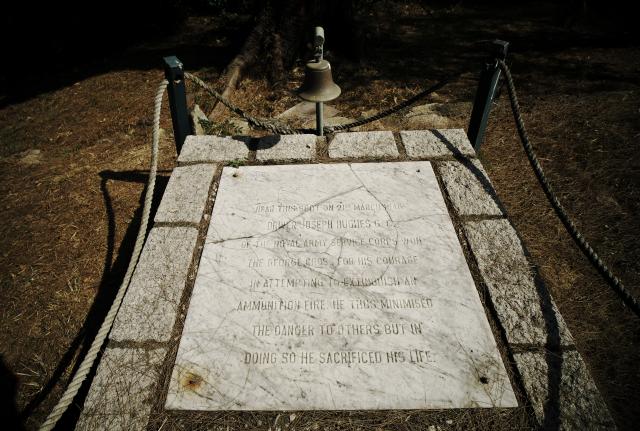
The stone was placed in a small yard area behind the garrison church at the Lei Yue Mun Park and Holiday Village, as of my last visit in 2019. For details and the location of the new memorial stone, please visit the VC & GC Association webpage.
Date picture taken
2019
Gallery
Comments
China Mail
The March 22, 1946 edition of the China Mail ran extensive coverage detailing the scale of damage and repercussions of the explosions. Here is the front-page headline excerpt:
For ease of reading, the transcription of the coverage is provided below, as the original story spanned multiple pages and some of the text is illegible at times:
SHAUKIWAN DISASTER
Munition Dumps Explode, Seriously Injuring 50 People; One Death Reported
Compulsory Evacuation Ordered By Police
AFTER THREE HEAVY EXPLOSIONS AT MID-DAY WHICH CAUSED SEVERE PROPERTY DAMAGE, SERIOUSLY INJURED FIFTY PERSONS, INCLUDING ELEVEN BRITISH SERVICE PERSONNEL, AND CAUSED MINOR INJURIES TO PERHAPS TWO HUNDRED OTHERS, THE SHAUKIWAN DISTRICT LAST NIGHT LAY UNDER THE SHADOW OF FURTHER DISASTER, THE MENACE OF THE EXPLOSION OF A DUMP CONTAINING FIFTY-FIVE TONS OF AMMUNITION.
Fires started by the earlier explosions were in dangerous proximity to this dump, and though every effort was being made, under difficulties to smother them, it was not expected that the "All Clear" could be given for at least twenty-four hours.
THE DISASTER, WHICH ALL VICTIMS COMPARED TO AN AIR RAID EXPERIENCE, ACTUALLY OCCURRED IN AMMUNITION DUMPS ASSOCIATED WITH LYEEMUN FORT AND IT WAS OF SUCH PROPORTIONS THAT IT WAS A MIRACLE THAT ONLY ONE FATALITY WAS DEFINITELY REPORTED. AT ONE TIME DURING THE DAY, IT WAS ANNOUNCED THAT TWO BRITISH SERVICEMEN, WERE DEAD, BUT LAND FORCE H.Q. LATER STATED THAT THERE WAS NO CERTAINTY THAN ANYONE IN THE FORCES HAD BEEN KILLED.
What had happened was that Kung Nam village, in the direct line of the blast, had been virtually reduced to a ruin, and that Shaukiwan Village, the Colony's most thriving fishing centre, only escaped the same fate because of an intervening ridge of hill running down from the fort to the sea, which broke the force of the concussion.
SEVERAL OF THE ELEVEN SERVICE PERSONNEL INJURED SUFFERED FROM SEVERE BURNS, OTHERS WOULD PROBABLY HAVE SUFFERED SIMILARLY, BUT FOR THE FACT THAT BEFORE THE FIRST TERRIFIC EXPLOSION OCCURRED, A WARNING HAD BEEN GIVEN AND THOSE IN THE IMMEDIATE VICINITY HAD AN OPPORTUNITY OF GETTING PARTIALLY CLEAR.
WARNING WAS POSSIBLE BECAUSE OF THE ORIGIN OF THE DISASTER. TWO LORRIES WERE ENGAGED IN LOADING OPERATIONS AT THE ENTRANCE TO AN AMMUNITION DUMP. ONE OF THEM, FOR REASONS NOT YET EXPLAINED, CAUGHT FIRE SOON AFTERWARDS. IT BLEW UP AND THERE FOLLOWED A WHOLE SERIES OF EXPLOSIONS, INCLUDING THREE OF TREMENDOUS FORCE WITHIN ROUGHLY FIVE MINUTES OF EACH OTHER.
These three explosions were heard plainly in the city, which soon afterwards was being gently showered with dust from the huge cloud which had been sent up by the blasts five miles away.
A complete picture of the disaster was still difficult last night. The damage and destruction was considerable and widespread, but at no one place did it assume the proportions of a major catastrophe. Casualties occurred as far away as a mile and a half. Men within a hundred yards suffered no more than shock.
A member of the R.A.F. who was one of several men working near the scene of explosion, told the "China Mail:"
"A party of R.A.F. personnel was working, not more than 50 yards from one of the magazines when suddenly an alarm to "clear out" was given. All the men in the vicinity scattered for cover but they had not gone far when the first shattering explosion occurred, throwing many to the ground."
The eye-witness said he could not tell whether any of the party was injured. He himself was blown off his feet but he escaped without Injury.
Row Of Magazines
Describing events, he said that the first explosion apparently started at the end of a row of magazines. The first occurred with terrific force, followed by several minor ones. Then a second big explosion took place about five minutes after the first. Five minutes after that, following several more "muffled" explosions, buildings near the scene were shaken by another heavy blast.
The immediate vicinity was completely covered with debris and a heavy pall of dust and smoke lay over the area, making it hard at the time to see more than a few feet.
Giving an airman's Impression, he likened the blast, to the shake-up likely to be made by "a couple of stick" of bombs dropped on a small area.
Village Casualties
Three babies were among the ten persons injured in one house (a jeweller's establishment) in Shaukiwan village.
"We heard the explosion," said one of the more fortunate of the inmates, "but we did not know what had happened, and then the roof came crashing about our heads."
Steel bars whirling through the air caused the damage. Coming in a cluster, they smashed through the roof, tore white-ant ridden fir poles into matchwood, and buried the occupants under tiles and rubble.
This part of the premises was completely wrecked.
In the front part of the structure, of two storeys, a large concrete block crushed through both roof and the first floor, without causing any injuries.
Lethal "Weapon"
In the road outside, only ten yards away lay a twisted sheet of steel, roughly thirty feet long, a weighing more than a ton, which had travelled nearly half a mile before hurtling into Shaukiwan village. Miraculously, it caused little damage and no casualties, falling plum square across the street, between two rows of buildings, practically touching both sides, and burying itself more than a foot into the asphalt and smashing the water-main.
In its passing, it tore a hole in the roof of the building nearest the scene of the explosion and brought down part of the small verandah, but the sum total was trivial in relation to its potentiality for spreading disaster.
Extensive Damage
Dozens of roofs were smashed through by iron rods and pieces of concrete. Some of these flying missiles must have weighed two or three hundred-weight each, and smaller pieces were scattered over the entire area within a radius of half a mile.
Kung Nam village which was in direct line of the blast suffered worse. Fortunately, it is little more than a fishing hamlet of thirteen or fourteen houses. As one officer on the spot put it, "They don’t look new anymore," a masterpiece of understatement.
Without exception they were badly damaged and for practical purposes, the village is no longer habitable.
Here, half the population was to be counted among the injured, and many of the more serious cases came from Kung Nam. Several men were blown clean into the water, but these were the more fortunate ones. In the houses, scores were injured by the crashing masonry, and it was astounding that the only death was that of an old woman, aged about 60, whose body was found at about four in the afternoon.
The barrack area, above the ammunition dumps also suffered severely.
Most of the occupants of the buildings appear to have received the warning in time and managed to get to cover outside.
The structures yesterday afternoon were described as “looking like London after the Blitz.”
Twelve persons, three of them requiring hospital treatment, were injured in Shaukiwan Main Street, a mile from the dump, and were given first aid treatment in the Shaukiwan Public Dispensary.
Still farther away, near Taikoo Dock, a woman was picked up with a shrapnel wound in the forehead.
Flying Debris
Flying glass caused numerous minor Injuries. Windows were shattered as far away as the Lady Park Recreation Centre. One of the heaviest sufferers in this respect was Shaukiwan Police Station itself, which was littered inside and out with shattered window glass.
Shaukiwan Police Station, converted into a temporary dressing station, dealt with the majority of the minor casualties. At one time, when the injured were being brought up in appreciable number, injections were given to sufferers in the street outside.
Medical Work
Medical aid could hardly have been more efficiently or completely organised, Within a few minutes of the explosions, the Royal Navy had mustered five ambulances, three lorries, ten medical officers and numerous Sick Berth Attendants in the Shaukiwan District, and a continuous stream of vehicles following brought medical supplies, operating equipment, more ambulances, more doctors, more nurses, from all three Services, the Civil Medical Department and the Red Cross.
The collection of the casualties proceeded swiftly and all who required hospital treatment were on their way to hospitals within an hour and a half of the first blast.
The Fire Brigade, under Chief Brigade Officer Smith, was as quickly on the scene, but owing to the position of the ammunition dumps, it was impossible to get fire appliance close enough to deal efficiently with the fire which followed the explosions.
Village Evacuated
The danger of the further explosion compelled the issue of an order for the evacuation of Shaukiwan Village and pitiable sights were seen. Mothers wrapped up babies in heavy quilts and rushed wild-eyed through the streets, old men and old women struggled along, carrying a few belongings in hastily thrown together bundles, walking casualties were there, assisted by friends, others seemed prepared to take their chance and had to be routed out of their homes before they would go.
The stall-holders in the market appear to have taken panic, for everything was left as it stood, stalls laden with vegetables, tomatoes and fruit, forgotten and unguarded.
Everywhere there were signs of the same hasty flight. Scarcely five per cent of the village population stayed long enough to lock their doors behind them. Few bothered even to shut them. At two o'clock in the afternoon, except for the odd policeman, a stray chicken and a dog or two, there was no sign of life in the village.
Most of the people found temporary accommodation with friends in the Taikoo area.