I’m intrigued by a deleted entry in the 1916-17 Rate Book that includes 1-5 Perfection Place among the jointly owned properties of my grandfather, C.E. Warren and his partner/brother-in-law, John Olson jnr. No. 1 Perfection Place is given as a “Dwelling” but has never been mentioned as an address for any of the members of the Warren or Olson family by my predecessors who trawled the accessible records to establish our joint family histories.
The following link shows a sketch of typical house in Perfection Place. The text implies that the houses were residential and typically owned by well off families.
In the early years, the rich who had a big family usually bought a large piece of land and built a house there, calling it a "terrace" (meaning a terrace on the hillside). They did so because of tradition (the tradition of having a big family) and security (a wall could be built around the house, and also a gate tower and a corner tower to guard against thieves). These buildings were usually western in style. The terrace as shown in the painting does not exist any more.
I can only find entries for nos. 2 and 3 Perfection Place in the jury lists and not until 1935 and 1936; namely for the Oji Paper Company and William C. Jack Co. Ltd. Jacks was a large engineering company that undertook similar projects to C.E. Warren & Co.
Perfection Place has not been given as the address of the previous Warren factory that moved to Bowrington at the end of 1910. I should be interested to know if Perfection Place 1-5 crops up in any other context around this date. The name of the new owner, So Tang Shi, is similar (but not identical) to the “Kot Tang Shi” mentioned by seemex as a possible ancestor, but the possibly relevant 1913 Carl Smith card for that name is missing.
Apologies that I have no idea how to place a marker correctly on the map. I hope the link and I.L. no will help.
When I posted this message, I must have overlooked the fact that I have a Rate Book record of Perfection Place 1-5 in the year 1916. Here it is belatedly:
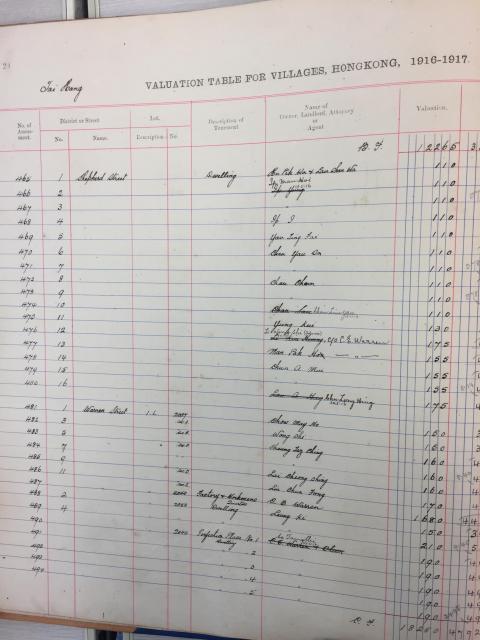
In May 1916 my grandfather, C.E. Warren sold his share of 13 Broadwood Road to John Olson and moved in to 20 Broadwood Road which had just been completed. Their joint sale of Perfection Place 1-5 seems to have been one of the transactions that fully separated their ownership of various properties.
Photos that show this Place
Comments
I've added a marker at the
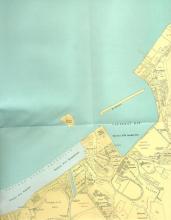
I've added a marker at the location of IL 2040 as shown at https://www.hkmapservice.gov.hk/OneStopSystem/map-search#
Perfection Place - origin of name?
Does anyone have any idea how the name "Perfection Place" originated?
Perfection Place
Hi Jill, I've just been doing random searches and one led back to an old Gwulo posting, that we both contributed to. It was the "Kot Tang Shi" and "So Tang Shi" link. I was looking at the map insert and I see this location was quite close to Moreton Terrace.
My original discovery of Kot Choy was due to a letter involving the sale of a property located at 4 Moreton Terrace. It was owned by Kot Choy! It was sold in 1937 and the proceeds were disbursed in 1941. At that time I had no idea of the relationship of Kot Choy to my family. The coincidence in the similarity of the two names and now the site locations being so close? The Moreton Terrace developement I think began about 1925. There's not much info on it.
Anyway, I trust all is well with you.
Regards, Brian
Seeking Perfection Place (again)
Hi Brian, you remind me that I have let my search for Perfection Place go cold. I'm sure that there are Gwulo historians who could maybe dig out an old map of the Tai Hang area in which it figures. I'd be very grateful! I.L. 2040 is the key. Was it the former name of Warren Street? I had thought that Warren Street was built from scratch to house the company workers.
I had never heard of Kot Choy before you mentioned him. I don't know much about the friendships or business connections of the Olsons, but Hong Kong is a small place.
info supplements for the place
With some luck, I could find below info within a few clicks. See if it may help for your connections on the timeline.
The I.L. 2040 was on sale by auction as early as Sept. 1913 (link).
In the notification, some description of the lot is like :
20,250 (about)
150-150-135-135 ft.
N S E W
Cost of removal of existing pig-sties at present and boundary stones are specified as conditions to the purchaser. [1] Pigsties may suggest it is more 'rural', kept towards the hillside ?
Some of its development over time may be more or less seen in maps. e.g on the gwulo maps :
1901 'Tai Hang Village' is marked on the east of the area, but some different strips on the west side (near this place);
School Street, King Street, Shepherd Street and the Lanes exist already, but no Warren Street yet. It is said that many of these Tai Hang street names are related to government officers of the late 19th century and after.
1905 'Tai Hang Village' is put over the west side of this wide area, some blank space towards the hillside [*]
On the plan of Victoria 1914, the lot no. 2040 is marked there, near 165. It does not exist in the 1913 plan. [2]
A photo of this area of Tai Hang from the Harvard-Yenching Library of Harvard University (👈click to view). [3] Possibly from the 1950s.
I think the related houses are near middle left, beneath the hillside.
Your inputs and comments are welcome, to fill in more context.
The name of the terrace Perfection Place in Chinese is not a direct translation (十全). It is kind of Chinese thinking/idiom about being perfect.
sources
1. Government Gazette, 1913
2. hkmaps.hk
3. cityintime.hk
[*] in the 1897 Plan, the west side of it is denoted as 'Hoong Heong Lo Valley' (literally, the name is Red Incense Burner), which the map of 1880 also shows, here
Perfection Place
I must have missed your kind message last year. Thank you, hkspace!
How would you translate the Chinese characters for "Perfection Place" yourself? Please give as many versions as you like.
my try of alternative translation
A known recent usage of this ancient term 十全 is from the noted emperor (1711-1799) of the Qing Dynasty, when he boasted of the conquests in his reign and proclaimed himself '十全 Old Man' in 1792.
But in usual Chinese naming, I think 'perfection' is seldom put on as-is. In the Chinese University HK, we have the Lake of Ad Excellentiam 未圓湖, which comes close with the Chung Chi College's motto and Chinese philosophy.
I try to jot down two translations for Perfection Place :
1. 完全台 : 全 signifies 'wholeness', sufficient
2. 完全坊 : 坊[+] appears a recent reinvention for translating 'Place' by developers in HK
Above information is generally available in the public domain.
[+] Fong - as in 'Kau U Fong' (Central), Yi Pei 'Fong' / Yi Pei Square (photo in 1966)
Perfection Place
Thank you for this explanation. That makes sense about being whole or complete. I don't read Chinese but will try to send this to our son, who does. I like the name "Perfection Place". It's a pity that it disappeared.
Perfection Place
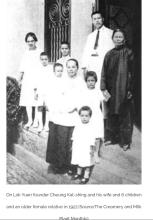
This subject caught my eye! I have been familiar with #1 Perfection Place since my childhood in HK during the 50s and 60s. My grandparents lived there! I don't know exactly when their occupation started, but I have collected old pictures of my grandparents and family at that house with the earliest dated as 1922 (as appeared in an American trade magazine 'The Creamery and Milk Plant Monthly). My grandfather founded the old On Lok Yuen business which included an ice cream factory. Grandfather passed away in 1963. My grandmother continued to live there. After her passing in 1983, the family sold the property (probably to the developers of the current high rise building at that location)
Grandfather's name Cheung Kat Shing
Perfection Place
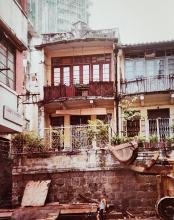
Good to know that Perfection Place still existed in the 50s and 60s. Thank you, Matt for posting the nice picture of your family. We've no record that any members of the Warren or Olson family actually lived at Perfection Place, but it was right next to C.E. Warren & Co. tile factory - not sure if it pre-existed that. I think the photo of your house matches the drawing in the Hong Kong Memory link that I posted at the beginning of this thread. Do you agree?
https://www.hkmemory.hk/MHK/collections/kong_kai_ming/All_Items/Images/201106/t20110614_38667.html?f=classinfo&cp=1980%E5%B9%B4%E4%BB%A3&ep=1980s&path=/MHK/collections/kong_kai_ming/All_Items/8709/8713/index_3.html
Perfection Place
Yes Jill. The picture you posted is a pretty good match. I visited my grandparents quite often during the 50s and 60s and had overnight stays. I still remember the interior of the terrace house very well. It had 2 stories of living space and a roof top via internal stair case. From the street level, we had to go up a flight of steps before reaching a neighbour's front courtyard, then through that yard before reaching the gate to grandparent's courtyard. Their house was the slightly taller one on the left of the picture.
The high rise residential building currently at that location is named Warrenwoods, and they use Tai Hang Rd as their main entrance.
Place Marker of Perfection Place
Looking at this recently posted photo at https://gwulo.com/media/53881 and 1970 map at: https://www.hkmaps.hk/viewer.html, there appears to be a mismatch of IL 2040 and address 1-5 Perfection Place.
The current place marker is correct for IL 2040 but 1-5 Perfection Place was slightly to the west of Warren Street and opposite Jones Street.
It may well be that 1-5 Perfection Place was originally on IL 2040 but later at some point (through private sale ?) the large lot became sub-divided and Perfection Place took on its own lot number.
A small mention made in a guide book published in 1991: Jones Street boasts a row of old homes called "Perfection Place".
Update
1913-14 Land Purchases made by Mr. C. E. Warren
(1) Tracing back, IL 2040 was offered for sale by public auction on 15 September 1913. See: https://sunzi.lib.hku.hk/hkgro/view/G1913/33426.pdf (double click). The Tai Hang Village lot was sold to Messrs. Warren & Co. for $7,100 or about 35 cents per foot. There was brisk competition from Chinese bidders. HK Telegraph 16 September 1913 refers. See here and scroll to Page 5.
(2) For reference, IL 2050 and 2051 in Tai Hang Village were sold to Mr. C. E. Warren on 17 November 1913. See: https://sunzi.lib.hku.hk/hkgro/view/G1913/33564.pdf (double click) and China Mail 18 November 2013 (Sale).
(3) IL 2087 in Tai Hang Village was also sold to Mr. C. E. Warren on 28 September 1914. See: https://sunzi.lib.hku.hk/hkgro/view/G1914/38624.pdf (double click) and China Mail 29 September 1914 (Sale).
re: Place Marker of Perfection Place
Thanks for checking the location. I've moved the marker west to its correct location.
The terrace of houses 1-5, and the two houses 6-7 to their south, are also visible on the recently added 1980 map: https://gwulo.com/node/54944?a=1#19~22.27828~114.19141~Map_by_GovHK-Mar…
I.L. 2050 in 1914-1915
With regard to the ownership of I.L. 2050, this page of the Rate Books records the situation in 1914-1915. Three of the Perfection Place properties are also recorded.
Hi Jill, I have written a…
Hi Jill, I have written a short story about this place. It is translated from Chinese in this link: https://www.facebook.com/share/p/14a6Ngvxpqj/
The English name “Perfection Place,” is quite distinctive. It appears to be a translation of the Chinese phrase “十全十美” (meaning “perfect in every way”), taking the first two characters “十全,” and using “Place” instead of the more commonly used “Terrace” for “臺.”
Although Perfection Place was located in Tai Hang, the site was not part of the Tai Hang Inland Lot (T.H.I.L.), but rather Inland Lot No. 2040, near Tai Hang Village (T.H.I.L. 165), covering about 20,250 square feet. The lot was auctioned on September 15, 1913, and purchased by C. E. Warren for $7,100. Newspapers reported that Warren would "build on the lot just acquired a modern tile factory, equipped with up-to-date plant, in extension of of the factory which they built a few years ago and which has already proved inadequate for the growing requirements of their business". C. E. Warren (for whom Warren Street in Tai Hang may have been named) operated C. E. Warren & Co., a company engaged in building construction and the sale of bricks and tiles, with its factory also located in Tai Hang.
Public Works Department reports from 1913 onward help trace the development of the site:
- The 1913 report mentioned that a “godown and quarters” would be built on I.L. 2040.
- The 1914 report stated that construction of the godown and quarters had not yet been completed by the end of the year, and also mentioned plans to build five Chinese houses on the same lot.
- The 1915 report recorded that both the godown and quarters, as well as the five Chinese houses, had been completed. It also referred to a scavenging lane for the site, then named Nos. 1–5 Tin Keng Terrace.
In the "Index to the Streets, House Numbers, and Lots of the City of Victoria (1915)", I.L. 2040 is listed under the final section of “Second Lane” in Tai Hang, but under a different name: Perfection Place Nos. 1–5, with the Chinese name “什全台.” The character “什,” when used as a number, is equivalent to “十,” so “什全台” is the same as “十全臺.”
Putting this information together, the lot was originally intended for factory use, but plans later changed. Part of the site became a godown and quarters, while the rest was developed into housing. Five Chinese houses were constructed, initially named Tin Keng Terrace, but soon renamed Perfection Place, a name that continued thereafter. Since these were tenement houses rather than European-style houses, it seems C. E. Warren never intended to live there himself.
According to information provided by Jill, a descendant of C. E. Warren (see Gwulo link below), the 1916 Rate Book shows that Nos. 1–5 Perfection Place were originally owned by C. E. Warren & Olson (Olson being John Olson, Warren’s brother-in-law). However, this entry was crossed out and annotated with “So Tang Shi 27.5.16,” suggesting that on May 27, 1916, Warren transferred the ownership of Perfection Place to "So Tang Shi". Very little is known about this new owner.
I have previously read 《測量香港五十年》(Fifty Years of Surveying in Hong Kong) by So Chun-hin, Albert, which includes a memoir of his surveying career and mentions "Perfection Place". Upon revisiting the text, it was discovered that the place had once been owned by the So family.
While working at Urban Estate, Albert So handled a lease modification case that required a site visit to Tai Hang. He described the scene:
“Walking from Lai Yin Street in Tai Hang toward the slope beside Tai Hang Road, I saw a platform about ten feet above ground level. Stone steps on both sides led up to it, and on a wall in front of the steps were three large carved characters: ‘Perfection Place.’ On the platform stood an old pre-war building - two stories high, consisting of five connected units. It had been vacant for many years and was in a dilapidated state. Later, from Land Registry ownership records, I found a 1913 owner surnamed So, named So Tang Shi. She was recorded in the family genealogy as my grandfather’s third wife.”
The date mentioned here may be inaccurate, since the lot was owned by C. E. Warren in 1913 and only changed the ownership in 1916. This passage helps resolve a long-standing mystery: “So Tang Shi” is not a full personal name, but a way of combining the surnames “So” and “Tang,” with the given name omitted, usually used to refer to a woman after marriage.
Perfection Place story
Hi hkcitypotoshoot! I'd love to read your short story on Perfection Place. I don't use Facebook, so I wonder if you can post the story on Gwulo as a "Story". Failing that, David could give you my email address and perhaps you could send it to me as a Word document. I look forward to reading it whichever way.
Hi Jill, my previous post…
Hi Jill, my previous post here is the main part of the story but without any photos. You can read the original post in https://www.facebook.com/share/p/14a6Ngvxpqj/, even you don't have facebook account.
Story of Perfection Place
Got it! Nice to see the actual street sign "Perfection Place". Thanks.