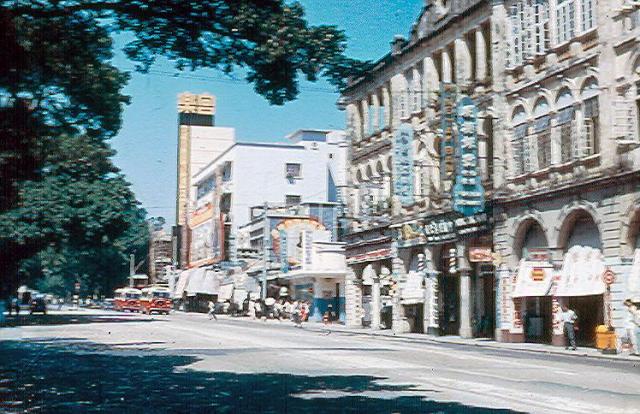
Princess Theatre: Usually had the newest films. Well known Dim Sum restaurant and in the 1960’s it was 30cents a dish, so if a dozen of us school boys could scrape together a dollar each we could go there and have something tasty ! In the low rise row of shops (awnings, white and blue paint) was an aquarium shop and my brother used to catch guppies in the paddy fields across the road from our house and take them to the shop to exchange for other fish. In the bigger row of shops on the right resided the dealer for Marklin trains, and it was a magnet for us to go there and watch his window displays.
Thanks for the contribution. Most of the guys who have contributed to the 367 Association's gallery were stationed at RAF Little Sai Wan. In the 1950s, it was well off the beaten track (now the site of the huge housing complex of Siu Sai Wan) and, while we occasionally crossed the harbour on the Star Ferries, we seldom ventured far down Nathan Road. So, it's interesting to read your memories. Hong Kong was very different in those days!
Thanks for your answer. My own connection with LSW was through the sailing club. The Enterprise fleet of two man dinghies was the biggest class in HK from 1960 to the mid 1980’s. . The service clubs at LSW, RAF KaiTak, Gordon Hard, and Stanley all had fleets along with TaiPo Boat Club, Hebe Haven YC and Royal HKYC. Regattas were held by all clubs, some twice a year as well as the HK Championships so the sailors from about 80 boats would meet each other at different times of the year on a number of occasions.
In the early days we would get to LSW by the long and winding road, which I think speared off Sheko Road, later on the lower gate was manned which shortened the journey by several miles.
Sometimes we brought the boats by road, but other times we sailed there.
Once you got to LSW the sailing was good, and the shore facilities convenient. Ariel House was always good for a large plate of eggs ham and chips, at very low cost !
The RAF moved out of Little Sai Wan in early 1962, and considerable alterations were then made to the buildings, e.g., to the large three-storey blocks of accommodation for airmen. On each floor there were up to ten rooms, each designed to accommodate four airmen, but with the introduction of two bunk beds it could be as many as six. Toilets and shower rooms were at one end of each floor. The rooms were accessed from long corridors running along the back of the blocks, with communal balconies at the front. There we would spend hours of our free time sitting admiring the view across the camp and the bay, watching junks under full sail, and sampans and ships crossing the mouth of the bay, while occasional planes flew low on their finals onto or from the original Kai Tak runway — even before the new runway jutting into Kowloon Bay was built. Under later civilian tenure, most of those rooms were converted into single person flatlets. Ariel House that you mention had been the Officers' Mess and the swimming pool and tennis court came after the RAF had quit the site. During my time 1957/8 there was no yacht club as a serious typhoon in September or October 1957 had wrecked everything!
On my several visits from 1987 to 2007, I always made a point of re-visiting the 'old place', scrambling round the Point to sit on our sunbathing rocks, recalling the days of my youth and half wondering whether to have a swim — but choosing instead to walk up the Leaping Dragon Trail (the old steep and twisting camp road that you mention) and use the now well-built path over the flank of Pottinger Peak to Big Wave Bay
Comments
Princess Theatre: Usually…
Princess Theatre: Usually had the newest films. Well known Dim Sum restaurant and in the 1960’s it was 30cents a dish, so if a dozen of us school boys could scrape together a dollar each we could go there and have something tasty ! In the low rise row of shops (awnings, white and blue paint) was an aquarium shop and my brother used to catch guppies in the paddy fields across the road from our house and take them to the shop to exchange for other fish. In the bigger row of shops on the right resided the dealer for Marklin trains, and it was a magnet for us to go there and watch his window displays.
Thanks for the contribution…
Thanks for the contribution. Most of the guys who have contributed to the 367 Association's gallery were stationed at RAF Little Sai Wan. In the 1950s, it was well off the beaten track (now the site of the huge housing complex of Siu Sai Wan) and, while we occasionally crossed the harbour on the Star Ferries, we seldom ventured far down Nathan Road. So, it's interesting to read your memories. Hong Kong was very different in those days!
LITTLE SAI WAN
Thanks for your answer. My own connection with LSW was through the sailing club. The Enterprise fleet of two man dinghies was the biggest class in HK from 1960 to the mid 1980’s. . The service clubs at LSW, RAF KaiTak, Gordon Hard, and Stanley all had fleets along with TaiPo Boat Club, Hebe Haven YC and Royal HKYC. Regattas were held by all clubs, some twice a year as well as the HK Championships so the sailors from about 80 boats would meet each other at different times of the year on a number of occasions.
In the early days we would get to LSW by the long and winding road, which I think speared off Sheko Road, later on the lower gate was manned which shortened the journey by several miles.
Sometimes we brought the boats by road, but other times we sailed there.
Once you got to LSW the sailing was good, and the shore facilities convenient. Ariel House was always good for a large plate of eggs ham and chips, at very low cost !
The RAF moved out of Little…
The RAF moved out of Little Sai Wan in early 1962, and considerable alterations were then made to the buildings, e.g., to the large three-storey blocks of accommodation for airmen. On each floor there were up to ten rooms, each designed to accommodate four airmen, but with the introduction of two bunk beds it could be as many as six. Toilets and shower rooms were at one end of each floor. The rooms were accessed from long corridors running along the back of the blocks, with communal balconies at the front. There we would spend hours of our free time sitting admiring the view across the camp and the bay, watching junks under full sail, and sampans and ships crossing the mouth of the bay, while occasional planes flew low on their finals onto or from the original Kai Tak runway — even before the new runway jutting into Kowloon Bay was built. Under later civilian tenure, most of those rooms were converted into single person flatlets. Ariel House that you mention had been the Officers' Mess and the swimming pool and tennis court came after the RAF had quit the site. During my time 1957/8 there was no yacht club as a serious typhoon in September or October 1957 had wrecked everything!
On my several visits from 1987 to 2007, I always made a point of re-visiting the 'old place', scrambling round the Point to sit on our sunbathing rocks, recalling the days of my youth and half wondering whether to have a swim — but choosing instead to walk up the Leaping Dragon Trail (the old steep and twisting camp road that you mention) and use the now well-built path over the flank of Pottinger Peak to Big Wave Bay