(If you can help to transcribe a page and upload the text to Gwulo, please leave a comment below and I'll send you the files.)
Step 1: Receive files from David
You'll receive two files, an empty .txt text file, and a .jpg scan of the diary that will look like this:
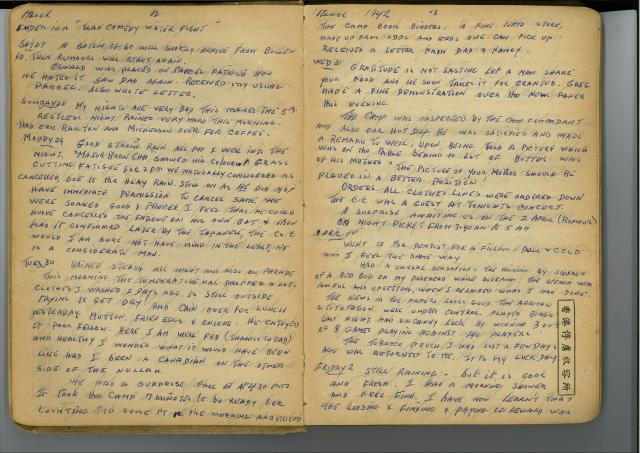
The file name will be something like: Diary page 21 - Mar 1943.jpg
The 'Mar 1943' tells you the month when the first entry on this page was written.
Save the two files to your computer.
Step 2: Use AI to extract the text
In your web browser, go to https://gemini.google.com/app
Click the '+' and upload the .jpg file I sent you.
Where it says 'Ask Gemini', paste the following command:
| Extract the text from this handwritten page and convert it to sentence case. Separate lines by spaces, and separate paragraphs by carriage return. |
Press the Enter key, and after a few seconds you will see the text extracted from the page, e.g.:
|
March 12 ended in a "SLAP COMEDY WATER FIGHT" Sat 27 A batch of 60 will shortly arrive from Bowen Rd. Then rumours will start again. Oswald was placed on parcel fatigue how he hated it. Saw Dad again. Received my usual parcel. Also wrote letter. Sunday 28 My nights are very bad this makes the 5th. restless night. Rained very hard this morning. Had Eric Railton and Michelson over for coffee. Monday 29 Good strong rain all day & well into the night. ... |
Copy all the text from Gemini, and paste it into the .txt file I sent you.
Step 3: Correct the extracted text
The AI does a very good at recognising the text, but there are usually a few mistakes, and sometimes it even misses a whole sentence.
Open both the .txt file and the .jpg files on the screen, then work through them line by line, comparing the two versions and correcting any mistakes you find.
N.B. We are making a faithful copy of the original, so preserve any mistakes in the original writing, only correct mistakes that Google Gemini made. e.g. Landau always incorrectly calls the airfield Kia Tak, so we leave that unchanged.
If you cannot read a word clearly, insert (sp.?) after it to let readers know.
When you've finished, save the .txt file.
Step 4: Add the days' entries to the Gwulo website
You'll add one page to Gwulo for each day's entry in the diary.
Find the first day's entry in the .txt file. In the above example it is:
| March 12 ended in a "SLAP COMEDY WATER FIGHT" |
Log in to the Gwulo website (you'll need to create an account if this is your first time posting to the site).
Look for the Directory menu on the left of the page, and click [+page] to add a new diary page.
On the next screen, Create Page(s) from Book / Document, fill in the fields as follows:
- Title: <leave this blank>
- Book / Document: Choose Leo Landau's wartime diary from the list.
-
Text: Paste in the text for the first day's entry in the .txt file. Don't include the date, so for the page shown above you'd just paste:
ended in a "SLAP COMEDY WATER FIGHT" - Date(s) of events described: Enter the day's date in format dd/mm/yyyy, so for this example you'd enter: 12/03/1943 (Remember that the month and year are shown in the names of the files I sent you.)
- Scroll down and click the Save button.
Repeat Step 4 for the next day's entry:
| Sat 27 A batch of 60 will shortly arrive from Bowen Rd. Then rumours will start again. Oswald was placed on parcel fatigue how he hated it. Saw Dad again. Received my usual parcel. Also wrote letter. |
Repeat Step 4 for all the remaining days' entries in the .txt file.
Step 5: Let David know that the page is finished
Please reply to my email, attaching a copy of the updated .txt file. If you're able to transcribe & upload another page, please let me know and I'll send over the files.
Thank you! The diary entries you've put online are now available for future generations of researchers to read as part of Leo Landau's wartime diary. They will also be included in the daily emails sent to subscribers of the Wartime Diaries project.
Diary transcribing
Hi David,
I would like to be the fifth+ persons to join this transcription exercise.
May share to all some optional proofreading aid by AI, after some more trials myself.
Thanks and regards.
p.s. updated 5 Sep.
(proofreading with AI, brief findings)
I have tried to use Claude AI (Sonnet 5) to aid the proofreading. As objective of this exercise is to keep the original text with spelling errors, the actual gains may not be big.
Below are few cases in which Claude helped in proofreading the limited samples produced by Gemini :
one sentence omitted from original image
add back some short words (e.g. prepositions) or punctuations, missed or misread
For readers in UK, Australia, Canada, I think you can use Claude right away. Readers in HK may be able to use Claude AI, if you are subscriber of some mobile service provider.
I use a prompt like this, with Gemini's transcribed text document :
compare the transcription against the original image and organize by entry, with the transcription’s wording versus what the image actually shows
My estimate is that the result may help to make some improvement, but less than 5% of the whole text.
If you would like to have a proofreading aid at hand, or some second opinion when no ideas, Claude (claude.ai) could be a good option.
AI's results vary, grey areas will remain grey. So it depends how humans make good use of it and judgment.
re: Diary transcribing
Thank you for helping, I've just sent the files to your email address.
transcribing the 'original' text - e.g. page 37
Page 37 I worked on appears to be one page which shows clearly the diary was written twice : first time lighter, possibly in pencil; second time in ink and mostly in capitals. In other words, the 2nd time was likely a transcription.
Could we refer to the lighter text* to make it more readable and closer to the 'original' ? There are pros and cons, in either way. What do admin and readers doing this exercise think ?
Best regards.
* if it exists
Re: pencil and ink
I was also wondering about the double-layer text in Leo Landau's diary. Likely someone transcribed the pencil text to ink text. It is impossible for to judge if both text were written by the same person, but I think it was Leo himself, possibly after the war.
Possibly Barbara knows more about it.
Re: pencil and ink
Barbara explained that after the war her father went through the diary re-writing all his pencil notes in ink. If an ink word isn't clear then it's worth looking at the pencilled text for clues, but in general we can just use the ink version.