After numerous delays, a decision was made in 1881 to establish a mission in Hong Kong. Some ten years after the plan was first conceived, the Revd Charles R. Hager was ordained as a missionary to China in the Bethany Congregational Church, San Francisco, California, on February 16, 1883. The remarks made by a Chinese member of the Congregational mission of the American Missionary Association illustrate the close links that were to be established between Chinese Christians in the United States and Hager's mission in Hong Kong.
The Chinese spokesman, Mr. Jee Gam, an assistant in the Congregational mission in San Francisco, expressed the concerns, dreams, and hopes of his Chinese colleagues for their motherland: "It was ten years ago when our Chinese brethren first felt the need of a mission in China at or near the districts from which most of our brethren came... The first three years we often expressed our great desire among ourselves for this mission, but never thought of telling our superintendent, Revd W.C. Pond. Not a word was said to him until at our usual Wednesday evening Bible class, about seven years ago, when the subject of foreign missions was accidentally mentioned. We then told Revd W.C. Pond what we so much desired. He at once approved it."
Hager's first Sunday in Hong Kong was spent with the Wan family, a visit that was not fortuitous.
Five years previously, Wan Ching-kai had been in correspondence with the Chinese in California regarding the establishment of a mission in Hong Kong. His enthusiasm for evangelism was noted in a report by the Revd W.C. Pond of the California Chinese mission: "Wan Ching Kai... has suggested that, in that English city of Hong Kong, mission work among the Chinese could be conducted most successfully, upon the very plan which we use here [in California]; and is very desirous himself to send native preachers into the neglected interior districts, asking whether our Chinese brethren here could not help him to do so...
The emphatic testimony which these bear to his good judgment and general efficiency, as well as his Christian character, makes both the work he has done and the work he wants to do, confirm my confidence in the suggestion I have made."
Fung Foo, a member of the California mission who visited Hong Kong in 1878, reported that Wan Ching-kai, "the most active deacon of the London Missionary Society congregation in Hong Kong," told him that the Chinese of Hong Kong felt a great need to learn English. He urged Fung to remain in Hong Kong and establish a night school to teach English, similar to those successfully conducted in California.
Lee Sam, a convert of the California mission who had accompanied Hager to Hong Kong, assisted him in establishing the mission there and also sold and distributed literature on behalf of the American Bible Society.
Immediately after Hager's arrival in Hong Kong, he wrote an account for *The Pacific* of his first Sunday, relating his visit to the Wan family: "After breakfast I went to the house of Mr. Wang [sic] Ching Kai and found Lee Sam there. The family were all gathered together for morning worship, and though the place was far from being anything like our own, it was quite comfortable and pleasant. The family consisted of the father and his two sons, a nephew, and the wife of the eldest son. Two other sons belong to the family, but they were not present."
Even before organizing his Sunday schools, Hager had opened an evening school to teach English. He started with only four or five pupils, but attendance soon averaged between thirty and forty. Enthusiasm waned for some students after the initial novelty, with some finding too much use of the Bible in the teaching. Many attendees were day students at the Government Central School, and some found the burden of both day and night school too onerous, leading them to drop out.
Inasmuch as Sun Yat-sen was living in the same house as Mr. Hager, it is likely that he attended these sessions. Hager described the class in an article entitled 'Three Months on Chinese Soil', which appeared in *The Pacific* on August 15, 1883.
One Sunday, Hager set out for the school, taking literature to distribute at the civil hospital, which was on his route between the mission house on Bridges Street and Sai Ying Pun. Upon arriving at the schoolroom, he found two brothers, a colporteur of the Bible Society, and about forty young scholars. Hager faced a difficult situation as his expected helper did not arrive, and he was not yet proficient in Cantonese. He was rescued by the providential arrival of Mr. Noyes, a Presbyterian missionary visiting Hong Kong from Canton. Hager described the scene: "There were ten singing books and they could sing a few hymns. We opened with 'Jesus, Lover of my Soul', but I did not recognize it by the tune, much less by the words. Then I asked the principal teacher to pray. All remained standing in a reverent attitude, you could have heard a pin drop. I was perplexed as to what to do next. We sang, while I whispered to go and ask Fung Foo to come as he had promised to be there. But in a few minutes Mr. Noyes... appeared. Greatly relieved, I asked him to take charge... He read part of the 19th chapter of Matthew, where it speaks of little children being brought to Jesus. One boy was asked to read a verse, and then Mr. Noyes would ask them questions and explain it... We then sang, 'There is a happy land, far, far away, where saints in glory stand, bright, bright as day'... Mr. Noyes then spoke at some length on..." During the week, a Chinese boys' school was taught there, and Hager noted, "our young friend [Sun] lived in the second story with some other Chinese, and an American Bible Society's colporteur and I lived on the third story." Sung Yuk-lam, the new convert, was placed in charge of the school, which met on the ground floor, and he remained there until 1899.
In 1884, the American Board mission opened three day schools, which were listed as grant-in-aid schools. These included the Bridges Street school, taught by Sung Yuk-lam with an assistant, which had ninety-three boys; the East Street school, taught by Chau Cheung-tai, with twenty-eight boys; and the Station Street school, taught by Chau Tsing-tsun, with forty-one boys. The East Street school had been taken over from its former patron, the Revd Ho Kau of the London Missionary Society congregation. It was closed in 1887, and its teacher, Chau Cheung-tai, replaced Tsing-tsun at the Station Street school. The same year, the American Board mission took over the management of two schools from the Presbyterians: one on Queen's Road West, where Hager had opened a Sunday school on September 1, 1883, and the other in Hing Lung Lane. An event much discussed by Sun Yat-sen and other residents of 2 Bridges Street was an unpleasant encounter with European prejudice experienced by Sung Yuk-lam and a cook who lived there. A report in the *China Mail* of July 28, 1884, under the police news title 'Insolent Chinese', detailed the incident: "Cho Kwok-in, a cook, No. 2 Bridges Street, charged with using threatening and abusive language to Charles Bond, a bill collector, while sitting with wife and daughter listening to the band at Murray Barracks. He sat on a seat on which two Chinese sat. The defendant began using disgusting language. The complainant remonstrated. Defendant said in English, 'You no belong mandarin, what for you sit down by me, you goddamned son of...' The complainant's wife walked away and defendant assumed a fighting attitude. The complainant told him to go away or he would give him in charge. The defendant said he was sitting on the bench when the complainant came up, raised his stick and told him to go away, which he refused to do. Sung Yuk-lam, defendant's friend, said he was sitting down when complainant and two ladies came up. He got up from the seat but the defendant did not." Cho Kwok-in was fined $3. Apparently, public benches were considered for Europeans and not to be shared with Chinese, even if the latter had a prior claim to occupancy.
The Central Government School, later Queen's College, is notable as the institution where Sun Yat-sen was enrolled in March 1884.
Separately, Miss Harriet Noyes founded True Light College in Canton in 1872. Its successors include the Hong Kong True Light School, Tai Hang Road, Hong Kong; the Kowloon Chan Kwong (True Light) Girls' School, Kowloon Tong; and the True Light English School, Waterloo Road, Kowloon.
The biography of Jee Gam and the careers of his children illustrate the rise of a poor immigrant boy to a position where he could provide university education for his children. They, for their part, returned to China to contribute to the new China of Sun Yat-sen. Jee Gam accompanied an uncle to San Francisco, where he first found work as a house-boy. Dissatisfied with his wages, he went to work in a factory. One Sunday, he found his way to a Chinese Sunday school. The superintendent of the school was attracted by the boy's appearance and manners and introduced him to the family of the church's pastor, the Revd George Mooar. He was taken into the family as a servant but was soon considered part of the family circle. In 1870, with two other Chinese, he joined the Oakland Congregational Church, quickly becoming a leader in Christian work among the Chinese. In 1871, he returned to China to marry a bride who had been chosen for him. A son was born but died, and another boy was adopted to console the bereaved mother. Jee Gam returned to California, leaving his wife in China. Later, he sent for her to join him, but his father suggested it would be better for him to take a second wife in California. Jee Gam replied that this was against his principles as a Christian, persisted, and his wife was allowed to join him.
He returned to China in 1876 to bring his wife back with him to California. She was not a Christian, but when Jee Gam transferred his membership from the First Congregational Church, Oakland, to the Bethany Congregational Church in 1884, she was baptized and received into membership with him. In 1895, the Congregational Association of Chinese Christians requested that Jee Gam be ordained. He had been doing the work of a pastor for twenty-five years, and his ordination on September 19 was the anniversary of the date on which he had begun his Christian work in California. In addition to the son adopted in China, Jee Gam had nine children, all of whom were baptized. One son, Jee Shin Fwe Pong Mooar, received a medical degree from the University of California and practiced as an eye surgeon in Tientsin. Another son, Jee Shin Yien Luther MacLean, received an MA from Harvard University and later joined the Ministry of Finance of the Chinese Republic. All the other children who grew to maturity received a good education in one way or another, and all except one returned to China.
Jee Gam planned to spend his old age on Chinese soil but died on his way home within a day's journey to Honolulu. His body was returned to China for burial.
Fung Foo (1849-1934), alias Chung-ling or Pat Sun, was another Chinese boy in the United States who came under church influence and received an English-language education. An orphan, he was shipped out as a coolie to Cuba at the age of 15. Instead of working in the sugar fields as a labourer, he became a house-servant. After completing his service, he drifted to New York City, where he came under the patronage of the superintendent of the Five Points mission. He was sent with two other Chinese boys to study at Howard University in Washington, D.C. Although Fung Foo's Hong Kong obituary states he was educated at Harvard, this is an error; Howard was a school founded for the education of blacks and was associated with the American Missionary Association. While at Howard, he wrote to the Secretary of the American Missionary Association, which was financing his studies, stating, "I am preparing myself to be a teacher, and will go back to my country to teach my people this language."
His youthful resolve was realized, for after returning to Hong Kong in 1881, he became a teacher at the Government Vernacular School at Sai Ying Pun, whose successor is King's College, Bonham Road. He was later appointed headmaster and served in the Hong Kong government school system until his retirement.
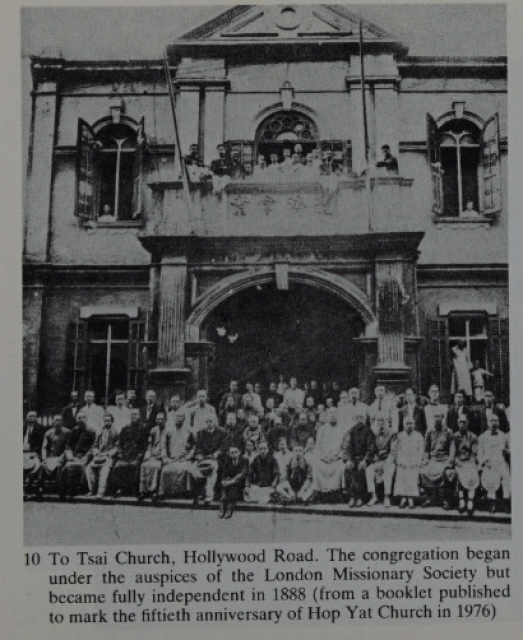
After completing his studies, Fung Foo went to San Francisco, where he became a helper in the Congregational Chinese Mission sponsored by the same society. His services were of considerable value, and he helped to draft the constitution for the Chinese Young Men's Christian Association. He married Kwan Uet-ming, the eldest daughter of Kwan Yuen-fat, an elder in the London Missionary Society congregation. Fung Foo was therefore related by marriage to Wan Ping-chung, whose wife was a cousin of Uet-ming. Fung Foo was a deacon in the To Tsai Church (formerly the London Missionary Society congregation and subsequently the Hop Yat Church) and was later ordained and became an elder. In the later years of his life, he assisted in the organization of Ying Wah College and established a free school at Castle Peak, New Territories, for poor boys.
The government's policy regarding the Chinese population was articulated by Governor John Pope Hennessy in a speech at the Prize Day of Central School (now Queen's College) in 1880. He stated: "It is my wish—it has been the ambition of nearly every man who preceded me in the government of this colony, and it has been the policy of all Secretaries of State, who have written to my predecessors and myself that Hong Kong should be made an Anglo-Chinese colony, where her Majesty should have thousands upon thousands of Chinese subjects, with a thorough knowledge of the English language—amenable to English law and appreciating the British Constitution, loyal to their Queen, and a strength to this distant part of her Majesty's Empire. Our education scheme will accomplish a practical result if it assists in achieving this. An Anglo-Chinese colony, such as I have over and over again expressed my wish to see here, must spring from the children in the colony."
That the influential section of the Chinese population had accepted their role as defined by the governor is evident in his further remarks: "Last year there came a deputation of Chinese merchants and shopkeepers. Some of them said, 'We have children and grandchildren born in this colony, and we ourselves desire to become naturalized. We desire to see the property we hold transmitted to our children as from British subjects to British subjects.'
1, by lausanching
10, by lausanching
12, by lausanching
11, by lausanching
13, by lausanching
17, by lausanching
notes of Chapter 5
2, by lausanching
3, by lausanching
4 Fung Foo, by lausanching
5, by lausanching
6, by lausanching
OCR
--- OCR result for Untitled-1.gif ---
3. The American Board mission opened three day-schools, which were listed as
grant-in-aid schools in 1884. These were Bridges Street, teacher, Sung Yuk-lam, with
an assistant, ninety-three boys; East Street, teacher, Chau Cheung-tai, twenty-
eight boys; and Station Street, teacher, Chau Tsing-tsun, forty-one boys. The
school on East Street had been taken over from its former patron, the Revd Ho
Kau, of the London Missionary Society congregation. It was closed in 1887, and its
teacher, Chau Cheung-tai, replaced Tsing-tsun at the Station Street school. The
same year, the American Board mission took over the management of two schools
from the Presbyterians. One was the school on Queen's Road West, where Hager
had opened a Sunday school on 1 September 1883, the other was a school in Hing
Lung Lane.
4. The biography of Jee Gam and the careers of his children illustrate the rise of
a poor immigrant boy to a position where he could provide university education for
his children. They, for their part, returned to China to contribute to the new China
of Sun Yat-sen.
Jee Gam accompanied an uncle to San Francisco. He first found a situation as a
house-boy. Dissatisfied with his wages, he went to work in a factory. One Sunday,
he found his way to a Chinese Sunday school. The superintendent of the school was
attracted by the boy's appearance and manners and introduced him to the family of
the pastor of the church, the Revd George Mooar. He was taken into the family as
a servant, but was soon considered part of the family circle. In 1870, with two other
Chinese, he joined the Oakland Congregational Church. He soon became a leader
in Christian work among the Chinese. In 1871, he returned to China to marry a
bride who had been chosen for him. A son was born, but died. To console the
bereaved mother another boy was adopted. Jee Gam returned to California, leav-
ing his wife in China. Later, he sent for her to join him, but his father suggested
--- OCR result for Untitled-2.gif ---
attracted by the boy's appearance and manners and introduced him to the family of
the pastor of the church, the Revd George Mooar. He was taken into the family as
a servant, but was soon considered part of the family circle. In 1870, with two other
Chinese, he joined the Oakland Congregational Church. He soon became a leader
in Christian work among the Chinese. In 1871, he returned to China to marry a
bride who had been chosen for him. A son was born, but died. To console the
bereaved mother another boy was adopted. Jee Gam returned to California, leav-
ing his wife in China. Later, he sent for her to join him, but his father suggested
that it would be better for him to take a second wife in California. Jee Gam replied
that this was against his principles as a Christian. He persisted and his wife was
allowed to join him.
He returned to China in 1876 to take his wife back with him to California. She
was not a Christian, but when Jee Gam transferred his membership from the First
Congregational Church, Oakland, to the Bethany Congregational Church, in 1884,
she was baptized and received into membership with him.
In 1895, the Congregational Association of Chinese Christians requested that Jee
Gam should be ordained. He had been doing the work of a pastor for twenty-five
years. The date of the ordination, 19 September, was the anniversary of the date on
which he had begun his Christian work in California.
In addition to the son adopted in China, Jee Gam had nine children; all were
baptized. One of his sons, Jee Shin Fwe Pong Mooar, having received a medical
--- OCR result for Untitled-3.gif ---
degree from the University of California, went to Tientsin, where he practised as an
eye surgeon. Another son, Jee Shin Yien Luther MacLean, received an MA from
Harvard University and later joined the Ministry of Finance of the Chinese Repub-
lic. All the other children who grew to maturity received a good education in one
way or another and all except one returned to China.
Jee Gam was planning to spend his old age on Chinese soil but died on his way
home within a day's journey to Honolulu. His body was returned to China for
burial.
1000
--- OCR result for Untitled-4.gif ---
10. Fung Foo (1849-1934) was another of those Chinese boys in the United
States who came under church influence and received an English-language educa-
tion.
Fung Foo (#), alias Chung-ling () or Pat Sun (E), an orphan, was
shipped out as a coolie to Cuba at the age of 15. Instead of working in the sugar-
fields as a labourer, he became a house-servant. After completing his service, he
drifted up to New York City. There he came under the patronage of the superinten-
dent of the Five Points mission and was sent with two other Chinese boys to study
at Howard University at Washington, DC. The Hong Kong obituary of Fung Foo
states that he was educated at Harvard, but this is an error. Howard was a school
founded for the education of blacks and was associated with the American Mission-
ary Association.
After completing his studies, Fung Foo went to San Francisco, where he became
a helper in the Congregational Chinese Mission sponsored by the same society. His
services were of considerable value and he helped to draft the constitution for the
Chinese Young Men's Christian Association.
While at Howard, he had written to the Secretary of the American Missionary
Association, which was financing his studies, stating, 'I am preparing myself to be a
teacher, and will go back to my country to teach my people of this language'. His
youthful resolve was realized, for after returning to Hong Kong in 1881, he became
a teacher at the Government Vernacular School at Sai Ying Pun. Its successor is
King's College, Bonham Road. Later, he was appointed as Headmaster. He served
in the Hong Kong government school system until his retirement.
He married Kwan Uet-ming (AB), the eldest daughter of Kwan Yuen-fat, an
elder in the London Missionary Society congregation. Fung Foo was therefore re-
lated by marriage to Wan Ping-chung, whose wife was a cousin of Uet-ming. Fung
Foo was a deacon in the To Tsai Church( formerly the London Missionary Society
congregation and subsequently the Hop Yat Church) and was later ordained and
became an elder. In the later years of his life, he assisted in the organization of Ying
Wah College and established a free school at Castle Peak, New Territories, for
poor boys.
--- OCR result for Untitled-5.gif ---
boys.
11. Lee Sam was a convert of the California mission which had sent the Revd
--- OCR result for Untitled-6.gif ---
C. Hager to Hong Kong. He accompanied Hager to Hong Kong and assisted him in
establishing the mission there. He also sold and distributed literature on behalf of
the American Bible Society.
12. This was the Central Government School, later Queen's College, in which
Sun Yat-sen was enrolled in March 1884.
13. Either this is a misprint or Hager did not hear the name clearly. Miss Harriet
Noyes founded True Light College in Canton in 1872. Its successors are the Hong
Kong True Light School, Tai Hang Road, Hong Kong; the Kowloon Chan Kwong
(True Light) Girls' School, Kowloon Tong; and the True Light English School,
Waterloo Road, Kowloon.
--- OCR result for Untitled-7.gif ---
295
+6
55
Chinese
Christians:
985 Élites, Middlemen, and the
Church in Hong Kong
CARL T. SMITH
With a Foreword by James Hayes
Published to mark the twenty-fifth anniversary of the founding of the
Hong Kong Branch of the Royal Asiatic Society
--- OCR result for Untitled-8.gif ---
Contents
Foreword by James Hayes
Preface
Plates
Introduction
PART I MISSION SCHOOLS AND THEIR
PRODUCTS: A NEW TYPE OF CHINA
COAST MIDDLEMAN
xiii
xvi
1
13
1 The Morrison Education Society and the Moulding of
its Students
13
2 The Formative Years of the Tong Brothers, Pioneers
in the Modernization of China's Commerce and
Industry
3 Translators, Compradores, and Government Advisers
4 Friends and Relatives of Taiping Leaders
225
34
52
75
5 Sun Yat-sen's Baptism and Some Christian Connec-
tions
PART II THE CHURCH, MIDDLEMEN, AND THE
HONG KONG SETTING
87
103
6 The Emergence of a Chinese Élite in Hong Kong
7 The English-educated Chinese Élite in Nineteenth-
century Hong Kong
103
139
8 The Hong Kong Church and Nineteenth-century
Colonial Attitudes
172
9 The Hong Kong Situation as it Influenced the
Protestant Church
182
10 The Early Hong Kong Church and Traditional
Chinese Ideas
Epilogue
Appendix
195
210
212
--- OCR result for Untitled-9.gif ---
Sunday, Fager set out for the school. He took with him litera-
ture to distribute at the civil hospital, which was on his route be-
tween the mission house on Bridges Street and Sai Ying Pun.
When the missionary finally arrived at the school-room, he found
there the two brothers, a colporteur of the Bible Society and some
forty young scholars.
Hager found himself in a difficult situation as the helper he had
been depending upon to assist him did not arrive. Hager was not
yet proficient in Cantonese and needed assistance. He was rescued
from his dilemma, however, by the providential arrival of Mr
Noyes, a Presbyterian missionary who was visiting Hong Kong
from his station in Canton. Hager described the situation thus:
There were ten singing books and they could sing a few hymns. We
opened with 'Jesus, Lover of my Soul', but I did not recognize it by the
tune, much less by the words. Then I asked the principal teacher to pray.
All remained standing in a reverent attitude, you could have heard a pin
drop. I was perplexed as to what to do next. We sang, while I whispered to
go and ask Fung Foo to come as he had promised to be there. But in a few
minutes Mr. Noyes... appeared. Greatly relieved, I asked him to take
charge... He read part of the 19th Chapter of Matthew, where it speaks
of little children being brought to Jesus. One boy was asked to read a
verse, and then Mr. Noyes would ask them questions and explain it... We
then sang, 'There is a happy land, far, far away, where saints in glory
stand, bright, bright as day'... Mr. Noyes then spoke at some length on
--- OCR result for Untitled-10.gif ---
During the week a Chinese boy's school was taught there, while
our young friend [Sun] lived in the second story with some other
Chinese, and an American Bible Society's colporteur and I lived
on the third story'.2
Sung Yuk-lam, the new convert, was placed in charge of the
school, which met on the ground floor. He remained there until
1899.3
An event much talked about by Sun Yat-sen and the other
residents of 2 Bridges Street was an unpleasant encounter with
European prejudice experienced by Sung Yuk-lam and a cook
who lived there. A report of it is given in the China Mail of 28 July
1884, in the police news under the title 'Insolent Chinese':
Cho Kwok-in, a cook, No. 2 Bridges Street, charged by use of threatening
and abusive language to Charles Bond, a bill collector, while sitting with
wife and daughter listening to the Band at Murray Barracks. He sat on a
seat on which two Chinese sat. The defendant... began using disgusting
language. The complainant remonstrated. Defendant said in English,
'You no belong mandarin, what for you sit down by me, you god-damned
son of...' The complainant's wife walked away and defendant assumed a
fighting attitude. The complainant told him to go away or he would give
him in charge. The defendant said he was sitting on the bench when the
complainant came up, raised his stick and told him to go away, which he
refused to do. Sung Yuk-lam, defendant's friend, said he was sitting
down when complainant and two ladies came up. He got up from the seat
but the defendant did not.
--- OCR result for Untitled-11.gif ---
The defendant, Cho Kwok-in, was fined $3. Apparently, public
benches were considered to be for the use of Europeans and were
not to be shared with Chinese, even though the latter might have a
prior claim to occupancy.
Even before Hager had organized his Sunday schools, he had
opened an evening school to teach English. He began with only
four or five pupils, but soon there was an average attendance of
between thirty and forty. There was some waning of enthusiasm
among the students after the initial novelty had worn off. Some
found there was too much use of the Bible in the teaching. Many
of those who came were students during the day at the Govern-
ment Central School. Some of these found the burden of both day-
and night-school too onerous and dropped out.
Inasmuch as Yat-sen was living in the same house as Mr Hager,
it is likely that he attended these sessions; Hager's description of
the class is therefore of interest. He wrote of it in an article entitled
'Three Months on Chinese Soil', which appeared in The Pacific on
15 August 1883:
--- OCR result for Untitled-12.gif ---
After numerous delays, a decision was made in 1881 to establish a
mission in Hong Kong.
Some ten years after a plan for a mission was first conceived, the
Revd Charles R. Hager was ordained as a missionary to China in
the Bethany Congregational Church, San Francisco, California,
on 16 February 1883. The remarks made by a Chinese member of
the Congregational mission of the American Missionary Associa-
tion illustrate the close links which were to be established between
Chinese Christians in the United States and Hager's mission in
Hong Kong.
The Chinese spokesman was Mr Jee Gam, an assistant in the
Congregational mission in San Francisco. In his remarks he ex-
pressed the concerns, dreams and hopes of his Chinese colleagues
for their motherland:
It was ten years ago when our Chinese brethren first felt the need of a
mission in China at or near the districts from which most of our brethren
came... The first three years we often expressed our great desire among
ourselves for this mission, but never thought of telling our superintendent,
Rev. W.C. Pond. Not a word was said to him until at our usual Wednes-
day evening Bible class, about seven years ago, when the subject of for-
eign missions was accidentally mentioned. We then told Rev. W.C. Pond
what we so much desired. He at once approved it.
--- OCR result for Untitled-13.gif ---
Hager spent his first Sunday in Hong Kong with this family. It
was not fortuitous that he should have done so. Five years pre-
viously, Wan Ching-kai had been in correspondence with the
Chinese in California in regard to their establishing a mission in
Hong Kong. His enthusiasm for evangelism is mentioned in a re-
port published by the Revd W.C. Pond, of the California Chinese
mission:
Wan Ching Kai... has suggested that, in that English city of Hong Kong,
mission work among the Chinese could be conducted most successfully,
upon the very plan which we use here [in California]; and is very desirous
himself to send native preachers into the neglected interior districts,
asking whether our Chinese brethren here could not help him to do so...
The emphatic testimony which these bear to his good judgment and
general efficiency, as well as his Christian character, makes both the work
he has done and the work he wants to do, confirm my confidence in the
suggestion I have made.
Fung Foo, 10 a member of the California mission who visited
Hong Kong in 1878, reported that Wan Tsing-kai, 'the most active
deacon of the London Missionary Society congregation in Hong
Kong', told him that the Chinese of Hong Kong felt that there was
a great need for them to learn the English language. He urged
Fung to remain in Hong Kong and establish a night-school to teach
English similar to those successfully conducted in California.
Immediately after Hager's arrival in Hong Kong, he wrote an
account for The Pacific of his first Sunday in Hong Kong Here
--- OCR result for Untitled-14.gif ---
Fung Foo, 10 a member of the California mission who visited
Hong Kong in 1878, reported that Wan Tsing-kai, 'the most active
deacon of the London Missionary Society congregation in Hong
Kong', told him that the Chinese of Hong Kong felt that there was
a great need for them to learn the English language. He urged
Fung to remain in Hong Kong and establish a night-school to teach
English similar to those successfully conducted in California.
Immediately after Hager's arrival in Hong Kong, he wrote an
account for The Pacific of his first Sunday in Hong Kong. He re-
lated how he visited the Wan family: 'After breakfast I went to the
house of Mr. Wang [sic] Ching Kai and found Lee Sam¹¹ there. The
family were all gathered together for morning worship, and though
the place was far from being anything like our own, it was quite
comfortable and pleasant. The family consisted of the father and
his two sons, a nephew, and the wife of the eldest son. Two other
sons belong to the family, but they were not present.'
--- OCR result for Untitled-15.gif ---
Ո
6 The chapel and mission house of the Basel Missionary Society station at Sai Ying Pun. The photograph was taken from the corner of Third
and Western Streets. The 1867 chapel remains, but the mission house has been rebuilt since the drawing of about 1870 shown in Plate 1
(from a booklet published to mark the one-hundredth anniversary of Kau Yan Church in 1967)
--- OCR result for Untitled-16.gif ---
10 To Tsai Church, Hollywood Road. The congregation began
under the auspices of the London Missionary Society but
became fully independent in 1888 (from a booklet published
to mark the fiftieth anniversary of Hop Yat Church in 1976)
--- OCR result for Untitled-17.gif ---
The policy of the Government regarding the Chinese population
is set forth in a speech that Governor John Pope Hennessy gave at
the Prize Day of Central School (now Queen's College) in 1880.
It is my wish-it has been the ambition of nearly every man who preceded
me in the Government of this Colony, and it has been the policy of all
Secretaries of the State, who have written to my predecessors and
myself that Hongkong should be made an Anglo-Chinese Colony,
where Her Majesty should have thousands upon thousands of Chinese
subjects, with a thorough knowledge of the English language--amenable
to English law and appreciating the British Constitution, loyal to their
Queen, and a strength to this distant part of Her Majesty's Empire. Our
education scheme will accomplish a practical result if it assists in achieving
this. An Anglo-Chinese Colony, such as I have over and over again ex-
pressed my wish to see here, must spring from the children in the Colony.
That the influential section of the Chinese population had
accepted their role as defined by the Governor is evident in his
further remarks:
Last year there came a deputation of Chinese merchants and shop-
keepers. Some of them said, 'We have children and grandchildren born
in this Colony, and we ourselves desire to become naturalized. We desire
to see the property we hold transmitted to our children as from British
subjects to British subjects.'... They also told me they desired to keep