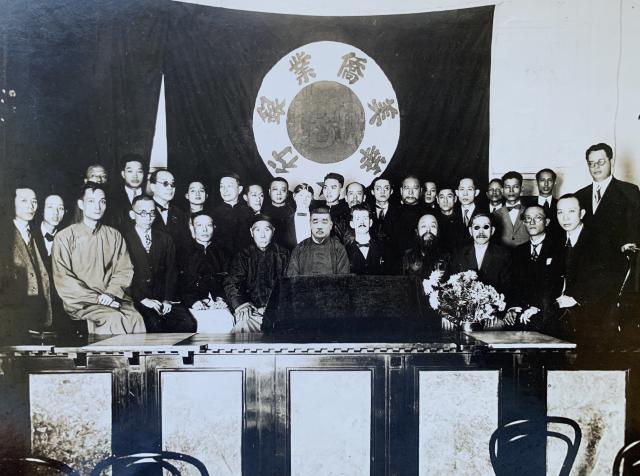
Almost 100 years ago my father Noel Instone Brewer established the Instone Banking Corporation which received considerable media attention when after just two years it collapsed with my father being sent to prison.
Noel was born in Kowloon on 19 November 1895, the youngest son of Walter William Brewer, proprietor of Brewer & Co bookshop. At the age of 11 Noel accompanied his father on the steamer Japan for the first leg of their journey back to England to enjoy retirement, but Walter died at sea on 27 April 1907. Noel continued the voyage and stayed with relatives to attend school in Brighton, England. Having finished his schooling he returned to Hong Kong and bought back Brewer & Co which was then owned by a local Chinese businessman but had fallen into decline. Noel revived the business and subsequently resold it for three times the purchase price. In 1920 Noel travelled to London to take his bar exams, and he was called to the bar of the Inns of Court Middle Temple in 1923. He then came back to Hong Kong to practise as a barrister, appearing frequently at the Supreme Court in Jackson Road, Central.
During a visit to the United States Noel became aware of a potential business opportunity. There was no specialist trustee bank in Hong Kong, and he planned to establish the first. He discussed this venture with several potential investors and, as a result, the small business that Noel had envisaged grew into a sizable enterprise. He became founder and president of the Instone Banking Corporation with its head office at 25 Des Voeux Road. The opening ceremony on 28 December 1927 was attended by many prominent figures including Li Yuan-hung (former president of China), Kwik Djoen-eng (the Java Sugar King), and Chung Wu (Minister of Finance, Peking). The bank grew successfully with the opening of several branches throughout the colony. In February 1928 the Instone Banking Corporation led negotiations on behalf of a consortium of banks for a potential loan of $500,000 to the Canton government for the stabilisation of their currency.
However, due to an unprecedented peculiarity, Chinese authorities demanded the closure of the branches in Shekki and Canton. China considered the bank foreign as only 40% of the investments were Chinese, but neither the American consul nor the British consul could register the bank as neither held majority capital. The closures left investors jittery and there were calls for an independent audit. The bank was placed into administration despite protests that there were sufficient funds to repay all creditors in full. Nowadays the Hong Kong Monetary Authority sets strict fiscal rules but those were simpler times. Because Noel had been reluctant to build a large business he did not want to hold vast quantities of cash. He considered that promissory notes from his major investors were sufficient to satisfy capital adequacy, a point which the court could not dispute. However the balance sheet stating that this sum was actually deposited with the bank was deemed to be false and Noel was found guilty of perjury and sentenced to 4 months in jail. Although Victoria Prison is a delightful tourist attraction today, it was no doubt extremely unpleasant to be incarcerated there in 1932.
With little faith in the Hong Kong appeals procedure, having served his sentence, Noel travelled to London to appeal his case before the bench of the Middle Temple where he was completely exonerated of all charges. They were considered amongst the finest legal minds in the world and the decision was a huge embarrassment to the Hong Kong government. He was granted financial compensation and a free pardon by Sir William Peele, governor of Hong Kong. It made headline news in the China Mail “Sensational sequel to local trial” and I still have the advertisement from the news vendor’s stand with the bold headline “Mr. Brewer vindicated” followed by the lessor news in small letters “Japanese Premier seriously wounded”.
Following his ordeal Noel returned to work in England and after WWII he was appointed magistrate for Hamburg in the control commission for Germany, where he met my mother. He died in England on 12 July 1965, having sadly never again returned to Hong Kong, although our home was full of Chinese furniture, ornaments and mementos of the past.