Historic Building Appraisal Tin Hau Temple Ma Wan Tsuen, Lei Yue Mun, Kowloon
Historical Interest
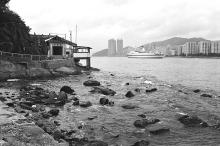
Tin Hau Temple (天后廟) in Ma Wan Tsuen (馬環村) of Lei Yue Mun (鯉魚 門) is at the waterfront of the narrow channel of the eastern end of the Victoria Harbour (維多利亞港). It was first built in the 18th year of the Qianlong (乾隆, 1753) reign of the Qing (清) dynasty by a Zheng Lian-chang (鄭連昌) but completely reconstructed in 1953. Zheng Lian-chang is said to be the great grandson of Zheng Jian (鄭建), who was believed to be a subordinate of the renowned Ming (明) dynasty’s revolutionary leader Zheng Cheng-gong (鄭成功) against the Qing government. After Zheng Cheng-gong retreated to Taiwan, Zheng Jian and his followers settled in Mirs Bay (大鵬灣). Their descendents became pirates causing troubles in the coastal areas. Cheung Po-tsai (張保仔), the famous private in the Jiaqing (嘉慶, 1796-1820) reign of the same dynasty was believed to be a subordinate of Zheng Yi (鄭一), a descendent of Zheng Jian. It is said that the temple served as Zheng Lian-chang’s outpost as well as a worshipping place.
Architectural Merit
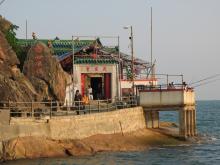
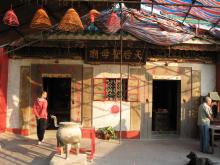
The “1953” temple is a Qing vernacular design building of a two-hall-one-courtyard plan. The courtyard between the entrance and main halls has been covered. It is constructed of concrete with its walls to support its pitched roofs of timber rafters, purlins and clay tiles. Its roofs are covered with green ceramic tiles and its walls with ceramic tiles of different colours. A gateway is in front of the temple with the Chinese characters “天后宮” inscribed on it. The temple has two entrances, one for the Tin Hau Temple and another for the Hip Tin Temple (協天宮) which was added after 1953 for the worship of Kwan Tai (關帝). Its ridges are each with a set of ceramic dragon fish locally known as aoyus (鰲魚). The ridge of the entrance hall has an additional pearl in the middle. Its wall friezes are with reliefs of bats and the Eight Immortals (八仙).
Rarity, Built Heritage Value & Authenticity
It is a Tin Hau temple to remind the history of Lei Yue Mun, and has little built heritage value. The temple was renovated in 1964, 1968, 1986 and 1996 with some other unknown ones. The temple has been poorly renovated which very much diminishes its authenticity.
Social Value, & Local Interest
The temple served as a venue for the Rural Committee of Lei Yue Mun (鯉魚門鄉公所) to deal with local affairs. The villagers regarded the temple as their ancestral shrine as they did not have their own ancestral hall. The Birthday of Tin Hau (天后誕) on the 23rd of the third lunar month will be highly celebrated by the villagers and the deities of the Tin Hau Temple (天后宮) in Cha Kwo Ling (茶果嶺) and the Tam Kung Temple (譚公廟) in Shau Kei Wan (筲箕灣) would be invited to the celebrations. Cantonese opera performances and lion dances would be held at the open space close to the temple.
Group Value
Apart from the Tin Hau Temple, the old quarry site structures on the coast of Lei Yue Mun (鯉魚門舊石礦場建築, Grade 3), and the old Lei Yue Mun Barracks (鯉魚門舊鯉魚門軍營, Declared Monuments, Grade 1 and 2) are examples of historic buildings in the area.
Comments
Built in 1753
The Tin Hau Temple in Ma Wan Village, Lei Yue Mun was built in the 18th year of Qing Emperor Qianlong (1753 AD).
Further reading here.
Historic Building Appraisal #1374
Historic Building Appraisal
Tin Hau Temple
Ma Wan Tsuen, Lei Yue Mun, Kowloon
Historical Interest
Tin Hau Temple (天后廟) in Ma Wan Tsuen (馬環村) of Lei Yue Mun (鯉魚 門) is at the waterfront of the narrow channel of the eastern end of the Victoria Harbour (維多利亞港). It was first built in the 18th year of the Qianlong (乾隆, 1753) reign of the Qing (清) dynasty by a Zheng Lian-chang (鄭連昌) but completely reconstructed in 1953. Zheng Lian-chang is said to be the great grandson of Zheng Jian (鄭建), who was believed to be a subordinate of the renowned Ming (明) dynasty’s revolutionary leader Zheng Cheng-gong (鄭成功) against the Qing government. After Zheng Cheng-gong retreated to Taiwan, Zheng Jian and his followers settled in Mirs Bay (大鵬灣). Their descendents became pirates causing troubles in the coastal areas. Cheung Po-tsai (張保仔), the famous private in the Jiaqing (嘉慶, 1796-1820) reign of the same dynasty was believed to be a subordinate of Zheng Yi (鄭一), a descendent of Zheng Jian. It is said that the temple served as Zheng Lian-chang’s outpost as well as a worshipping place.
Architectural Merit
The “1953” temple is a Qing vernacular design building of a two-hall-one-courtyard plan. The courtyard between the entrance and main halls has been covered. It is constructed of concrete with its walls to support its pitched roofs of timber rafters, purlins and clay tiles. Its roofs are covered with green ceramic tiles and its walls with ceramic tiles of different colours. A gateway is in front of the temple with the Chinese characters “天后宮” inscribed on it. The temple has two entrances, one for the Tin Hau Temple and another for the Hip Tin Temple (協天宮) which was added after 1953 for the worship of Kwan Tai (關帝). Its ridges are each with a set of ceramic dragon fish locally known as aoyus (鰲魚). The ridge of the entrance hall has an additional pearl in the middle. Its wall friezes are with reliefs of bats and the Eight Immortals (八仙).
Rarity, Built Heritage Value & Authenticity
It is a Tin Hau temple to remind the history of Lei Yue Mun, and has little built heritage value. The temple was renovated in 1964, 1968, 1986 and 1996 with some other unknown ones. The temple has been poorly renovated which very much diminishes its authenticity.
Social Value, & Local Interest
The temple served as a venue for the Rural Committee of Lei Yue Mun (鯉魚門鄉公所) to deal with local affairs. The villagers regarded the temple as their ancestral shrine as they did not have their own ancestral hall. The Birthday of Tin Hau (天后誕) on the 23rd of the third lunar month will be highly celebrated by the villagers and the deities of the Tin Hau Temple (天后宮) in Cha Kwo Ling (茶果嶺) and the Tam Kung Temple (譚公廟) in Shau Kei Wan (筲箕灣) would be invited to the celebrations. Cantonese opera performances and lion dances would be held at the open space close to the temple.
Group Value
Apart from the Tin Hau Temple, the old quarry site structures on the coast of Lei Yue Mun (鯉魚門舊石礦場建築, Grade 3), and the old Lei Yue Mun Barracks (鯉魚門舊鯉魚門軍營, Declared Monuments, Grade 1 and 2) are examples of historic buildings in the area.
Source: https://www.aab.gov.hk/filemanager/aab/common/historicbuilding/en/1374_…